Vendor: Rambus, Inc. Category: Random Number Generator

NIST ESV certified, AIS-31, FIPS (SP800-90A/B/C) True Random Number Generator

The TRNG-IP-76 is a FIPS-compliant and certified IP core for True Random Number Generation (TRNG) with an optional post-processor…

Overview

The TRNG-IP-76 is a FIPS-compliant and certified IP core for True Random Number Generation (TRNG) with an optional post-processor and several internal self-tests. Designed for easy integration into ASICs and SOCs, the 100% digital standard cell based TRNG-IP-76 provides a reliable and cost-effective embedded IP solution for our customer’s SoCs.

How the TRNG-IP-76 works

TRNGs are typically deployed in semiconductors for securing data communications, electronic transactions, and data storage. They are used for generation of keys, initialization vectors, cookies, and nonces. Additionally, TRNGs can also be used for statistical sampling, communications protocol timers, as well as noise generation.

To provide a hardware-based, nondeterministic noise source the TRNG-IP-76 uses a state of the art reliable free running oscillator (FRO) implementation.. This allows stable operation across very wide process, voltage, and temperature (PVT) ranges, as required for modern process node (45nm and below) semiconductors.

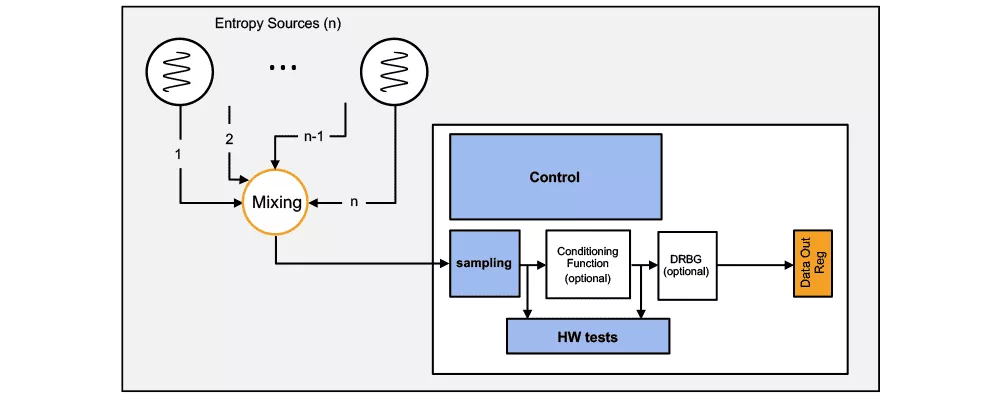
When running asynchronously, the FROs accumulate a timing jitter largely due to shot noise effects. When the signal is sampled, this jitter causes unpredictability of the outcome, thereby providing some entropy. These samples feed a complex, non-linear combinatorial circuit that produces the final TRNG output. This function is referred to as a hardware-implemented Non-deterministic Random Bit Generator (NRBG).

The TRNG-IP-76 is a security aware design:

  • Patented test circuits on the oscillators that detect locking to periodic signals.
  • Repeating output data detection on NRBG and DRBG (compliant with FIPS-140).
  • Hardware-implemented health-tests, including ‘Repetition Count Test’ and ‘Adaptive Proportion Test’ (compliant with SP800-90B).
  • Secure random data buffer wipe-after-read and zeroize functions (compliant with FIPS-140).
  • Secure reading mode where data is only available on request, for a (configurable) limited time.
  • Automatic shutdown on fatal errors.
  • Various on-line and off-line integrity and known-answer tests on the Conditioning Function, DRBG and self-test circuits.

The TRNG-IP-76 is compliant with Federal Information Processing Standards (FIPS) Publication 140-3, facilitating system certification. The design is compliant with the latest versions for NIST SP800-90A/B/C. A NIST SP800-90 Deterministic Random Bit Generator (DRBG) is available for the required post processing. The TRNG-IP-76 is ESV certified and is FIPS-approved when integrated into Rambus Root of Trust solutions.

The TRNG-IP-76 is silicon proven, and its flexible, layered design makes it easy to integrate into SoCs. A driver development kit is included.

Key features

  • Standard configurations of the TRNG-IP-76 include:
    • TRNG-IP-76a-8: base configuration with 8 FROs
    • TRNG-IP-76d-8-SHA2: 8 FROs and DRBG
    • TRNG-IP-76d-8-BC_DF: 8 FROs, DRBG with BC_DF
  • All configurations operate with eight Free Running Oscillators (FROs).
  • In addition to the base configuration, the TRNG-IP-76 offers several configurable options that are described in the NIST specification SP800-90c draft:
    • A vetted SHA-2 based conditioning component (SP800-90B), can be embedded in the NRBG. This conditioning component is responsible for increasing the entropy rate to produce full-entropy bit strings used to seed a DRBG.
    • A Deterministic Random Bit Generator, based on AES in counter mode, can be added. It can be coupled with a block cipher derivation function in case no conditioning component is present (compliant with SP800-90A).

Block Diagram

Benefits

  • Non-deterministic Random Number Generator, FIPS-140 SP800-90A/B compliant, ESV certified for NRBGs and DRBGs (#E167).
  • High performance, low power, fully digital, standard cell only, supports all CMOS nodes.
  • Available as standalone RBG or embedded in the RT-130, RT-630, RT-660 Root of Trusts

What’s Included?

  • Documentation
    • Hardware Reference and Programmer Manual
    • Integration Manual
    • Noise & Entropy document
  • Synthesizable Verilog RTL source code
  • Self-checking RTL test bench, including test vectors and expected result vectors
  • Simulation scripts
  • Many different configurations possible:
    • Conditioning Function support
    • Fault Injection protected support
    • (optional) Deterministic Random Bit Generator
    • (optional) DMA handshake
    • Gate count ranging from: 10.9k + 11.5k to 56k + 11.5k gates
    • Up to 1 GHz

Specifications

Identity

Part Number
TRNG-IP-76
Vendor
Rambus, Inc.
Type
Silicon IP

Files

Note: some files may require an NDA depending on provider policy.

Provider

HQ: USA

Learn more about Random Number Generator IP core

The Silent Guardian of AI Compute - PUFrt Unifies Hardware Security and Memory Repair to Build the Trust Foundation for AI Factories

At the scale of the Vera Rubin platform, yield, calibration, and security failures compound across tens of thousands of devices. A single unified hardware anchor at the silicon level is not optional, it is architectural necessity. A physical unclonable function-based hardware root-of-trust, PUFrt, jointly developed by eMemory and PUFsecurity, was designed precisely for this role: a fully integrated implementation of the Caliptra 2.0 open standard that simultaneously manages cross-die memory repair and hardware root of trust across the full platform.

A Comprehensive Post-Quantum Cryptography (PQC) Solution based on Physical Unclonable Function (PUF)

This article provides an in-depth analysis of the specific PPA challenges introduced by PQC and elucidates how PUF-PQC leverages its unique dualtrack strategy to deliver a robust and flexible Hardware Root of Trust (HRoT) across diverse application scenarios. Furthermore, it demonstrates the integration of Physical Unclonable Function (PUF) with a NIST SP 800-90B compliant True Random Number Generator (TRNG) to serve as critical components of PUFrt (Root of Trust), ensuring the security of post-quantum key generation starting from the entropy source.

Frequently asked questions about Random Number Generator IP cores

What is NIST ESV certified, AIS-31, FIPS (SP800-90A/B/C) True Random Number Generator?

NIST ESV certified, AIS-31, FIPS (SP800-90A/B/C) True Random Number Generator is a Random Number Generator IP core from Rambus, Inc. listed on Semi IP Hub.

How should engineers evaluate this Random Number Generator?

Engineers should review the overview, key features, supported foundries and nodes, maturity, deliverables, and provider information before shortlisting this Random Number Generator IP.

Can this semiconductor IP be compared with similar products?

Yes. Buyers can compare this product with similar semiconductor IP cores or IP families based on category, provider, process options, and structured technical specifications.

×
Semiconductor IP