Overview
1G Ethernet PHY IP Core is available for licensing as a Whitebox IP, with unlimited usage and full modification rights granted to the customer, ensuring a high level of flexibility with the deliverables.
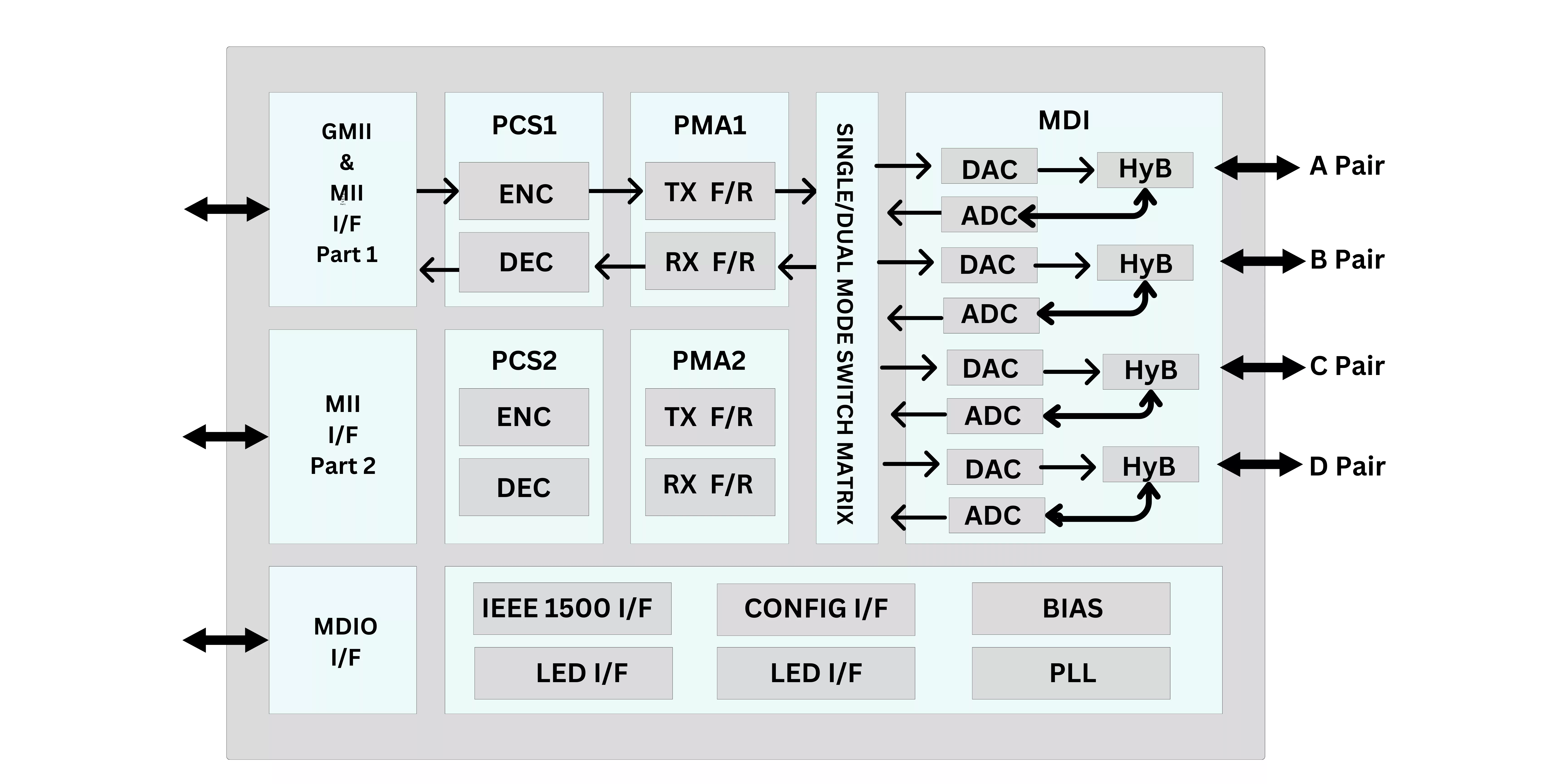
The GbE PHY IP for Giga 10/100/1000 Ethernet applications is a highly integrated solution including the Twisted Pair Physical Medium Dependent Sub-layer (TP-PMD, 100BASE-TX only), Physical Coding Sub-layer (PCS), and Physical Medium Attachment Layer (PMA). It supports 10BASE-T, 100BASE-TX, and 1000BASE-T protocols with a very low power consumption and area. The Media Access Control Layer (MAC) is connected to this GPHY via GMII (Giga Media Independent Interface) or via RGMII. It supports Unshielded Twisted Pair Category 5 Cable (UTP5), or UTP5/UTP3 cable. The Gigabit physical layer function is defined by IEEE 802.3ab and IEEE 802.3u.
Learn more about Single-Protocol PHY IP core
T2M-IP, the global leader in semiconductor IP cores and technology expertise, is proud to announce the immediate availability of its partner's VESA-compliant DisplayPort v1.4 Rx PHY and Controller IP Cores.
T2M announces the availability of its partner’s Bluetooth V6.0 RF Transceiver IP Core in 22nm ULL and 40nm ULP.
Incorporating BroadR-Reach™ technology for Automotive Excellence, this PHY delivers exceptional performance for automotive and industrial applications, providing a superior alternative to traditional BaseT1 solutions.
Designed to meet the evolving needs of next-generation automotive and industrial applications, the CAN XL Controller IP offers superior performance and flexibility while maintaining backward compatibility with previous CAN standards.
T2MIP, a leading provider of semiconductor IP cores, proudly announces the immediate availability of their partner's H.264 and H.265 HEVC Codec IP cores.
T2M-IP is excited to announce that its state-of-the-art USB 3.0 IP, developed in the 22nm ULP (Ultra Low Power) and ULL (Ultra Low Leakage) process technologies, has been successfully licensed to over 10 customers worldwide in the past two years.