Vendor: EnSilica Category: Post Quantum

PQC CRYSTALS core for accelerating NIST FIPS 202 FIPS 203 and FIPS 204

eSi-Crystals is a hardware core for accelerating the high-level operations specified in the NIST FIPS 202, FIPS 203 and FIPS 204 …

Overview

eSi-Crystals is a hardware core for accelerating the high-level operations specified in the NIST FIPS 202, FIPS 203 and FIPS 204 standards.

It supports the Cryptographic Suite for Algebraic Lattices (CRYSTALS), it is lattice-based digital signature algorithm designed to withstand attacks from quantum computers, placing it in the category of post-quantum cryptography (PQC). 

Unlike traditional , Crystals relies on the complexity of lattice problems, specifically the challenge of finding short vectors in a lattice. 

Dilithium aims to provide a secure digital signature solution that remains resilient in the face of potential threats posed by quantum computers, which have the capacity to compromise conventional public-key cryptography algorithms like RSA and ECC.

CRYSTALS encompasses two cryptographic primitives: Kyber, a secure KEM, and Dilithium, a strongly EUF-CMA-secure digital signature algorithm.

Key features

  • Si-Crystals is a hardware core for accelerating the high-level operations specified in the NIST
  • FIPS 202, FIPS 203 and FIPS 204:
  • FIPS 202: SHA-3 Standard: Permutation-Based Hash and Extendable-Output Functions : 
  •  Supported Operations:
    •   SHA3-224
    •   SHA3-256
    •   SHA3-384
    •   SHA3-512
    •   SHAKE128
    •   SHAKE256
  • Configurable Keccak Core;
    •   Automatic Input message padding according to FIPS 202;
    •   Double Input/Output Data Buffer, allowing absorbing/Squeezing a data block while the Keccak core is busy processing another data block;
    •   AMBA AXI-Stream interface for controlling the core and loading input and unloading output data sets.
  • FIPS 203: Module Lattice Key Encapsulation Mechanism (ML-KEM) standard.
    •  Supported operations:
      •   Key Generation
      •   Encapsulation
      •   Decapsulation  
    •  Supports all security levels specified in FIPS 203:
      •   ML-KEM-512
      •   ML-KEM-768
      •   ML-KEM-1024
  • FIPS 204: Module Lattice Digital Signature Algorithm (ML-DSA) standard .
    •  Supported operations:
      •   Key Generation
      •   Sign
      •   Verify
    •  Supports all security levels specified in FIPS 204:
      •   ML-DSA-44
      •   ML-DSA-65
      •   ML-DSA-87
  • Configurable arithmetic unit architecture for achieving the required performance and silicon area
  • Constant time operations for resistance against time analysis attacks

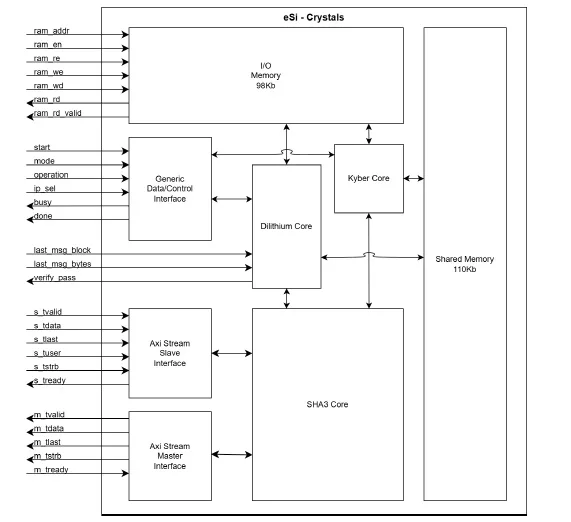
Block Diagram

Applications

  • Automotive
  • Datacentres 
  • Networking
  • Space
  • Military
  • Industrial IoT
  • Medical
  • Telecommunications
  • Banking
  • Government

What’s Included?

  • System Verilog RTL
  • C Model 
  • Testbench
  • Software libraries

Specifications

Identity

Part Number
eSi-Crystals
Vendor
EnSilica
Type
Silicon IP

Files

Note: some files may require an NDA depending on provider policy.

Provider

HQ: UK

Learn more about Post Quantum IP core

How to design secure SoCs Part IV: Runtime Integrity Protection

In previous articles, we gave an overview about secure SoC architectures (Part I), about the importance of key management (Part II) and secure boot (Part III) - the first line of defense. Part IV of the series focuses on runtime integrity protection, a paramount, ensuring the application remains secure even during active operation.

How to design secure SoCs Part IV: Runtime Integrity Protection

SoC designers are increasingly challenged to integrate robust security measures into their designs. Modern connected devices, such as automotive Electronic Control Units (ECUs), Internet of Things (IoT) nodes, and industrial control systems, face increasing susceptibility to cyberattacks. This escalating threat landscape underscores the critical importance of mandatory security requirements.

Nine Compelling Reasons Why Menta eFPGA Is Essential for Achieving True Crypto Agility in Your ASIC or SoC

Today’s world is already overly complicated to provide robust product security, with extremely motivated hackers creating novel threats exposing new vulnerabilities every day. But considering tomorrow’s world with the looming threat of quantum computing, expanding AI possibilities and rapidly evolving regional regulations and export control risk with severe financial penalties, this is a daunting challenge.

Providing protection against EMFI attacks

This Agile Analog blog post is focused on describing the dangers of Electromagnetic Fault Injection (EMFI) attacks and outlining the importance of EMFI sensors that are designed to provide protection.

Deploying StrongSwan on an Embedded FPGA Platform, IPsec/IKEv2 on Arty Z7 with PetaLinux and PQC

The objective of this article is to present and analyze a concrete IPsec/IKEv2 deployment on an FPGA-based embedded Linux system. Using an Arty Z7 FPGA platform with PetaLinux and StrongSwan, the focus is on system-level integration rather than protocol theory: how the IPsec stack is built and deployed, how classical and post-quantum key exchange are integrated without modifying standardized protocols, and what architectural trade-offs arise when moving cryptographic operations into programmable logic.

Frequently asked questions about Post-Quantum Cryptography IP cores

What is PQC CRYSTALS core for accelerating NIST FIPS 202 FIPS 203 and FIPS 204?

PQC CRYSTALS core for accelerating NIST FIPS 202 FIPS 203 and FIPS 204 is a Post Quantum IP core from EnSilica listed on Semi IP Hub.

How should engineers evaluate this Post Quantum?

Engineers should review the overview, key features, supported foundries and nodes, maturity, deliverables, and provider information before shortlisting this Post Quantum IP.

Can this semiconductor IP be compared with similar products?

Yes. Buyers can compare this product with similar semiconductor IP cores or IP families based on category, provider, process options, and structured technical specifications.

×
Semiconductor IP