Vendor:
Vicip Ltd.
Category:
Post Quantum
ML-KEM-X Post-Quantum Cryptography Core
Scalable, Parameterized, ACVP-Validated Key Encapsulation IP for FIPS 203 Compliance
Overview
The VIC-ML-KEM-X is a highly efficient, production-ready hardware IP core implementing the ML-KEM Post-Quantum Cryptography (PQC) standard, fully compliant with the definitive NIST FIPS 203 specification.
Featuring a flexible, compile-time parameterized architecture, the core can be configured to support a single dedicated security strength or a dual-mode configuration with dynamic, software-driven runtime selection. The core accelerates the entire post-quantum public-key cryptographic loop—including Key Generation, Encapsulation, and Decapsulation—shielding communications against future quantum-tier threats while optimizing resource allocation for constraint-driven System-on-Chip (SoC) architectures.
Key features
Feature Definitive FIPS 203 Compliance
- Implements the finalized NIST ML-KEM standard, eliminating regulatory risk and ensuring long-term cryptographic interoperability.
Scalable Architecture Profiles
- Configurable via pre-synthesis parameters to instantiate dedicated standalone hardware (512-only or 768-only) or a dynamic dual-mode configuration.
100% ACVP Validated
- Proven architectures; successfully passes 100% of the official NIST ACVP internal projection vector suites across all execution paths (KeyGen, Encap, Decap) for both 512 and 768 profiles.
Ultra-Lean Footprint
- Fits inside a compact 12.45k LUT envelope in the baseline configuration, leaving ample programmable logic available for application-layer circuits. Aggressive Timing
Closure Achieves a 6.25 ns
- core clock period target, allowing seamless integration into high-frequency embedded clock domains.
Native Montgomery Domain Processing
- Keeps polynomial coefficients within the Montgomery domain throughout back-to-back lattice arithmetic operations (NTT/INTT), eliminating redundant reduction cycles and maximizing pipeline efficiency.
Minimal DSP Utilization
- Consumes only 6 DSP blocks, meticulously optimized to preserve scarce math tiles on budget-sensitive target FPGAs.
Side-Channel Analysis (SCA) Defense
- Features advanced, localized temporal jitter mitigation within the underlying Keccak (SHA3/SHAKE) processing engines to counter non-invasive physical attacks.
Full Subsystem Monolithic Core
- Combines KeyGen, Encap, and Decap into a single tightly coupled state machine, minimizing integration complexity and processor interaction.
Standardized SoC Interfaces
- Packaged with industry-standard control and data interfaces to optimize bus mapping, processor offloading, and standard DMA controller pairing.
Block Diagram
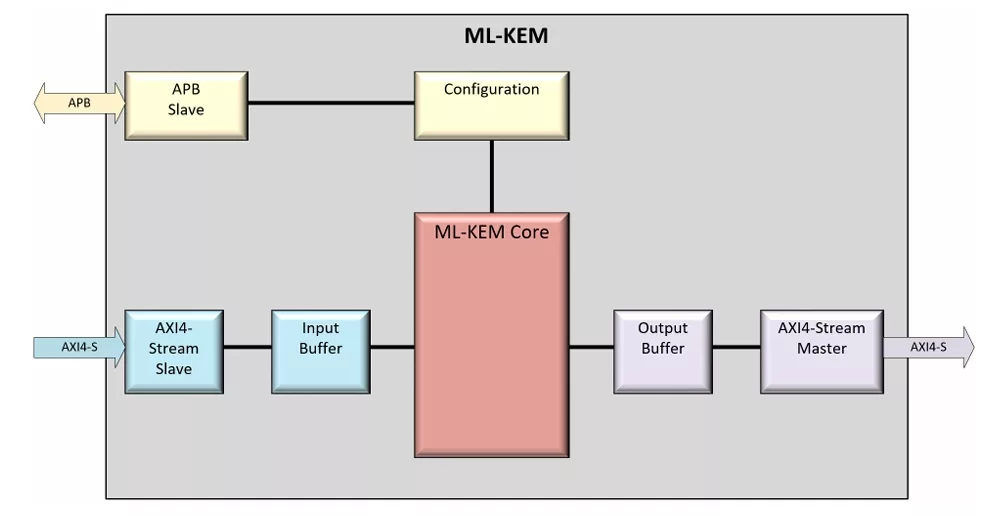
Click to open fullscreen
Specifications
Identity
Part Number
VIC-ML-KEM-512 PQC Core
Vendor
Vicip Ltd.
Type
Silicon IP
Security
Crypto Algorithm
CRYSTALS-Kyber (ML-KEM)
Files
Note: some files may require an NDA depending on provider policy.
Provider

HQ:
Cyprus
Learn more about Post Quantum IP core
How to design secure SoCs Part IV: Runtime Integrity Protection
In previous articles, we gave an overview about secure SoC architectures (Part I), about the importance of key management (Part II) and secure boot (Part III) - the first line of defense. Part IV of the series focuses on runtime integrity protection, a paramount, ensuring the application remains secure even during active operation.
How to design secure SoCs Part IV: Runtime Integrity Protection
SoC designers are increasingly challenged to integrate robust security measures into their designs. Modern connected devices, such as automotive Electronic Control Units (ECUs), Internet of Things (IoT) nodes, and industrial control systems, face increasing susceptibility to cyberattacks. This escalating threat landscape underscores the critical importance of mandatory security requirements.
Nine Compelling Reasons Why Menta eFPGA Is Essential for Achieving True Crypto Agility in Your ASIC or SoC
Today’s world is already overly complicated to provide robust product security, with extremely motivated hackers creating novel threats exposing new vulnerabilities every day. But considering tomorrow’s world with the looming threat of quantum computing, expanding AI possibilities and rapidly evolving regional regulations and export control risk with severe financial penalties, this is a daunting challenge.
Why Post-Quantum Security Starts with the Chip
Upgrading to new encryption matters. But there's a question that's easy to overlook: where does that encryption actually run, and where are the keys kept? The answer is a tiny piece of silicon inside the device itself, whether that's your phone, your car, or a machine on a factory floor.
Overcoming power management IP challenges
With modern chips, power management sits right at the core of the architecture. Between scaling down to advanced nodes and pushing for maximum performance-per-watt, managing power has become one of the most complex, high-risk parts of silicon design. Here is what engineering teams are actually dealing with.
Frequently asked questions about Post-Quantum Cryptography IP cores
What is ML-KEM-X Post-Quantum Cryptography Core?
ML-KEM-X Post-Quantum Cryptography Core is a Post Quantum IP core from Vicip Ltd. listed on Semi IP Hub.
How should engineers evaluate this Post Quantum?
Engineers should review the overview, key features, supported foundries and nodes, maturity, deliverables, and provider information before shortlisting this Post Quantum IP.
Can this semiconductor IP be compared with similar products?
Yes. Buyers can compare this product with similar semiconductor IP cores or IP families based on category, provider, process options, and structured technical specifications.