Overview
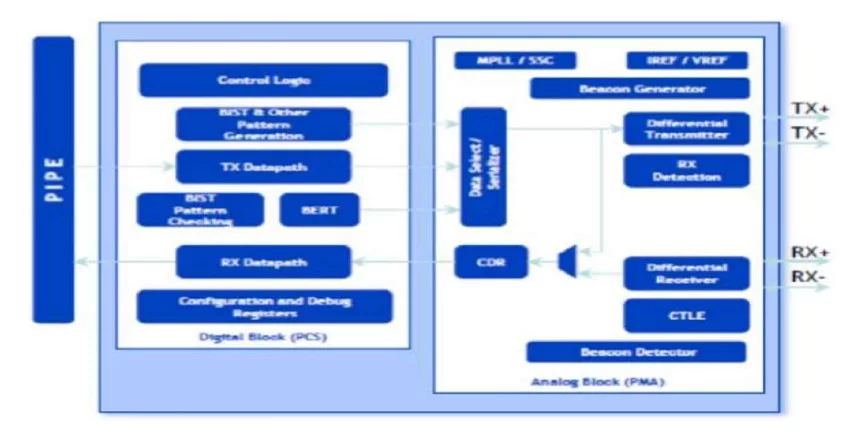
The PCIe2.0 PHY IP is a complete physical layer (PHY) IP solution designed for mobile and consumer applications. Compliant with the PCIe2.0 base specifications, the PHY IP integrates mixed-signal circuits to support both 2.5GT/s and 5.0GT/s data transmission rates. The PCIe2.0 PHY IP consists of both the Physical Media Attachment (PMA) layer and the Physical Coding Sublayer (PCS), and connects easily to either the PCIe2.0 MAC layer using the standard PIPE-3.0 interface.
The PCIe2.0 PHY IP transceiver is optimized for low power consumption and minimal die area (sub-0.30mm2), without sacrificing performance and high-data throughput. The PCIe2.0 PHY IP comprises a complete on-chip physical transceiver solution with Electro Static Discharge (ESD) protection, built-in self test module with embedded jitter injection, and a dynamic equalization circuit that ensures full support for high-performance designs.
Learn more about Multi-Protocol PHY IP core
T2M-IP, the global leader in semiconductor IP cores and technology expertise, is proud to announce the immediate availability of its partner's VESA-compliant DisplayPort v1.4 Rx PHY and Controller IP Cores.
T2M announces the availability of its partner’s Bluetooth V6.0 RF Transceiver IP Core in 22nm ULL and 40nm ULP.
Incorporating BroadR-Reach™ technology for Automotive Excellence, this PHY delivers exceptional performance for automotive and industrial applications, providing a superior alternative to traditional BaseT1 solutions.
Designed to meet the evolving needs of next-generation automotive and industrial applications, the CAN XL Controller IP offers superior performance and flexibility while maintaining backward compatibility with previous CAN standards.
T2MIP, a leading provider of semiconductor IP cores, proudly announces the immediate availability of their partner's H.264 and H.265 HEVC Codec IP cores.
T2M-IP is excited to announce that its state-of-the-art USB 3.0 IP, developed in the 22nm ULP (Ultra Low Power) and ULL (Ultra Low Leakage) process technologies, has been successfully licensed to over 10 customers worldwide in the past two years.