Vendor: MIPS Category: DMA

Data Movement Engine - Efficient data-processing and simultaneous multi-threading, low latency and deterministic data access

The MIPS I8500™ Multi-Processing System (MPS) builds on a long history of high performance multi-threaded and multiprocessor IP p…

Overview

The MIPS I8500™ Multi-Processing System (MPS) builds on a long history of high performance multi-threaded and multiprocessor IP products. The I8500 supports the RVB23 profile of the RISC-V base ISA and mandatory extensions, plus a number of optional RISC-V extensions. It also includes further enhancements for a variety of functions and operations through MIPS-Defined Instructions (MDIs), a set of custom instructions provided as an extension from MIPS to the standard RISC-V ISA and related features.

The MIPS® I8500 Multiprocessing System (MPS) provides a highly scalable foundation for designing and building the types of cores required to handle the compute and data movement intensive tasks in high reliability, enterprise class systems, such as:

  • Machine learning on device
  • Networking and communications infrastructure (5G, WiFi-7, DPU, Sensor fusion, multi-protocol connectivity gateway/hub)
  • Mid-tier data center
  • High performance embedded applications

The I8500 MPS scales to 64 heterogeneous clusters of multi-threaded multi-core MIPS CPUs, using an ACE (AMBA® Coherent Extensions) interface at the cluster level to the system. This interface can also enable integration and coherent operation with heterogeneous processing units such as GPUs and accelerators at the System-on-Chip (SoC) level.

The I8500 is designed to provide best in class efficiency for highly parallel data processing and data movement operations common to both hardware multithreading per core, and scalabililty up to many core systems in groups of connected coherent clusters. Each core can be implemented with up to 4 hardware threads (harts) in a 9-stage triple issue in order microarchitecture. Within a cluster, the I8500 Coherence Manager (CM) maintains cache coherency between all cores, main memory, and I/O devices, as well as coherency over the system interface with other clusters.

The I8500 MPS is a configurable and synthesizable solution. The collection of clusters of cores can be configured with a variable number of cores, I/O coherent interfaces, and L2 cache size, along with other interfaces, interrupts, and debug/trace support. At the individual core level, each core can be configured with L1 cache sizes, optional inclusion of ScratchPad RAMs (SPRAMs) for Data or Instructions, and number of harts per core.
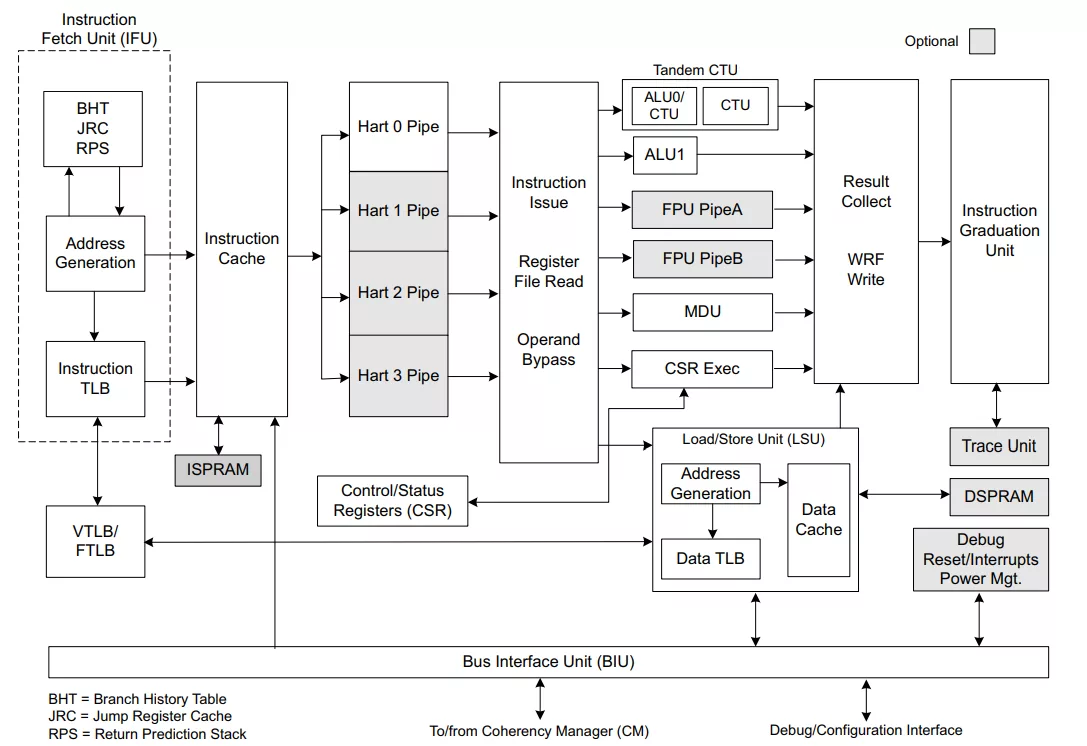

Key features

  • Scalability for highly parallel data processing and movement through multi-threading/multi-core/multi-cluster extensibility
  • Coherence Manager (CM) with integrated L2 cache
  • Up to 6 cores or 8 I/O coherence units (IOCUs) in any combination, up to 8 per cluster1
  • RISC-V compliant Advanced Platform Level Interrupt Controller (APLIC) compatible with the Advanced Interrupt Architecture (AIA)
  • RISC-V compliant Debug and Trace for multi-core and multi-cluster implementations, with multi-core trace funnel
  • Cluster Power Controller (CPC) for core level and system level voltage and clock power management 

Block Diagram

Benefits

  • Triple-issue In-order
  • Up to 4-way Simultaneous Multi-threading
  • Up to 8 Cores per Cluster
  • Automotive Capable ASIL-B

Specifications

Identity

Part Number
I8500
Vendor
MIPS
Type
Silicon IP

Files

Note: some files may require an NDA depending on provider policy.

Provider

HQ: USA

Learn more about DMA IP core

DMA IP Integration

There are many IP’s today . These IP’s can be simple IP’s like Timer to complex IP’s like Accelerators. In Most of the cases IP’s are Integrated in standard way. There are cases where you have the option of Integrating it differently. This goes un-noticed or unable to be implemented due to time constraints. One such IP that would be discussed in this paper is DMA . This paper tries to explain idea of Integrating Direct Memory access(DMA) and Interrupt Control Unit(ICU) differently but final implementation requires some changes in IP. There is a possibility that alternate design explained below may be already implemented.

Moving to AMBA® 5? Your AMBA® 4 IP Can Still Come With You

As SoC architectures adopt AMBA® 5 fabrics and components, many proven IP blocks still rely on AMBA® 4 or earlier interfaces. That creates a common integration problem: how do designers connect newer AMBA® 5 system components to existing IP without redesigning the IP or replacing verified blocks?

Frequently asked questions about DMA IP

What is Data Movement Engine - Efficient data-processing and simultaneous multi-threading, low latency and deterministic data access?

Data Movement Engine - Efficient data-processing and simultaneous multi-threading, low latency and deterministic data access is a DMA IP core from MIPS listed on Semi IP Hub.

How should engineers evaluate this DMA?

Engineers should review the overview, key features, supported foundries and nodes, maturity, deliverables, and provider information before shortlisting this DMA IP.

Can this semiconductor IP be compared with similar products?

Yes. Buyers can compare this product with similar semiconductor IP cores or IP families based on category, provider, process options, and structured technical specifications.

×
Semiconductor IP