High-Throughput Multi-Channel DMA Controller
Scatter-Gather | AMBA AXI5 | 1 - 126 Channels
Overview
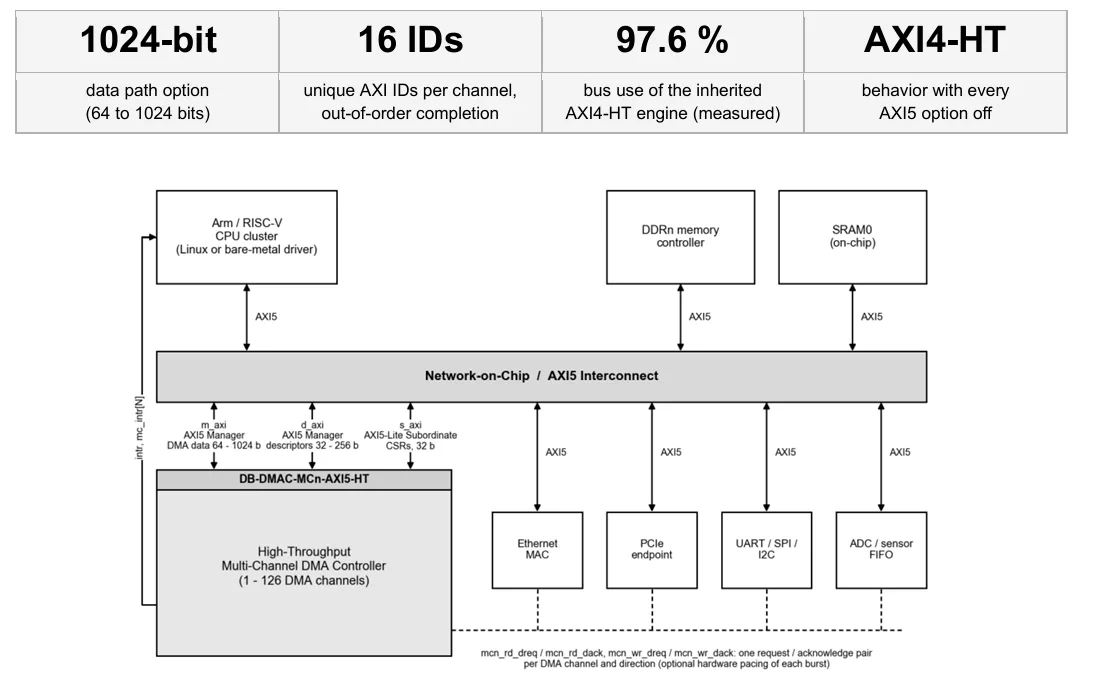
The Digital Blocks DB-DMAC-MCn-AXI5-HT SystemVerilog RTL IP Core is a high-throughput Scatter Gather (SG) Direct Memory Access (DMA) Controller with AMBA AXI5 Manager interfaces, a build-time number of independent DMA Channels (1 to 126) and a DMA data path of 64 to 1024 bits. It adds the AXI5 throughput features - unique IDs with out-of-order completion, read data chunking, the Busy indicator, QoS Accept and Max_Transaction_Bytes - to the DB-DMAC-MCn-AXI4-HT engine, so the interconnect and memory can keep up with a controller that already runs close to the full bus rate.
The inherited engine is measured: at 128 bits two channels use 97.6 % of the AXI4 bus, one channel holds 73 % at a 200-cycle read latency, and descriptor nodes are 2 cycles apart. The AXI5-HT keeps those mechanisms and lifts the limits that remain: one data ID per channel becomes a pool of unique IDs, so a channel's reads and writes complete out of order; wide reads come back in 128-bit chunks in any order; and the outstanding limit and channel arbitration follow the interconnect's Busy and QoS Accept signals. Every AXI5 feature is a build or register option; with all of them off the core behaves as the DB-DMAC-MCn-AXI4-HT.
Key features
High-Throughput Engine (from DB-DMAC-MCn-AXI4-HT, measured)
- Decoupled write path: AW runs ahead of W through a queue; W bursts go back-to-back
- Read-space reservation: buffer space is claimed when a read is issued, so RREADY is constant 1 - no read stalls, no head-of-line blocking between channels
- Descriptor overlap: the next node's reads start while the current node's writes drain (2 cycles between nodes)
- Dedicated descriptor manager with optional descriptor status write-back into each node
- Up to 16 outstanding reads and 16 outstanding writes per channel; burst lengths computed a cycle ahead, off the arbitration path
AXI5 Throughput Features
- Unique ID indicator: every burst takes its own ID from a per-channel pool (1 to 16, default 8) and asserts AxIDUNQ - the interconnect needs no ordering tracking for it
- Out-of-order completion: one channel's reads and writes complete in any order; data is reordered in a slot buffer and completion is counted per descriptor
- Read data chunking: memory returns wide reads in 128-bit chunks in any order; each chunk is written straight into its buffer slot
- Busy indicator: the outstanding-transaction limit steps down with RBUSY / BBUSY (75 / 50 / 25 %) and recovers after a hold-off
- QoS Accept: the round-robin arbiter favors requests the subordinate will accept now
- Max_Transaction_Bytes: bursts are cut at the interconnect stripe size (64 to 4096 bytes), so the interconnect never splits them
- Wake-up: AWAKEUP is raised a cycle before the first request after idle
AXI5 Transactions
- WriteZero zero fill per node: no source read and no write data on the bus
- WriteNoSnoopFull: full-line, all-strobe writes let a system cache allocate without merging
- Prefetch: optional data-less hint issued ahead of the read stream to hide DRAM latency
- Regular-transactions-only build for interconnects that require it
System, Integrity and Control
- Per-channel ARCACHE / AWCACHE and ARPROT / AWPROT: bufferable writes allow early responses; no-allocate reads keep source data out of the system cache
- Data Check: odd parity per byte on read and write data (RDATACHK / WDATACHK)
- AXI5-Lite register subordinate with WSTRB; 32-bit, 4 KB register window
- Descriptor-level error reporting: failing node address and cause (write response, read data or descriptor fetch; SLVERR or DECERR)
- Per-channel status and interrupts, global interrupt status / mask / vector, one processor interrupt; CIR and
- CFR describe the build to software
- Scatter-Gather and Transfer Control
- Linked lists of 32-byte nodes with 64-bit addresses and a 24-bit length; chained and ring structures (start / branch, re-start, Wait-On-Restart)
- Memory-to-Memory, Memory-to-Peripheral, Peripheral-to-Memory, Peripheral-to-Peripheral; fixed address FIFO transfers; per-channel DREQ / DACK hardware pacing
- Unaligned source and destination at any byte, any length
Integration
- 1 to 126 channels (one global interrupt bank per 32); data width 64 / 128 / 256 / 512 / 1024 bits; 64-bit addressing
- Each AXI5 feature is a build or register option, declared through the AXI5 interface properties; with all off the core is the DB-DMAC-MCn-AXI4-HT
- SystemVerilog interfaces with modports plus a flat-pin wrapper; AMBA Manager / Subordinate naming
- Fully synchronous single clock, rising-edge, no gated clocks, no internal tri-states; technology independent RTL for ASIC and FPGA
Block Diagram
Applications
- Bulk data movement on AXI5 network-on-chip and mesh interconnects with DDR or HBM memory
- Wide 512 and 1024-bit data paths where read latency dominates
- Buffer initialization and zero fill without a source read
- Scatter-gather DMA for networking, storage and PCIe endpoint data movement
Specifications
Identity
Files
Note: some files may require an NDA depending on provider policy.
Provider
Learn more about DMA IP core
DMA IP Integration
Using peripheral DMA boosts networked 32 bit MCU security and bandwidth
New AXI Scatter-Gather DMA Core Transfers Streaming Data to/from System Memory
Protecting Edge AI with RISC-V CHERI: See how easily memory-safe security can be added to an AI application (part 1)
The Next Leap in Datacenter AI: Orchestrating Custom Accelerators with SiFive Intelligent Control Units (ACUs)
Frequently asked questions about DMA IP
What is High-Throughput Multi-Channel DMA Controller?
High-Throughput Multi-Channel DMA Controller is a DMA IP core from Digital Blocks, Inc. listed on Semi IP Hub.
How should engineers evaluate this DMA?
Engineers should review the overview, key features, supported foundries and nodes, maturity, deliverables, and provider information before shortlisting this DMA IP.
Can this semiconductor IP be compared with similar products?
Yes. Buyers can compare this product with similar semiconductor IP cores or IP families based on category, provider, process options, and structured technical specifications.