ZLG Selects CAST CAN XL and TSN IP for Next-Generation Vehicle-Network Development and Test Tools
Standards-compliant IP supports CAN XL tools and deterministic Ethernet switches for OEM R&D, production, and testing
The MSC-CTRL IP core implements a high-speed serial interface controller designed to connect a microcontroller or SoC to external…
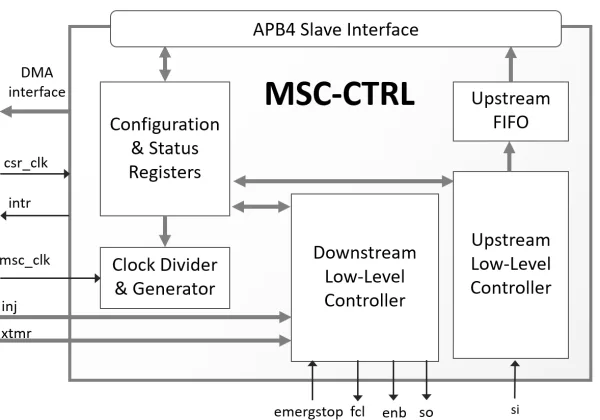
The MSC-CTRL IP core implements a high-speed serial interface controller designed to connect a microcontroller or SoC to external power devices or sensors. It implements the Microsecond Channel (MSC) and Microsecond Channel Plus (MSC-Plus) protocols—derived from the Microsecond Bus (uSB) serial concept—and acts as a bus master for downstream transmission and as a bus slave for upstream transmission.
The MSC-CTRL connects microcontrollers to peripheral devices via high-speed synchronous downstream and low-speed asynchronous upstream channels. It supports up to four slave devices in the MSC mode, while MSC-Plus is optimized for one-to-one communication with a single slave device. Advanced features, including Manchester encoding, fragmented command frames, and higher upstream baud rates, provide robust communication in a network of dedicated sensors or devices.
The controller’s communication with the host processor is facilitated by a 32-bit AMBA® APB4 subordinate interface. The MSC-CTRL features trigger signals to facilitate easy integration with an external DMA controller and a comprehensive set of interrupt sources for reporting status and error information.
The silicon-proven MSC-CTRL core is designed to industry best practices and has been rigorously verified. Available functional safety documents facilitate ISO 26262 ASIL B certification.
Supported Protocols
MSC 2nd Generation
MSC-Plus
Ease of Integration
Note: some files may require an NDA depending on provider policy.

Microsecond Channel (MSC/MSC-Plus) Controller is a IEEE-1588 / PTP IP core from CAST listed on Semi IP Hub.
Engineers should review the overview, key features, supported foundries and nodes, maturity, deliverables, and provider information before shortlisting this IEEE-1588 / PTP IP.
Yes. Buyers can compare this product with similar semiconductor IP cores or IP families based on category, provider, process options, and structured technical specifications.