Overview
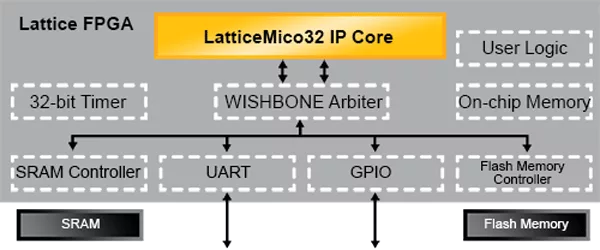
The LatticeMico32™ is a 32-bit Harvard, RISC architecture "soft" microprocessor, available for free with an open IP core licensing agreement. The LatticeMico32 provides the visibility, flexibility and portability that you expect in an open source hardware design. Everything you need is provided, including software development tools (via LatticeMico™ System) and evaluation boards to try out your designs in hardware.
By combining a 32-bit wide instruction set with 32 general purpose registers, the LatticeMico32 provides the performance and flexibility suitable for a wide variety of markets. Using a RISC architecture, the core consumes minimal device resources, while maintaining the performance required for a broad application set. To accelerate the development of microprocessor systems, several optional WISHBONE compatible peripheral components may be integrated with the LatticeMico32.
WISHBONE Compatible Peripheral Components
To accelerate the development of microprocessor systems, several optional WISHBONE compatible peripheral components may be integrated with the LatticeMico32.
* Memory controllers * DDR, DDR2 & DDR3 SDRAM
* Asynchronous SRAM
* On-chip Block Memory
* SDRAM controller
* On-chip dual port memory
* SPI Flash
* Parallel Flash
* I/O * 32-bit Timer
* DMA Controller
* GPIO
* I2C Master Controller
* SPI
* Tri-Speed Ethernet MAC
* UART
* PCI Target
Three Configurations to Optimize Area and Performance
* Basic * No Multiplier
* Multicycle Shifter
* No Cache
* Standard * Multiplier
* Pipelined Shifter
* 8K I-Cache, No D-Cache
* Full * Multiplier
* Pipelined Shifter
* 8K I-Cache, 8K D-Cache
Development Tools
LatticeMico System is to be used to implement a LatticeMico32 system with attached peripheral components. It is based on the Eclipse C/C++ Development Tools Environment, which is an industry open-source development and application framework for building software.
Supported Development Boards
Lattice has pre-defined a number of its development boards as platforms within the LatticeMico System Software. This allows you to rapidly start developing LatticeMico32 based systems on these boards. The following boards have been developed:
* LatticeMico32 Development Board for LatticeECP2
* LatticeMico32 Development Board for LatticeECP
Learn more about CPU IP core
Combining Arm® AGI CPU server platforms with Lattice FPGAs and AMI firmware creates a solution that provides advanced security, manageability, connectivity, and flexibility for next-generation AI data center infrastructure.
Lattice Prompt pairs with AI agentic tools developers already use, combining them with Lattice design tools, knowledge base, and documentation to turn natural language inputs into validated responses, dramatically accelerating FPGA development while optimizing design performance and capability.
First announced on May 4, 2026, the acquisition creates the industry's most complete secure management and control platform.
The acquisition brings together Lattice’s industry-leading low power FPGAs with AMI’s industry‑leading platform firmware and infrastructure manageability solutions for cloud and AI to create a complete portfolio of secure management and control solutions.
The collaboration demonstrates a real-time AI sensor fusion architecture that integrates TI mmWave radar and camera sensors using NVIDIA Holoscan Sensor Bridge running on Lattice’s low power FPGA. The FPGA acts as a companion chip delivering synchronized sensor data directly into GPU-accessible memory to enable low-latency and robust perception for robotics and industrial edge AI applications.
Sets new standard for secure control FPGAs with full CNSA 2.0-compliant post-quantum cryptography, crypto-agility, and hardware Root of Trust for next-generation infrastructure