IDE Security IP Modules for PCI Express 7.0
PCI Express is a ubiquitous interface for a wide variety of applications, from connecting accelerators and peripheral devices, to…
Overview
PCI Express is a ubiquitous interface for a wide variety of applications, from connecting accelerators and peripheral devices, to data center servers, to their use in consumer electronics. PCI Express links carry high value information between the host and the peripheral and from endpoint to endpoint.
The Integrity and Data Encryption (IDE) Security IP Modules for PCIe 7.0 provide confidentiality, integrity, and replay protection against hardware-level attacks. IDE adds optional capabilities for PCIe devices to perform hardware encryption and integrity checking on packets transferred across PCIe links.
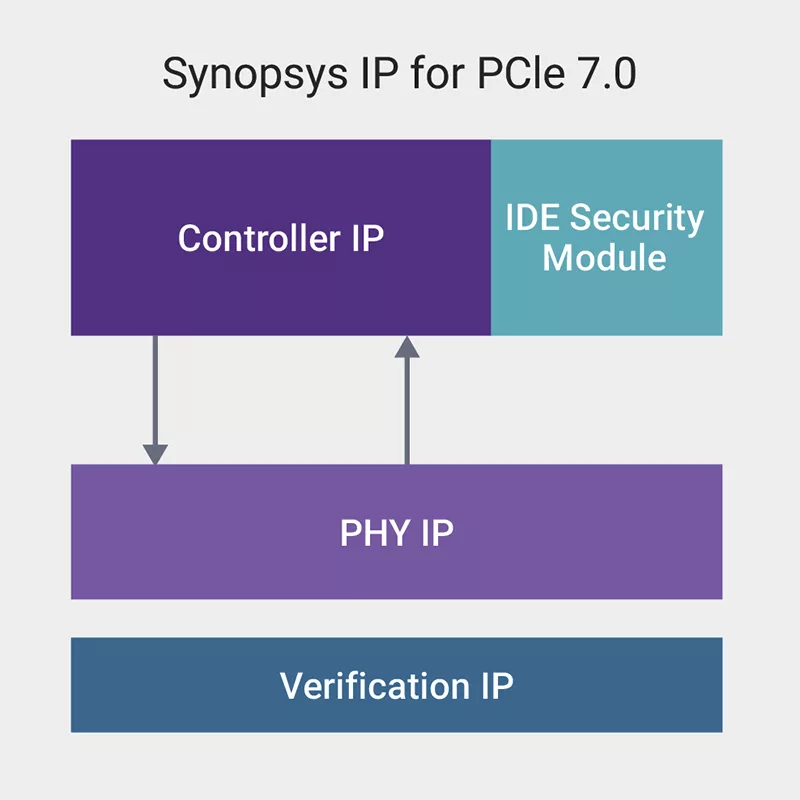
The IDE Security Modules for PCIe 7.0 offer seamless integration with the Controller for PCIe 7.0 via the Transaction Layer Packets (TLP) or Flow Control Units (FLITs) interfaces as defined in the PCI-SIG IDE specification. These interfaces match the data width used by the controller, e.g., 1024-bit or 512-bit, together with the maximum number of TLP prefixes to offer an optimal performance vs. area implementation.
The IDE extended capability registers are accessible from the Controller for PCIe 7.0, offering a clear view of the link capabilities during discovery and configuration timeframes.
The Secure PCIe Controllers with IDE provide support for the TEE Device Interface Security Protocol (TDISP), an Engineering Change Notice (ECN) released by PCI-SIG. TDISP standardized framework defines how to secure the interconnect between virtual machine hosts and devices, regardless of where the data center resides or who has access to the servers inside. The PCIe Controllers with IDE enable designers to build full TDISP support in their hyperscale SoCs and mitigate against data and system attacks to address the challenges of virtualized cloud security.
Interoperability between the IDE Security Modules and Controller for PCIe 7.0 is part of the development process, offering customers version compatibility and reference integration templates.
Key features
- Full support of PCI Express 7.0 (64GT/s) IDE specification
- High-performance AES-GCM based packet encryption, decryption, authentication
- Seamless integration with Synopsys controllers via TLP/FLIT packet-based interface
- FLIT mode support
- Support for PCIe 7.0, 6.0, 5.0, 4.0 and 3.1 data rates
- Customer configurable
- Aligns with PCIe controller’s configuration options
- Scalable data bus width: 128, 256, 512, 1024
- Lanes: x1, x2, x4, x8, x16, x32
- Partial header encryption support
- TDISP support
- Supports Arm Confidential Compute Architecture
- Optimized for area, performance & latency
- FIPS 140-3 certification support
- Multi-stream support
- PCRC calculation & validation
- Efficient key control & refresh
Block Diagram
Specifications
Identity
Files
Note: some files may require an NDA depending on provider policy.
Provider
Learn more about Single-Protocol PHY IP core
Achieving Compliance and Interoperability for Your PCI Express Design
Beyond DDR2 400: Physical Implementation Challenges in Your SoC Design
Synopsys Delivers First Complete UFS 5.0 and M‑PHY v6.0 IP Solution for Next‑Gen Storage
Industry 1st CXL 4.0 Verification IP: Transforming AI and HPC Systems
Low Power Analysis and Verification of Super Speed Inter-Chip (SSIC) IP
Frequently asked questions about Single-Protocol PHY IP
What is IDE Security IP Modules for PCI Express 7.0?
IDE Security IP Modules for PCI Express 7.0 is a Single-Protocol PHY IP core from Synopsys, Inc. listed on Semi IP Hub.
How should engineers evaluate this Single-Protocol PHY?
Engineers should review the overview, key features, supported foundries and nodes, maturity, deliverables, and provider information before shortlisting this Single-Protocol PHY IP.
Can this semiconductor IP be compared with similar products?
Yes. Buyers can compare this product with similar semiconductor IP cores or IP families based on category, provider, process options, and structured technical specifications.