What is High-Speed LVDS (SERDES) Transceiver?
High-Speed LVDS (SERDES) Transceiver is a Single-Protocol PHY IP core from Zipcores Electronic Systems Engineering S.L. listed on Semi IP Hub.
The LVDS_SERDES IP Core is a high-speed LVDS transmitter / receiver pair suitable for a wide range of serial interface applicatio…
The LVDS_SERDES IP Core is a high-speed LVDS transmitter / receiver pair suitable for a wide range of serial interface applications. The design is comprised of an independent transmitter and receiver that may be used separately or together as a single transceiver.
The transceiver can accept parallel data widths of up to 128-bits and features a user-defined multiplexer ratio. By modifying the generic parameters, dw, ratio, duty, skew, lanes and direction, the transceiver can be made compatible with a wide range of third-party LVDS devices such as those from National Semiconductor®, TI®, Thine® and Maxim®.
In total, the transceiver can support up to 8 serial data lanes - each data lane typically handling rates of between 500 Mbits/s and 1Gbits/s. The maximum data rate attained will be dependent on a wide range of factors such as: cable type, cable length, board layout, and the specification of the LVDS buffers. As a general rule, data rates of 350 Mbits/s per lane can be easily achieved on even the most basic FPGA platforms.
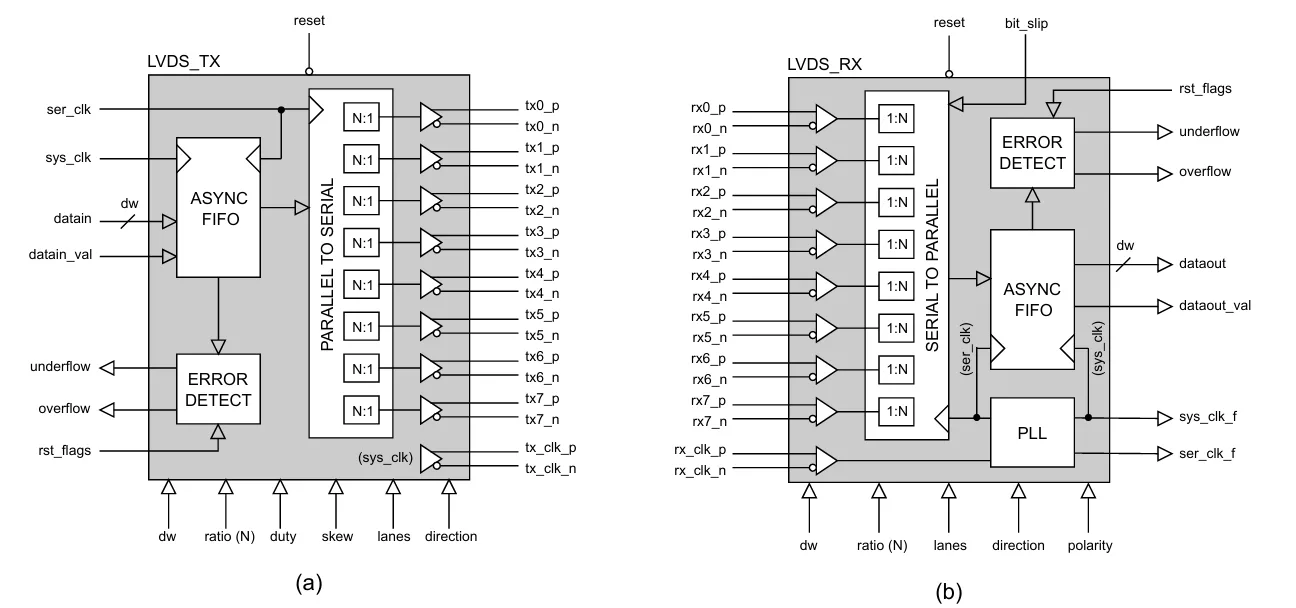
In addition to the 8 data lanes, a single clock lane is provided for synchronizing the data between the transmitter and receiver. Figure 1 shows the basic architecture of the transmitter and receiver pair. The following sections explain the transmitter and receiver functionality in more detail.
Note: some files may require an NDA depending on provider policy.
High-Speed LVDS (SERDES) Transceiver is a Single-Protocol PHY IP core from Zipcores Electronic Systems Engineering S.L. listed on Semi IP Hub.
Engineers should review the overview, key features, supported foundries and nodes, maturity, deliverables, and provider information before shortlisting this Single-Protocol PHY IP.
Yes. Buyers can compare this product with similar semiconductor IP cores or IP families based on category, provider, process options, and structured technical specifications.