High-performance 64-bit RISC-V architecture multi-core processor with AI vector acceleration engine
C910 utilizes a 12-stage superscalar pipeline, is compatible with RISC-V architecture, and is enhanced for arithmetic operations,…
Overview
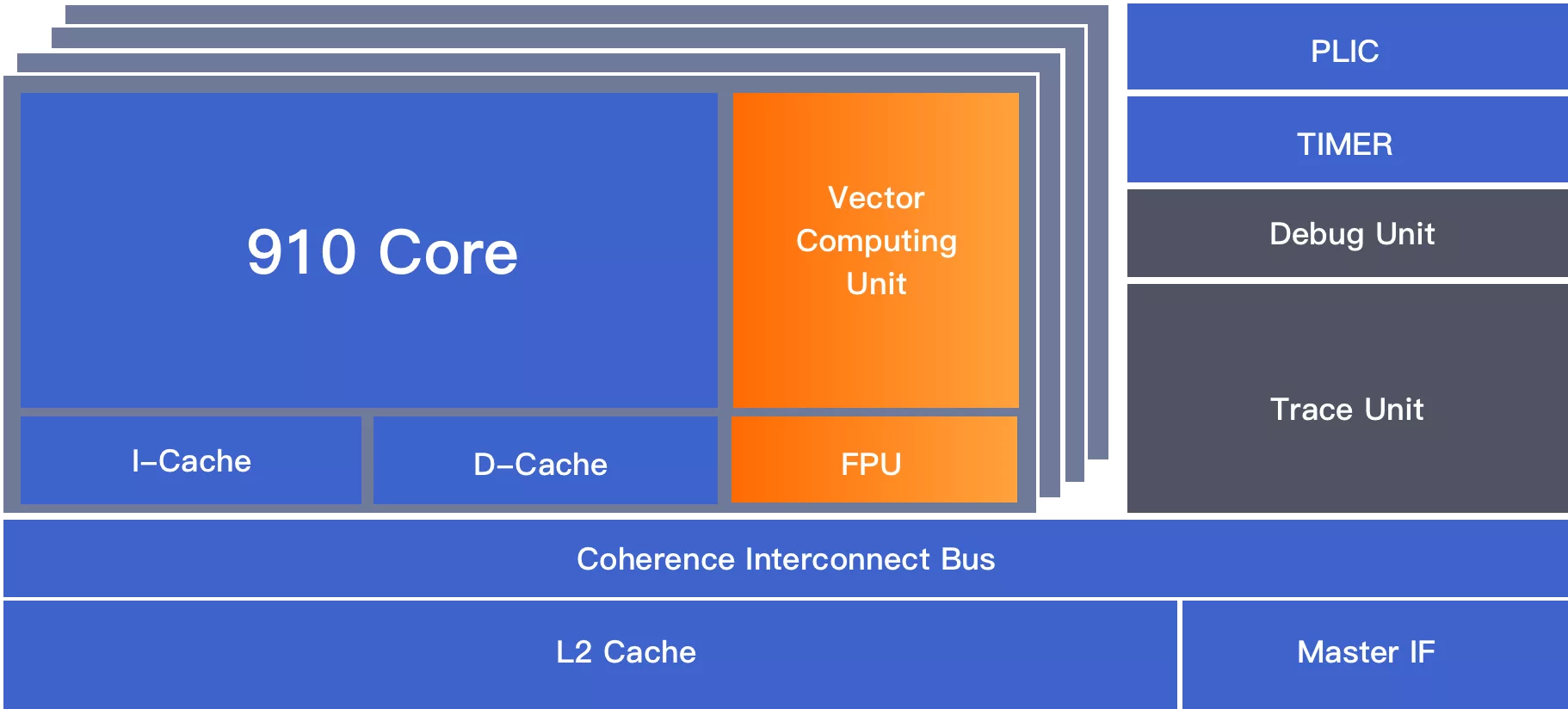
C910 utilizes a 12-stage superscalar pipeline, is compatible with RISC-V architecture, and is enhanced for arithmetic operations, memory access and multi-core synchronization. It also has a standard memory management unit and can run operation systems such as Linux. Utilizing a 3-issue and 8-execution out-of-order execution architecture, it can be equipped with a single/double-precision floating point engine. It can be further equipped with a vector computing engine for AI acceleration, making it suitable for application fields requiring high-performance, such as 5G and artificial intelligence.
Key features
- Instruction set: RISC-V RV64GC/RV 64GCV;
- Multi-core: Isomorphic multi-core with 1 to 4 optional clusters. Each cluster can have 1 to 4 optional cores;
- Pipeline: 12-stage;
- Microarchitecture: Tri-issue (superscalar), out-of-order;
- General register: 32 64-bit GPRs, 32 64-bit FGPRs, and 32 128-bit VGPRs;
- Cache: 2-stage cache; I-cache: 32 KB/64 KB (size options); D-cache: 32 KB/64 KB (size options); L2 Cache: 128KB~8MB (size options);
- Cache check: Optional ECC check and parity check;
- Bus interface: 1 128-bit master interface;
- Memory protection: On-chip memory management unit supports hardware backfilling;
- Floating point engine: Supports single and double precision floating point operations;
- AI vector calculation engine: Dual 128-bit operation width, supporting half-/single-/double-precision/8-bit/16-bit/32-bit/64-bit parallel computing;
- Multi-core consistency: Quad-core shared L2-cache, supporting cache data consistency;
- Interrupt controller: Supports a multi-core shared interrupt controller;
- Debugging: Supports multi-core collaborative debugging;
- Performance monitoring: Supports a hardware performance monitoring unit.
Block Diagram
Benefits
- AI vector acceleration engine: Provides dedicated vector operation instructions to accelerate various typical neural networks;
- Multi-cluster scaling: Provides up to 16 cores to further improve computing performance;
- Hybrid branch processing: Hybrid branch processing technology including branch direction, branch address, function return address and indirect jump address prediction to improve the fetching efficiency;
- ng branch direction, branch address, function return address and indirect jump address prediction to improve the fetching efficiency
- Data prefetching: Multi-channel and multi-mode data prefetching technology greatly improves data access bandwidth;
- Fast memory loading: Load memory access data in advance, and reduce the load-to-use latency;
- Storage speculation access prediction: Predicts random memory out-of-order speculation access, and improves execution efficiency.
Applications
- Intelligent Vision
Specifications
Identity
Compute
Files
Note: some files may require an NDA depending on provider policy.
Provider
Learn more about CPU IP core
Announcing Arm AGI CPU: The silicon foundation for the agentic AI cloud era
ChiPy®: Bridge Neural Networks and C++ on Silicon — Full Inference Pipelines with Zero CPU Round-Trips
Unleashing Leading On-Device AI Performance and Efficiency with New Arm C1 CPU Cluster
Encarsia: Evaluating CPU Fuzzers via Automatic Bug Injection
Introducing Cortex-A320: Ultra-efficient Armv9 CPU Optimized for IoT
Frequently asked questions about CPU IP cores
What is High-performance 64-bit RISC-V architecture multi-core processor with AI vector acceleration engine?
High-performance 64-bit RISC-V architecture multi-core processor with AI vector acceleration engine is a CPU IP core from T-Head listed on Semi IP Hub.
How should engineers evaluate this CPU?
Engineers should review the overview, key features, supported foundries and nodes, maturity, deliverables, and provider information before shortlisting this CPU IP.
Can this semiconductor IP be compared with similar products?
Yes. Buyers can compare this product with similar semiconductor IP cores or IP families based on category, provider, process options, and structured technical specifications.