CDM Dependence on Device Capacitance
This blog will focus on what happens during the CDM pulse itself, and will show how the pulse properties change as a function of DUT to Field Plate capacitance.
A radiation-hardened GlobalFoundries 12nm LP/LP+ 0.8V LVDS Transceiver.
A radiation-hardened GlobalFoundries 12nm LP/LP+ 0.8V LVDS Transceiver.
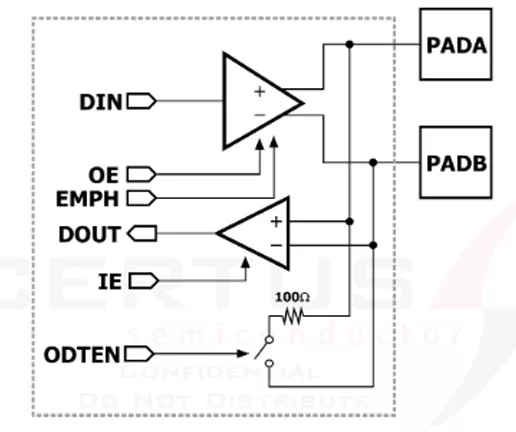
The 2.5Gbps LVDS transceiver in GlobalFoundries LP/LP+ is designed for high-speed, low-power data transmission in radiation-intensive environments. Engineered with a Rad-Hard by Design approach, the Rad-Hard cells have been proton tested to 64 MeV with a flux exceeding 1.3E+09, and is latch-up proven to 200mA across -40C to 125C, ensuring robust immunity against TID, SEE, and SEL effects. Additionally, the LVDS transceiver meets 2kV HBM, 500V CDM, and 2kV IEC 61000-4-2 system-level ESD protection, delivering superior reliability for harsh environments. With high speed integrity, low jitter, and minimal power consumption, this IP is ideal for aerospace, defense and other mission critical applications while maintaining compliance with industry-standard LVDS specifications.
Process Details
| Parameter | Value |
| Core Device | 0.8V |
| I/O Device | 1.8V Gate Oxide |
| BEOL | 1P13M |
| Top Routing | LB |
TX Electrical Specifications
| Description | Typical | Units |
| VDDIO | 1.8 | V |
| VDD | 0.8 | V |
| TX Rise Time | 190 | pS |
| TX Fall Time | 199 | pS |
| TX Prop. Delay Rise | 180 | pS |
| TX Prop. Delay Fall | 179 | pS |
| Out Enable Delay | 7692 | pS |
| TX amplitude | 385 | mV |
| Duty Cycle | 50 | % |
RX Electrical Specifications
| Description | Typical | Units |
| RX Fall Time | 71 | pS |
| RX Delay Rise | 193 | pS |
| RX Delay Fall | 198 | pS |
| Enable Delay | 81 | pS |
| RXLoad Cap | 0.1 | pF |
| Typcial RX Freq | 2.5 | Gbps |
| Foundry | Node | Process | Maturity |
|---|---|---|---|
| GlobalFoundries | 12nm | LP | — |
Note: some files may require an NDA depending on provider policy.

GF12 - 0.8V LVDS Rad-Hard Transceiver in GF 12nm is a Single-Protocol PHY IP core from Certus Semiconductor listed on Semi IP Hub. It is listed with support for globalfoundries.
Engineers should review the overview, key features, supported foundries and nodes, maturity, deliverables, and provider information before shortlisting this Single-Protocol PHY IP.
Yes. Buyers can compare this product with similar semiconductor IP cores or IP families based on category, provider, process options, and structured technical specifications.