Vendor: Key ASIC Category: Single-Protocol PHY

Ethernet 10/100 PHY

The KA13ETHB33 is a single-port PHY with an MII (Media Independent Interface).

Overview

The KA13ETHB33 is a single-port PHY with an MII (Media Independent Interface). It implements all 10/100M Ethernet Physical- layer functions including the Physical Coding Sub-layer (PCS), Physical Medium Attachment (PMA), Twisted Pair Physical Medium Dependent sub-layer (TP-PMD), 10Base-Tx Encoder/Decoder, and Twisted Pair Media Access Unit (TPMAU).


Key features

  • Supports MII.
  • Auto-MDX
  • 10/100Mbs operation supported
  • Full/half duplex operation
  • Twisted pair output only
  • Supports Base Line Wander (BLW) compensation
  • Adaptive Equalization
  • 25MHz crystal/oscillator as clock source
  • IEEE 802.3/802.3u compliant including auto- negotiation
  • 0~125°C junction temperature
  • Silterra 130nm CMOS process

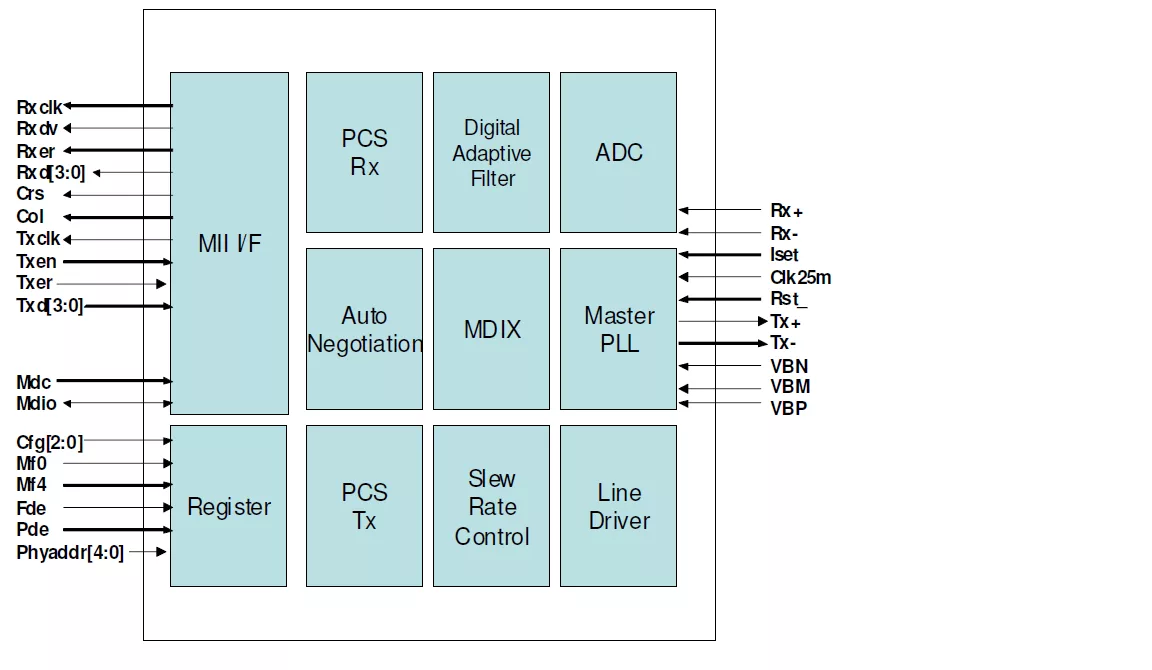
Block Diagram

Benefits

  • With on-chip DSP (Digital Signal Processing) technology, the chip provides excellent performance under all operating conditions.

Applications

  • Network Interface Adapters
  • Ethernet Hubs/Switches
  • ADSL/Cable Modems
  • VoIP Phone Sets

What’s Included?

  • Data Sheet
  • Test Documentation
  • Integration Guide
  • GDSII
  • LVS netlist
  • LEF model
  • Verilog Model
  • Timing Model

Specifications

Identity

Part Number
KA13ETHB33
Vendor
Key ASIC
Type
Silicon IP

Files

Note: some files may require an NDA depending on provider policy.

Provider

HQ: Malaysia

Learn more about Single-Protocol PHY IP core

Accelerating Your Development: Simplify SoC I/O with a Single Multi-Protocol SerDes IP

Enter the Multi-Protocol SerDes (Serializer/Deserializer)—a flexible, reusable IP block that allows a single PHY to support multiple serial communication protocols, such as PCIe, SATA, Ethernet, USB, and more. This approach enables SoC vendors to meet diverse customer requirements and application needs without redesigning I/O for each target market.

Boost SoC Flexibility: 4 Design Tips for Memory Subsystems with Combo DDR3/4 Interfaces

In today’s fast-paced SoC market, memory flexibility is no longer a luxury—it’s a competitive necessity. While DDR5 is gaining traction in high-performance systems, DDR3 and DDR4 remain dominant in embedded, industrial, and cost-sensitive markets. A combo DDR3/4 interface offers engineers a way to bridge these worlds, maximizing product reach while reducing design risk.

UFS Goes Mainstream

UniversalFlash Storage (UFS) was created for mobile applications and computer systems requiring high performance and low power consumption. These systems typically use embedded Flash based on the JEDEC standard eMMC. UFS was defined by JEDEC as the evolutionary replacement for eMMC offering significantly higher memory bandwidth. The standard builds on existing standards such as the SCSI command set, the MIPI Alliance M-PHY and UniPro as well as eMMC form factors to simplify adoption and development.

Design IP Faster: Introducing the C~ High-Level Language

In this paper, we introduce a new high-level, dataflow programming language called C~ (“C flow”) that further increases productivity by raising the level of abstraction from behavioral descriptions, while overcoming the limitations of C for hardware design. We present the syntax and semantics of this language, and the framework that provides hardware and software code generation. This paper illustrates the benefits of using C~ for hardware design of a IEEE 802.3 MAC, synthesized for FPGA and for 90nm CMOS technology.

Universal Flash Storage: Mobilize Your Data

Universal Flash Storage (UFS) was created for mobile applications and computer systems requiring high performance and low power consumption. These systems typically use embedded Flash based on the JEDEC standard eMMC. UFS was defined by JEDEC as the evolutionary replacement for eMMC offering significantly higher memory bandwidth. The standard builds on existing standards such as the SCSI command set, the MIPI Alliance M-PHY and UniProSM as well as eMMC form factors to simplify adoption and development.

Can MIPI and MDDI Co-Exist?

Since MIPI and MDDI standards both target interfaces to cameras and displays on mobile devices, are two separate standards really needed?

Frequently asked questions about Single-Protocol PHY IP

What is Ethernet 10/100 PHY?

Ethernet 10/100 PHY is a Single-Protocol PHY IP core from Key ASIC listed on Semi IP Hub.

How should engineers evaluate this Single-Protocol PHY?

Engineers should review the overview, key features, supported foundries and nodes, maturity, deliverables, and provider information before shortlisting this Single-Protocol PHY IP.

Can this semiconductor IP be compared with similar products?

Yes. Buyers can compare this product with similar semiconductor IP cores or IP families based on category, provider, process options, and structured technical specifications.

×
Semiconductor IP