Vendor: T2M GmbH Category: Single-Protocol PHY

Display Port v1.4 Tx PHY & Controller IP, Silicon Proven in TSMC 12FFC

The DisplayPort v1.4 Tx PHY IP in 12FFC is a modernistic technology designed to be integrated into chip designs for various devic…

TSMC 12nm FFC In Production View all specifications

Overview

The DisplayPort v1.4 Tx PHY IP in 12FFC is a modernistic technology designed to be integrated into chip designs for various devices, including graphics cards, monitors, and laptops. Utilizing the 12nm FinFET Compact process technology, this IP strikes a balance between power efficiency and performance, making it an ideal solution for implementing DisplayPort 1.4 functionality and using of this DisplayPort 1.4 Tx PHY IP, device manufacturers can enable seamless transmission of high-quality video and audio signals in their products. This integration enhances the visual experience for users, offering advanced features and high-speed data transmission capabilities supported by DisplayPort 1.4. This transmitter PHY supports a wide range of bit rates, ranging from 1.62Gbps (RBR) to 5.4Gbps (HBR2), ensuring efficient data transmission in modern display technologies. It includes integrated features such as 100-ohm termination resistors with common-mode biasing, which improves signal integrity and this transmitter PHY incorporates an integrated equalizer with tunable strength, allowing for signal optimization over long cable lengths or challenging environments. The IP also offers configurable analog characteristics, including CDR bandwidth, equalizer strength, terminator resistance, BGR voltage, and regulator voltage. This flexibility enables customization to meet specific requirements and enhances compatibility with different system configurations. This DisplayPort 1.4 Tx PHY IP in 12FFC plays a vital role in advancing display technologies and enabling the development of futuristic devices across various industries. Its integration into chip designs empowers device manufacturers to deliver enhanced visual experiences to users while maintaining efficient data transmission capabilities.

Key features

  • eDP version 1.4a / DP version 1.4 compliant transmitter
  • Supports HDCP1.4 and HDCP2.2(Optional)
  • Supports Forward Error Correction (Optional)
  • Consists of configurable (4/2/1) link channels and one AUX channel
  • Supports 1.62/2.7/5.4/8.1Gbps (HBR3) bit rate and all recommended link rate (ie 2.16Gbps etc)
  • Supports main link operation with 1 or 2 or 4 lanes
  • Supports both Default and Enhanced Framing Mode
  • Supports SST mode
  • Supports video packet and audio packet (8ch max)
  • Supports both Normal and Alternate Scrambler Seed Reset
  • Supports E-EDID data reading via I2C-over-AUX transaction
  • Supports Video test pattern generator (compliant with DP link CTS v1.2)
  • Configuration registers programmable via AMBA interface
  • Silicon Proven in TSMC 12nm FFC

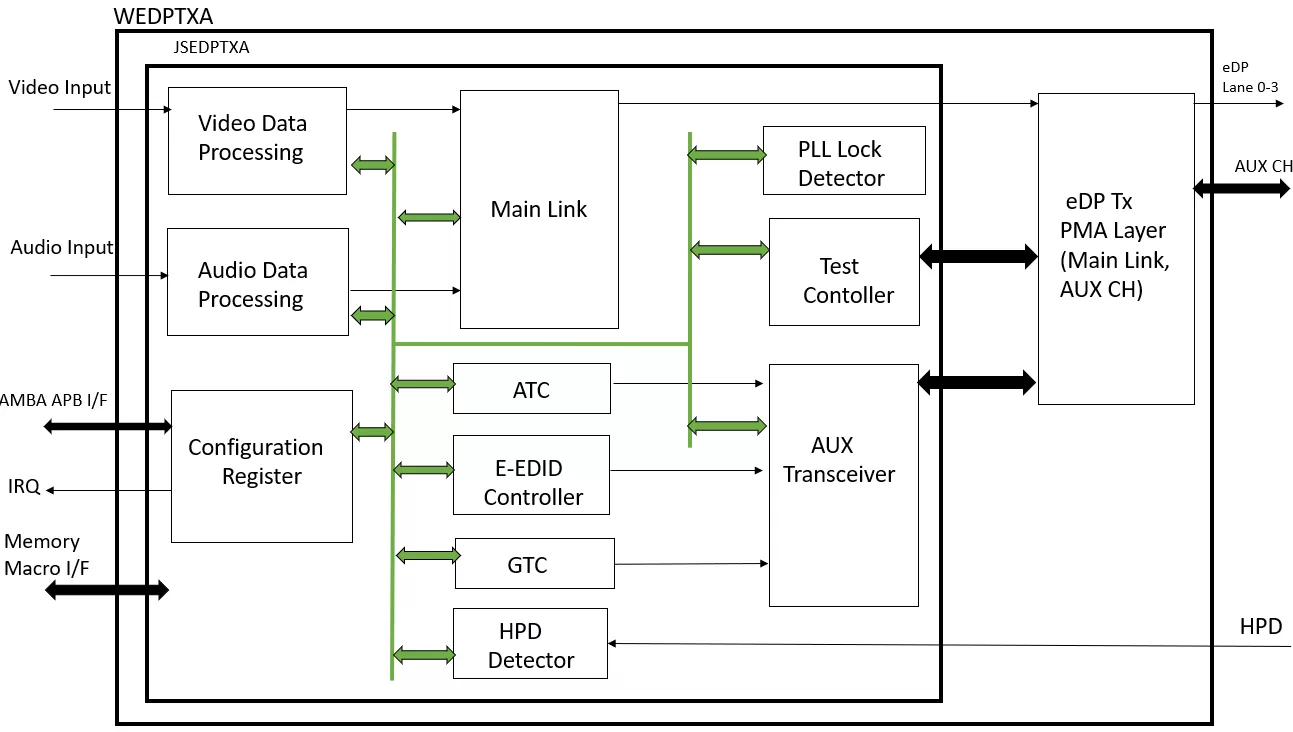
Block Diagram

What’s Included?

  • Verilog RTL or netlist source code of LINK controller.
  • Abstracted timing models for synthesis and STA
  • Timing constrains for synthesis and physical layout
  • Behavioural Verilog Model, simulation test bench, run control scripts, and test stimuli
  • Physical design database
  • Integration guidelines
  • Reference software sample code

Silicon Options

Foundry Node Process Maturity
TSMC 12nm FFC In Production

Specifications

Identity

Part Number
DisplayPort v1.4 Tx PHY IP in 12FFC
Vendor
T2M GmbH
Type
Silicon IP

Files

Note: some files may require an NDA depending on provider policy.

Provider

HQ: Germany

Learn more about Single-Protocol PHY IP core

Three Design Aspects you shouldn't miss while building an NB-IoT Protocol Stack

It is very important that the design aspects of the NB-IoT device protocol stack ensure low module cost and low energy consumption. This is required to match the industry expected module costs. This paper outlines some of the NB-IoT Protocol stack specification flexibilities and generic design aspects that are to be considered to meet the above requirements, especially with reference to LTE.

UFS Goes Mainstream

UniversalFlash Storage (UFS) was created for mobile applications and computer systems requiring high performance and low power consumption. These systems typically use embedded Flash based on the JEDEC standard eMMC. UFS was defined by JEDEC as the evolutionary replacement for eMMC offering significantly higher memory bandwidth. The standard builds on existing standards such as the SCSI command set, the MIPI Alliance M-PHY and UniPro as well as eMMC form factors to simplify adoption and development.

Design IP Faster: Introducing the C~ High-Level Language

In this paper, we introduce a new high-level, dataflow programming language called C~ (“C flow”) that further increases productivity by raising the level of abstraction from behavioral descriptions, while overcoming the limitations of C for hardware design. We present the syntax and semantics of this language, and the framework that provides hardware and software code generation. This paper illustrates the benefits of using C~ for hardware design of a IEEE 802.3 MAC, synthesized for FPGA and for 90nm CMOS technology.

Universal Flash Storage: Mobilize Your Data

Universal Flash Storage (UFS) was created for mobile applications and computer systems requiring high performance and low power consumption. These systems typically use embedded Flash based on the JEDEC standard eMMC. UFS was defined by JEDEC as the evolutionary replacement for eMMC offering significantly higher memory bandwidth. The standard builds on existing standards such as the SCSI command set, the MIPI Alliance M-PHY and UniProSM as well as eMMC form factors to simplify adoption and development.

Can MIPI and MDDI Co-Exist?

Since MIPI and MDDI standards both target interfaces to cameras and displays on mobile devices, are two separate standards really needed?

Frequently asked questions about Single-Protocol PHY IP

What is Display Port v1.4 Tx PHY & Controller IP, Silicon Proven in TSMC 12FFC?

Display Port v1.4 Tx PHY & Controller IP, Silicon Proven in TSMC 12FFC is a Single-Protocol PHY IP core from T2M GmbH listed on Semi IP Hub. It is listed with support for tsmc In Production.

How should engineers evaluate this Single-Protocol PHY?

Engineers should review the overview, key features, supported foundries and nodes, maturity, deliverables, and provider information before shortlisting this Single-Protocol PHY IP.

Can this semiconductor IP be compared with similar products?

Yes. Buyers can compare this product with similar semiconductor IP cores or IP families based on category, provider, process options, and structured technical specifications.

×
Semiconductor IP