Overview
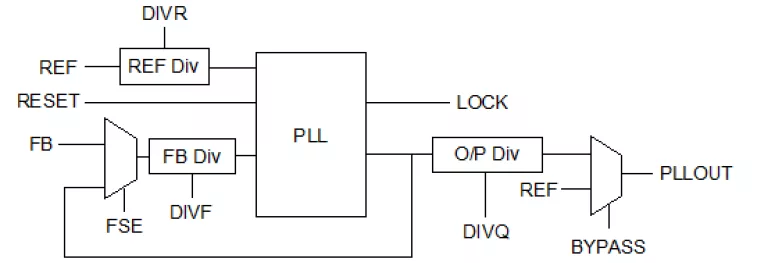
The Core Powered Wide Range PLL is easy to integrate, requiring no analog power supply, and can be placed anywhere on a chip.
This Wide Range PLL addresses a large portfolio of applications, ranging from simple clock de-skew and non-integer clock multiplication to programmable clock synthesis for multi-clock generation. These PLLs are designed for digital logic processes and use robust design techniques to work in noisy SoC environments, such as high speed communication to low power consumer to memory interfaces.
The PLL macro is implemented in Analog Bits’ proprietary architecture that uses core and thick-oxide devices, on a core level power supply.
PLL Operational Range Description Symbol Min Typ Max Units Input Frequency FREF 7 600 MHz Post-Divide Reference frequency FPFD 7 200 MHz VCO Frequency FVCO 8000 MHz Output Frequency FOUT 7 4000 MHz Lock Time TLOCK 70 µs Reset Time tRESET 1 µs Output Duty Cycle tDO 45 55 % Area A 0.02 sq. mm Total Power IDD 4.6 mA Operational Voltage V 0.675 0.75 0.825 V Operational Temperature TOP -40 25 125 O C Table 1: PLL Operational Range
Learn more about PLL IP core
At TSMC 2026 North America OIP Ecosystem Forum, Analog Bits will showcase new real-time power observability and sensing analog IP in TSMC’s N2P process technology and present a paper with Cerebras; Papers planned with partners at global OIP Ecosystem events to highlight smarter power delivery for scalable SoCs targeting data centers, automotive and more.
Strategic investment strengthens worldwide engineering capabilities and accelerates innovation to support growing need for smarter and more efficient analog and power solutions for advanced semiconductors.
Analog Bits continues to develop innovative mixed signal IP in TSMC N2P process technology, with integrated LDOs, pinless remote PVT sensors, and microwatt class and high-performance LC PLLs
We are honored to receive the 2025 OIP Partner of the Year Award from TSMC in the Analog IP category for enabling customer designs with broad portfolio of IPs to accelerate design creation.
Company will demonstrate newest LDOs, PLLs, and sensors proven on TSMC’s latest process technologies at the TSMC 2025 Open Innovation Platform® (OIP) Ecosystem Forum in Silicon Valley
Analog Bits will be demonstrating its newest LDO, power supply droop detectors, embedded clock LC PLL’s on the TSMC N3P process, and clocking, high-accuracy PVT and droop detectors on the TSMC N2P process at the Analog Bits booth at the TSMC 2025 North America Technology Symposium in Santa Clara, California.