Overview
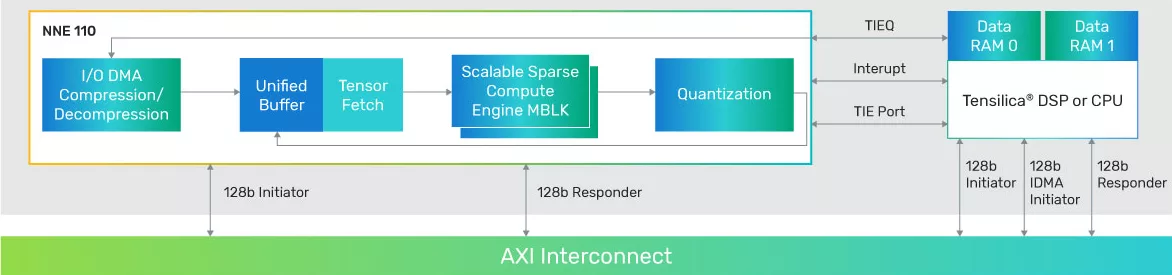
The Cadence® Tensilica® NNE 110 offers an energy-efficient hardware-based AI engine that can be paired with a Tensilica based DSP. The NNE 110 targets a variety of applications including audio, voice, and speech AI, lightweight vision AI, and always-on multi-sensory applications.
The product architecture natively supports the most common network layers found in these applications including convolution, depth-wise separable convolution, fully connected, LSTM, pooling, reshaping, and concatenation layers. Other layers can be supported (and further accelerated using TIE) using the host Tensilica DSP. The NNE 110 provides performance scalability from 32 to 128 MACs for 8x8-bit MAC computation, suiting a variety of low-power AI needs. It offers unique features for AI enhancement including hardware-based sparsity for compute and bandwidth reduction as well as on the-fly weight decompression for smaller system footprints.
Learn more about Edge AI Accelerator IP core
Cadence and Müller-BBM extend m|klang® e support to the latest Tensilica HiFi DSPs, enabling automotive OEMs and Tier-1 suppliers to implement active noise control and active sound design on Cadence HiFi DSP architectures for automotive programs.
This post explores the NPU and the vital role it plays in accelerating AI inference within these systems.
A joint AIZIP–Cadence view of de-risking the Physical AI voice front end from model evaluation through silicon integration
A Physical AI system crosses several communication boundaries. The main processor connects to local accelerators and storage. Major modules across the machine communicate with central compute and control. Functions partitioned across dies exchange data within the package.
Agreement with the European Chips Joint Undertaking extends access to Cadence EDA and Systems technologies and Managed Cloud Service for eligible European startups and SMEs.
This blog post examines how the TEE Device Interface Security Protocol (TDISP) enables trusted device assignment and works with Integrity and Data Encryption (IDE) in systems implementing the Arm Confidential Compute Architecture (CCA).