Vendor: Silvaco, Inc. Category: CPU

ColdFire V1 core with EMAC, Divider and Cryptograhic unit

The synthesizable 32-bit RISC ColdFire V1 Core (CFV1CORE) is the smallest and lowest power processor in the ColdFire family, usin…

Overview

The synthesizable 32-bit RISC ColdFire V1 Core (CFV1CORE) is the smallest and lowest power processor in the ColdFire family, using as few as 19K gates. The CFV1CORE small size and 32 bit performance make it ideal for a wide variety of consumer, healthcare, and other embedded systems applications.

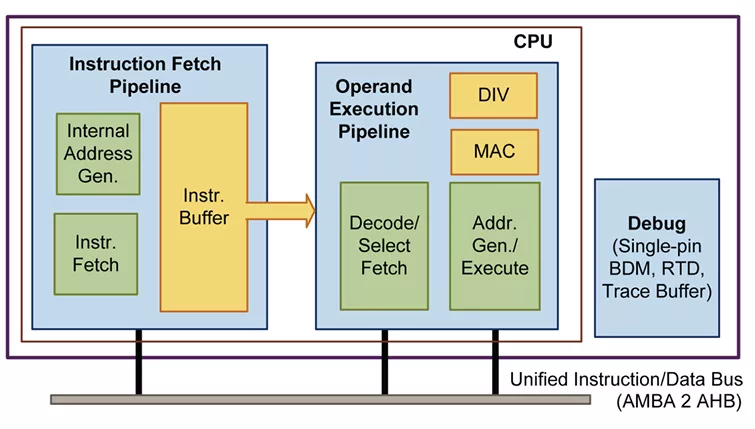
The CFV1CORE provides up to 230 DMIPS of performance at 200 MHz in a typical 90-nm technology. The ColdFire V1 CPU is based on a variable-length RISC architecture that allows instructions to be 16, 32, or 48 bits in length. The result is more efficiently packed code in memory, reducing memory requirements and lowering overall system cost. For DSP operations, the CFV1CORE includes (optional) dedicated hardware multiplier-accumulator (MAC) and divider (DIV) units. Debug support is through a single wire Background Debug Mode (BDM) interface and includes an on-chip trace buffer.

All ColdFire cores (V1, V2, V3, and V4) share the same architecture and instruction set. Upward compatibility from V1 to V2, V3, and ColdFire V4 processors provides a smooth roadmap to higher performance designs.

ColdFire architecture has been deployed in over half a billion production devices making it one of the most widely used embedded microprocessors in the world. With the CFV1CORE, you get production-proven processor IP, plus support from the extensive ecosystem of development tools, operating systems, drivers, and libraries supporting the ColdFire architecture.

Debug Support

 The optional debug unit provides a rich set of debug capabilities:

  •  ColdFire Debug B+ functionality mapped into the single-wire BDM interface
  •  64x6-bit trace buffer provides programmable start/stop recording conditions plus support for continuous or PC profiling modes
  •  Capture of compressed processor status and debug data into trace buffer provides program trace capabilities
  •  Compression of trace data enables capture of 500-1000 cycles of program trace in 64x6-bit trace buffer
  •  Real time debug support, with 6 hardware breakpoints (four  PC, one address, and one data) that can be configured into a 1 or 2-level trigger with a programmable response  (processor halt or interrupt)
  •  Debug resources are accessible through the single-wire BDM interface or the privileged WDEBUG instruction from the ColdFire V1 CPU
  •  Debug unit can use the CPU clock (internally divided by 2) or a separate asynchronous clock
  •  Separate clocks for CPU and debug unit enable shutdown of debug unit when not in use

 Ecosystem

 The entire ColdFire Family, including the ColdFire V1 Core, is supported by world-class development tools suites offered through leading tools developers including, NXP, Green  Hills Software, Wind River Systems and many others. NXP  CodeWarrior development tools offer a simple migration path  from the Freescale HCS08 to the ColdFire V1 architecture.
 

Key features

  •  
  • 32-bit microprocessor core with 24-bit address bus
  • AMBA 2 AHB unified instruction/data bus
  • Single-wire debug interface
  • Variable-length RISC architecture with 16, 32, and 48-bit instructions
  • Independent, decoupled instruction and execution pipelines
  • 2-stage Instruction Fetch Pipeline (IFP)
  • 2-stage Operand Execution Pipeline (OEP)
  • Static branch prediction to minimize change-of-flow execution time
  • Execute engines include ALU, barrel shifter, and optional MAC and DIV units
  • ColdFire Instruction Set Architecture Rev. C (ISA_C)
  • Standard ColdFire programming model with 16 general purpose, 32-bit registers
  • Programmable response upon detection of certain illegal opcodes and illegal addresses (processor exception or system reset)
  • Optional debug support including trace and real-time debug (RTD) through a single-wire BDM interface

Block Diagram

What’s Included?

  • The ColdFire V1 Core is delivered in Verilog source code and includes:
    •  Synthesizable Verilog source code (Source version)
    •  Integration testbench and tests
    •  Documentation
    •  Scripts for simulation and synthesis with commonly-used  EDA tools
  •  The Source version of the CFV1CORE is fully configurable (MAC, DIV, and debug units can be included/excluded through HDL parameter settings).

Specifications

Identity

Part Number
ColdFire V1 Processor
Vendor
Silvaco, Inc.
Type
Silicon IP

Videos

Putting the ColdFire Family to Work for You

Files

Note: some files may require an NDA depending on provider policy.

Provider

HQ: United States

Learn more about CPU IP core

Announcing Arm AGI CPU: The silicon foundation for the agentic AI cloud era

For the first time in our more than 35-year history, Arm is delivering its own silicon products – extending the Arm Neoverse platform beyond IP and Arm Compute Subsystems (CSS) to give customers greater choice in how they deploy Arm compute – from building custom silicon to integrating platform-level solutions or deploying Arm-designed processors.

Encarsia: Evaluating CPU Fuzzers via Automatic Bug Injection

Hardware fuzzing has recently gained momentum with many discovered bugs in open-source RISC-V CPU designs. Comparing the effectiveness of different hardware fuzzers, however, remains a challenge: each fuzzer optimizes for a different metric and is demonstrated on different CPU designs.

Frequently asked questions about CPU IP cores

What is ColdFire V1 core with EMAC, Divider and Cryptograhic unit?

ColdFire V1 core with EMAC, Divider and Cryptograhic unit is a CPU IP core from Silvaco, Inc. listed on Semi IP Hub.

How should engineers evaluate this CPU?

Engineers should review the overview, key features, supported foundries and nodes, maturity, deliverables, and provider information before shortlisting this CPU IP.

Can this semiconductor IP be compared with similar products?

Yes. Buyers can compare this product with similar semiconductor IP cores or IP families based on category, provider, process options, and structured technical specifications.

×
Semiconductor IP