Concealable physical unclonable functions using vertical NAND flash memory
By Sung-Ho Park 1, Ryun-Han Koo 1, Yeongheon Yang 2, Jiseong Im 1, Jonghyun Ko 1 & Jong-Ho Lee 1
1 Department of Electrical and Computer Engineering and Inter-university Semiconductor Research Center, Seoul National University, Seoul, Republic of Korea.
2 Research and Development Division, SK hynix Inc., Icheon, Republic of Korea.
Abstract
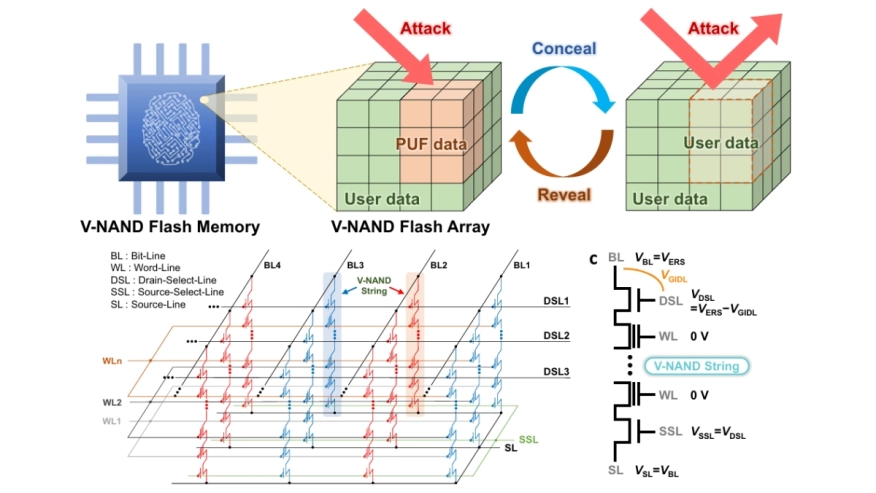
Physical Unclonable Functions (PUFs) can address the demand for enhanced hardware security. Vertical NAND (V-NAND) flash memory is the most commercialized non-volatile memory. However, it has been optimized to reduce cell-to-cell variation for stable data storage, which presents challenges for its application as a PUF, as PUFs inherently rely on such variations. Here, we propose a concealable PUF using V-NAND flash memory by generating PUF data through weak Gate-Induced-Drain-Leakage (GIDL) erase. The differences in doping depth among V-NAND strings arising from the fabrication cause variations in GIDL erase performance. The resulting V-NAND PUF demonstrated ideal security characteristics while maintaining 100% accuracy under variations in read count and temperature. Concealment is achieved by overwriting the PUF data with other data, and perfect conceal-reveal characteristics are maintained over 102 cycles. Concealable V-NAND PUF not only prevents attacks when the PUF is not in use but also allows the memory to be utilized as storage.
To read the full article, click here
Related Semiconductor IP
- PUF Security
- PUF IP
- Digital PUF IP
- PUF FPGA-Xilinx Premium with key wrap
- ASIL-B Ready PUF Hardware Premium with key wrap and certification support
Related Articles
- NAND Flash memory in embedded systems
- NOR continues to battle NAND flash memory in the handset
- Insights using NAND flash in portable designs
- Use NAND Flash for cost, density and performance advantages for mobile handsets
Latest Articles
- Terracotta: Enabling the Adoption of New DRAM Techniques via a Flexible DRAM Interface and Memory Controller
- A Framework for Accelerating Transformer Inference on RISC-V for Edge AI
- An Interleaved Parallel Dependent Quantization Hardware Architecture for H.266/VVC
- A Formal Security Analysis of CAN XL
- A Secure dToF LiDAR SoC with Dual-Domain Fingerprinting and Event-Driven AFE Circuit Achieving Sensor-Level Attack Resilience