Floadia Releases Automotive Embedded Flash IP on TSMC 180BCD Gen3 Platform
Embedded Flash IP “G1” Now Available on TSMC’s Automotive Platform AEC-Q100 Grade 1 Qualified
TOKYO, June 18, 2026 -- Floadia Corporation (hereinafter “Floadia”), a Tokyo, Japan-based developer of embedded flash IP (eFlash IP), has announced the release of its latest automotive eFlash IP, G1, implemented on TSMC’s 180BCD Gen3 process platform. The newly released IP is designed to meet the stringent reliability and performance requirements of next-generation automotive applications.
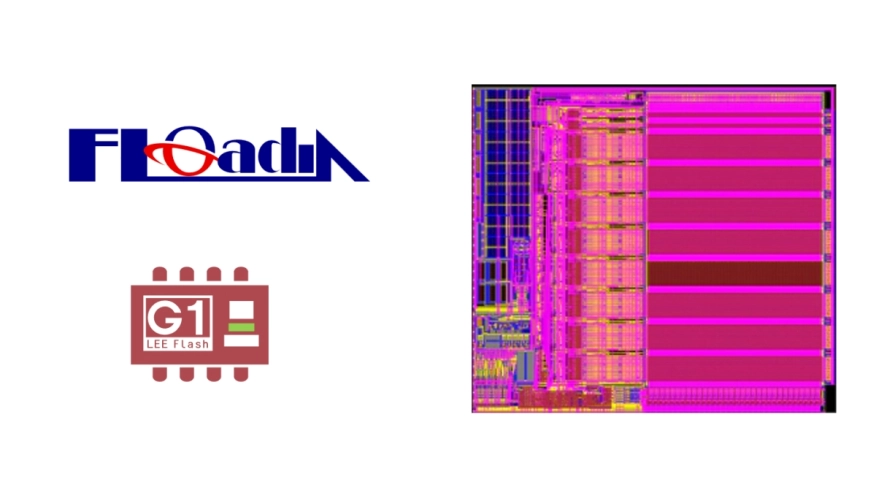 The G1 automotive eFlash IP integrates a 256KB program flash macro and a 1KB data flash macro based on SONOS technology, offering a highly reliable and cost-effective non-volatile memory solution for automotive ICs. The G1 eFlash process is added on top of TSMC’s standard 180BCD Gen3 platform without any modification to the original PDK, allowing customers to use the same qualified PDK while seamlessly integrating embedded flash into their designs. The IP has successfully passed AEC-Q100 Grade 1 full qualification on TSMC 180BCD Gen3, confirming its robustness under harsh automotive operating conditions and readiness for production.
The eFlash IP consists of:
- 256KB program flash (PFlash) for code storage
- 1KB data flash (DFlash) with 100K program/erase endurance, enabling EEPROM-like functionality for data storage
Both PFlash and DFlash are optimized for fast operation, achieving a maximum erase time of less than 20ms, which significantly improves system performance and reduces firmware update time in automotive systems.
To simplify system integration, the G1 eFlash IP includes an internal charge pump, eliminating the need for external high-voltage circuitry. In addition, both PFlash and DFlash provide an 8 parity-bit code for ECC interface, ensuring high data integrity and reliability throughout the device lifetime.
With its proven SONOS-based architecture, fast erase performance, and full automotive qualification, Floadia’s G1 eFlash IP on TSMC 180BCD Gen3 is well suited for a wide range of automotive applications, including power management ICs, motor drivers, body electronics, and other automotive systems.
Explore Floadia IP:
- Flash Beyond Flash IP
- Low Cost SONOS FLASH IP
- Zero Additional Mask Anti-fuse OTP
- Zero Additional Mask MTP
About Floadia Corporation:
Floadia Corporation was founded in 2011 by a team of seasoned engineers with over 20 years of experience in developing embedded non-volatile memory technologies at Hitachi, Ltd. and Renesas Technology (now Renesas Electronics Corporation). Floadia specializes in licensing proprietary process technologies and circuit designs for embedded non-volatile memory used in microcontrollers, power semiconductors, sensors, and other semiconductor devices. These technologies are provided to semiconductor manufacturers worldwide as high-value intellectual property (IP).
Related Semiconductor IP
- Flash Beyond Flash IP
- Low Cost SONOS FLASH IP
- Zero Additional Mask Anti-fuse OTP
- Zero Additional Mask MTP
Related News
- Floadia Releases High-Performance Automotive Embedded Flash IP on Leading Foundry’s 90BCD Platform
- Embedded Flash memory developer Floadia has raised 1.05 billion yen from INABATA and others
- TOSHIBA announced a Microcontroller employing Floadia's SONOS type Flash Memory IP "G1"
- Floadia Announces eNVM of 150 degree C retention on HHGrace 180BCD
Latest News
- GF unveils roadmap to deliver the world’s most advanced FD-SOI platform for Physical AI
- GlobalFoundries marks Dresden expansion milestone, announces next-generation platform for Physical AI
- TSMC September 2026 Revenue Report
- Lattice Collaborates with Arm to Advance Secure, Adaptable AI Data Center Infrastructure
- ZLG Selects CAST CAN XL and TSN IP for Next-Generation Vehicle-Network Development and Test Tools