Floadia Releases High-Performance Automotive Embedded Flash IP on Leading Foundry’s 90BCD Platform
Tokyo, Japan – July 1, 2026 – Floadia Corporation (hereinafter "Floadia"), a leading developer of embedded flash IP (eFlash IP) based in Tokyo, Japan, today announced the release of its latest automotive eFlash IP, G1, implemented on a leading foundry’s advanced 90BCD process platform. Engineered for next-generation automotive electronics, this new solution delivers exceptional area efficiency, high reliability, and unparalleled operational flexibility for automotive integrated circuits (ICs).
Highly Competitive Sizing and Scalable Lineup
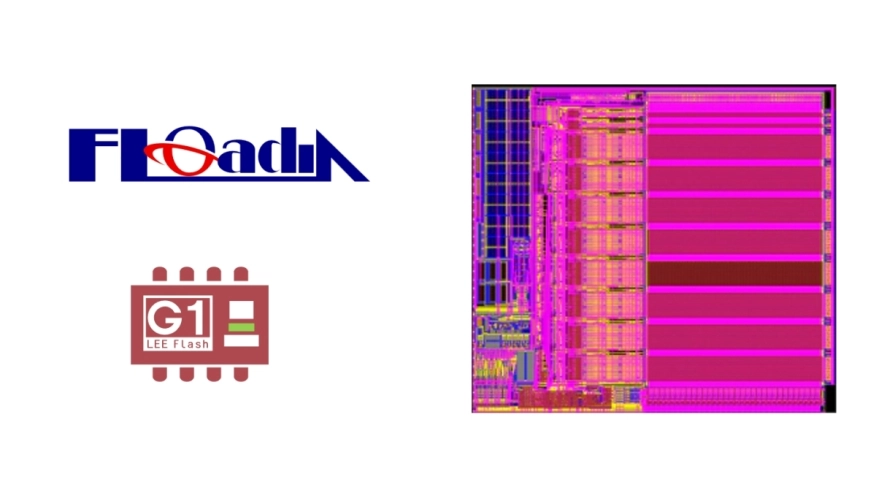 The flagship 256KByte G1 eFlash IP macro has successfully achieved full AEC-Q100 Grade 1 qualification, proving its robustness and readiness for mass production under harsh automotive operating conditions. Leveraging Floadia’s optimized architecture, the qualified 256KByte G1 eFlash IP boasts a highly competitive cell and macro size, allowing semiconductor manufacturers to maximize wafer yield and reduce die costs. To support diverse customer design-ins, Floadia offers a versatile, ready-to-integrate macro lineup spanning capacities from 32KByte up to 256KByte.
Advanced Concurrent Operation: Dual-Function eFlash + EEPROM
A key innovation of the 90BCD platform is the integration of unified eFlash and EEPROM functionality within a single IP. This architecture supports fully concurrent operations and Read-While-Write (RWW) capability, allowing the host system to seamlessly read data from one section of the memory while an erase or program operation is actively running in another area. Optimized for high-frequency data logging, the EEPROM portion supports 100,000 Program/Erase cycles alongside a robust data retention capability of 10 years at 125°C.
Seamless Integration with Zero PDK Modification
The G1 eFlash IP process is based on Floadia’s proprietary SONOS-based process and is added on top of the foundry’s standard 90BCD platform by adding just three additional masks. Because it requires absolutely no modifications to the original PDK, customers can confidently utilize the existing PDK while seamlessly integrating the G1 eFlash IP into their designs.
With its compact footprint and advanced concurrent read/write features, Floadia’s 90BCD automotive G1 eFlash IP is perfectly suited for sophisticated automotive power management ICs (PMICs), motor drivers, body electronics, and smart sensors.
Explore Floadia IP:
- Flash Beyond Flash IP
- Low Cost SONOS FLASH IP
- Zero Additional Mask Anti-fuse OTP
- Zero Additional Mask MTP
About Floadia Corporation
Floadia Corporation was founded in 2011 by a team of seasoned engineers with over 20 years of experience in developing embedded non-volatile memory technologies at Hitachi, Ltd. and Renesas Technology (now Renesas Electronics Corporation). Floadia specializes in licensing proprietary process technologies and circuit designs for embedded non-volatile memory used in microcontrollers, power semiconductors, sensors, and other semiconductor devices. These technologies are provided to semiconductor manufacturers worldwide as high-value intellectual property (IP).
Related Semiconductor IP
- Flash Beyond Flash IP
- Low Cost SONOS FLASH IP
- Zero Additional Mask Anti-fuse OTP
- Zero Additional Mask MTP
Related News
- Floadia Releases Automotive Embedded Flash IP on TSMC 180BCD Gen3 Platform
- Embedded Flash memory developer Floadia has raised 1.05 billion yen from INABATA and others
- TOSHIBA announced a Microcontroller employing Floadia's SONOS type Flash Memory IP "G1"
- GlobalFoundries and Microchip Announce Microchip's 28nm SuperFlash® Embedded Flash Memory Solution in Production
Latest News
- GF unveils roadmap to deliver the world’s most advanced FD-SOI platform for Physical AI
- GlobalFoundries marks Dresden expansion milestone, announces next-generation platform for Physical AI
- TSMC September 2026 Revenue Report
- Lattice Collaborates with Arm to Advance Secure, Adaptable AI Data Center Infrastructure
- ZLG Selects CAST CAN XL and TSN IP for Next-Generation Vehicle-Network Development and Test Tools