AI Accelerator Spec Maintains Rapid Update Pace
As the AI accelerator “arms race” continues unabated, UALink is likely to continue to get annual updates.
By Gary Hilson, EE Times | May 4, 2026
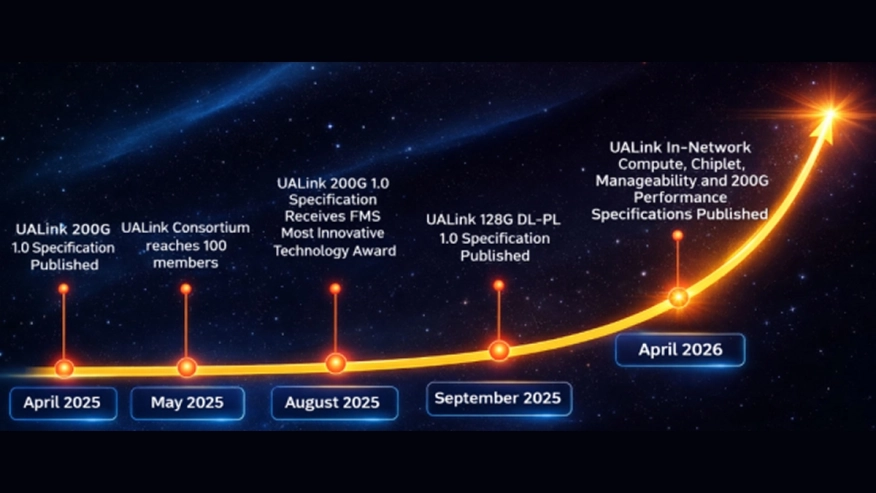
It makes sense that the standard governing AI accelerators should release an update less than a year after its first iteration.
Ultra Accelerator Link (UALink) 1.0 was released in April 2025, and the UALink consortium just released a major update to the specification that addresses in-network compute, chiplet definition, and manageability. These additions will support the deployment of UALink solutions in multi-workload environments and help improve UALink technology efficiency, performance for AI workloads, and ease of implementation.
In a briefing with EE Times, Kurtis Bowman, UALink consortium board chair, said the evolution of UALink reflects the rapid growth of accelerators in data centers, where memory bandwidth is critical to performance.
To read the full article, click here
Related Semiconductor IP
- UALink PHY + Controller
- Simulation VIP for UALink
- UALink Subsystem
- UALink 200G v1.0 Verification IP
- UALink Controller
Related News
- Synopsys Announces Industry's First Ultra Ethernet and UALink IP Solutions to Connect Massive AI Accelerator Clusters
- Ultra Accelerator Link Consortium (UALink) Welcomes Alibaba, Apple and Synopsys to Board of Directors
- First Benchmarks Revealed for Jalapeño, OpenAI’s Clean-Sheet General Purpose AI Accelerator ASIC
- SEMIFIVE Commences Mass Production of HyperAccel’s LLM AI Inference Accelerator ‘Bertha’ on Samsung 4nm, Spurring Growth Momentum
Latest News
- Weebit Nano Q1 FY27 Activities Update
- INTERA Launches EAGLE Cognit, Bringing Ultra-Low-Power Near-Memory AI Acceleration to Next-Generation Edge Devices
- AeroTSN-EP in Action: SOC-E Brings Live Aerospace TSN Demonstration to A&D TSN Summit 2026
- Agnisys and Axiomise Collaborate to Accelerate NoC Design and Formal Sign-off
- TSMC Reports Third Quarter EPS of NT$29.43