Why Physical AI Needs a New Generation of Embedded Memory

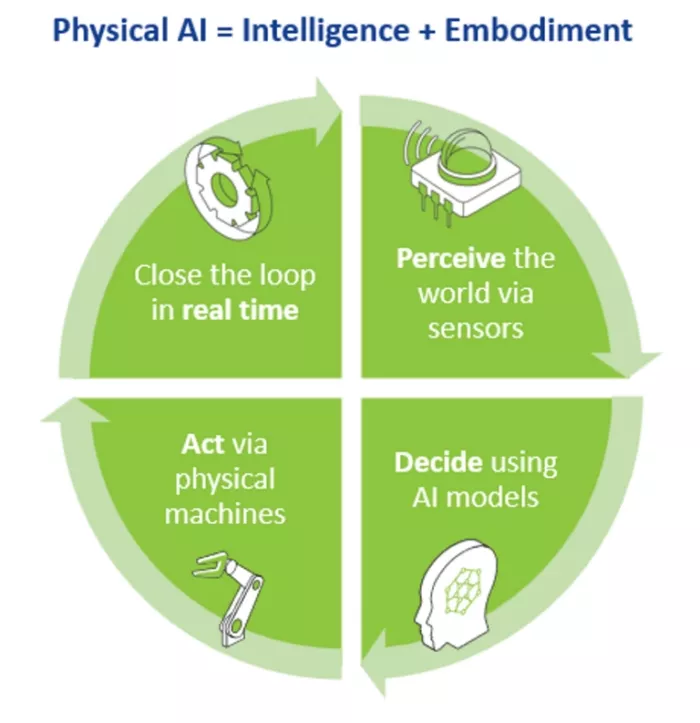
Artificial intelligence is moving beyond chatbots and data analytics into the physical world. A new generation of systems, often referred to as ‘physical AI,’ combines AI-driven decision making with real-world sensing and actuation. Robots, autonomous mobile systems, industrial automation equipment, drones, and intelligent vehicles must continuously perceive their environment, make decisions, and execute physical actions in real time.

Above: Physical AI systems were on display at the recent COMPUTEX 2026 in Taipei
Unlike the traditional AI agents and systems we interact with digitally, physical AI systems interact with and adapt to the physical world. This introduces new challenges for semiconductor designers and creates growing demand for memory technologies that can support continuous sensing, local intelligence, low-power operation, and real-time responsiveness.
Continuous Awareness Requires Smarter Electronics
Physical AI systems must maintain continuous spatial awareness while coordinating precise motor movements. To achieve this, intelligence is increasingly being distributed throughout the system rather than concentrated in a central processor.
AI inference is increasingly moving closer to where data is generated and decisions are made. Rather than relying exclusively on cloud-based processing, physical AI systems are deploying AI capabilities throughout the device, from dedicated AI accelerators and advanced SoCs to intelligent subsystems optimized for specific functions. These distributed AI workloads require fast, efficient access to models, firmware, and data while operating within strict power, latency, and cost constraints. As a result, intelligence is being embedded across a growing range of system components, from motor control and power management to sensing and battery management.
Motor controllers are becoming smarter, running increasingly sophisticated algorithms to improve precision, efficiency, and responsiveness. Power management ICs (PMICs) are evolving beyond basic power regulation to support intelligent sensing and system optimization. Sensors are becoming more capable as well, storing AI models, configuration data, calibration information, and operational parameters locally to reduce latency and improve system performance.
In addition, many physical AI applications require persistent data logging to support diagnostics, predictive maintenance, safety analysis, and continuous system improvement. Historical operating data can help identify developing faults, improve reliability, and optimize performance over time.
Battery management is also becoming more intelligent. Rather than simply monitoring charge levels, next-generation battery management systems continuously collect data, model battery behavior, and optimize operation in real time to maximize performance, efficiency, and lifetime.
Why Memory Matters
Many of these capabilities depend on fast, reliable access to non-volatile memory (NVM).
AI models, firmware, calibration information, operating parameters, event logs, and sensor data must often be stored locally and remain available even when power is removed. In many applications, systems must start instantly and operate within tight power budgets while maintaining high reliability.
Traditional embedded memory technologies were not designed with these emerging physical AI requirements in mind. In addition, traditional embedded NVM options face scaling, power and cost limitations. As AI functionality expands throughout a system, NVM must provide greater density, lower power consumption, faster access, and the ability to integrate efficiently alongside advanced logic and analog circuitry.
Explore Weebit IP:
ReRAM Aligns with the Needs of Physical AI
Emerging non-volatile memory technologies, and in particular ReRAM (RRAM), are well suited to address the demands of physical AI.
Because ReRAM can be integrated directly into system on chip (SoC) designs, even at small geometries, it enables compact architectures that reduce the need for external memory devices. Its low-power operation supports energy-constrained applications, while its high density allows more firmware, data, and AI models to be stored on-chip. Fast access times help support responsive operation, and its scalability makes it attractive for future generations of AI-enabled devices.
These characteristics are driving adoption across a growing range of applications, including motor control, power management, intelligent sensing, battery management, industrial automation, automotive systems, and other emerging physical AI platforms.
The Road Ahead
As AI becomes increasingly physical, memory is evolving from a supporting component into a key system enabler. The ability to store, access, and manage information efficiently at the edge will play an increasingly important role in determining the performance, power consumption, cost, and intelligence of future systems.
Looking further ahead, Weebit ReRAM may play an even more active role in physical AI systems. Emerging approaches such as in-memory computing (IMC) seek to perform certain AI operations directly within memory arrays, reducing the need to move data between memory and compute. For applications where power efficiency and real-time responsiveness are critical, such memory-centric architectures could become an important complement to conventional AI processing approaches.
For semiconductor designers building the next generation of physical AI applications, memory may no longer be viewed solely as storage, but as a fundamental component of future AI architectures.
Related Semiconductor IP
- ReRAM NVM in DB HiTek 130nm BCD
- ReRAM NVM in SkyWater 130nm
- ReRAM as FTP/OTP Memory
- ReRAM Secure Keys
Related Blogs
- Pushing the Boundaries of Memory: What’s New with Weebit and AI
- From GPUs to Memory Pools: Why AI Needs Compute Express Link (CXL)
- Physical AI at the Edge: A New Chapter in Device Intelligence
- The Rise of Physical AI and Robotics: Why Hardware-Based Security is Non-Negotiable
Latest Blogs
- Tape-Out Readiness Checklist: Engineering Decisions That Prevent Costly Respins
- How Cadence DSPs Put In-Cabin AI Audio On-Chip in SemiDrive's X10
- The Fastest Path to Scalable Photonic Systems: Using Proven IP for both PIC and EIC designs
- Building Trusted AI Agents from the Silicon Root of Trust
- Heterogeneous Computing in Space