The Century War: AC vs. DC Has Returned to the Battlefield

Over a century ago, the war between two power systems, alternating current (AC) vs. direct current (DC), had led us to a new era. Today, after 138 years, a new AC vs. DC century war has returned to the battlefield: analogue computation vs. digital computation. This war will lead us to a new AI/AGI generation and reveals a revolution for whole semiconductor market.
Digital computation has advantages on area and anti-noise comparing with traditional analogue computation. With those advantages, digital computation occupied semiconductor markets for decades. However, for AI applications requires “real-time-response”, such as automotive or aerospace, very high computation capability is necessary if adopting digital computation system. To meet the enormous demands, the system has built with more complex hardware and consume more power to support the needs.
To achieve the “real-time-response” requirement, analogue computation system is the only solution for next generation AI applications. The key to achieve analogue computation is in memory computation (IMC) a main technique of neural network architecture. To realize the idea, analogue memory is an indispensable piece. There are bunch of solutions for the analogue memory by material, such as MRAM, or by algorithm, such vector matrix multiplication. However, those solutions are not easy to port/implement from a process platform to another and result to a costive solution.
An Analogue OTP Memory is Realized by AGIC Unique “Wave-Particle Separation” Technology
AGIC team developed a unique “wave-particle separation” technology which achieve the AGIC Particle Momentum (APM). Figure 1. shows the APM results of the atom distribution on a common semiconductor material which exists in original foundry process. According to APM technology, the “atom” can be moved and changed its distribution. Hence, the resistance can be changed on a semiconductor material which can simulate the “weight” in biomedical neural network system.
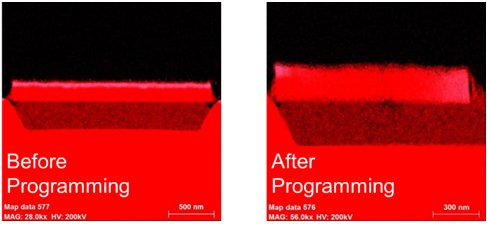
Figure 1. EDX result of atom distribution before and after APM.
AGIC Technology C-Fuse OTP provides following benefits:
- High-Temp Immunity (>400°C~1000°C)
- Portable across all process nodes including CMOS Logic, BCD, eHV, DRAM, and etc.
- No additional masks
- No additional steps
- No special/material requested
- Support geometry from 350 nm to 5 nm and beyond
- Qualification for AEQ-100 Grade 0 requirements
- MLC feature for high security requirement
Welcome to visit our website and contact with us for more detail presentation and discussion.
Artificial General Intelligence Cosmos IP total solution.
AGICIP (www.agicip.com)
Please contact us: Sales@agicip.com
Related Semiconductor IP
- nQrux® Root of Trust IP
- AXI to UCIe Bridge IP
- UCIe 2.x Controller IP
- SWI3S (SoundWire I3S Interface) Peripheral Controller Core IP
- OpenTitan-based RISC-V Secure Element
Related Blogs
- Evolution of AMBA AXI Protocol: An Introduction to the Issue L Update
- FPGAs vs. eFPGAs: Understanding the Key Differences
- LPDDR6 vs. LPDDR5 and LPDDR5X: What’s the Difference?
- The On-Device LLM Revolution: Why 3B-30B Models Are Moving to the Edge
Latest Blogs
- From Bug Hunting to Engineering Methodology: Lessons from AI-Driven Development
- Manufacturing Intelligence: Turning EDA Data into Trusted Action
- Execute-in-Place: Getting More from Embedded NVM
- Rethinking RTL flows with AI-driven hybrid formal verification
- Arm and NVIDIA: Building the trusted compute foundation for the agentic AI era