Empowering next-generation automotive edge computing with DFA IP

Deterministic floating-point acceleration for signal processing, control, and embedded AI in automotive MCUs and SoCs
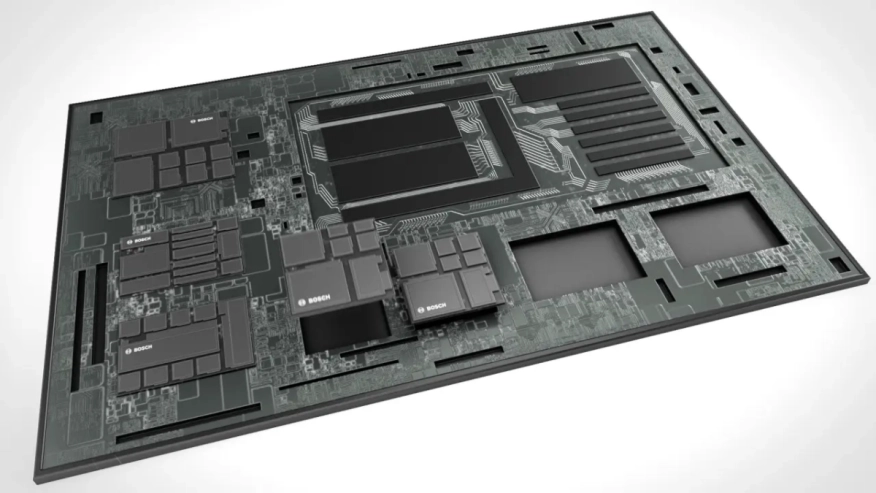 Automotive electronics are managing increasingly complex signal-processing, control, and AI workloads. These demands are moving beyond central vehicle computers into distributed electronic control units (ECUs), where compute capacity, power budgets, and predictable response times must be balanced. For time-critical functions, local data processing can reduce reliance on transfers to central systems. But adding compute performance alone is not enough: System designers also need predictable execution and efficient use of limited resources.
Introducing Bosch’s Data Flow Architecture
Data Flow Architecture (DFA) is a configurable hardware accelerator IP designed to offload compute-intensive floating-point workloads from a host CPU. It targets deterministic real-time signal processing, control algorithms, and embedded AI inference within automotive MCU and SoC platforms. DFA organizes computation as a data-flow graph. Operations become eligible to execute when their required input data is available. This allows independent processing paths to progress without relying on a single sequential instruction stream.
"With DFA, we bring deterministic high-performance computing closer to automotive edge applications. By offloading demanding signal-processing, control, and floating-point AI workloads, our customers can design more responsive and efficient embedded systems." Manish Taparia, Product Manager DFA Embedded Compute Platform
Key benefits
- Predictable accelerator execution: data-driven processing supports time-critical workloads; end-to-end timing also depends on memory, interconnection, and system integration.
- CPU offloading: reserves host CPU capacity for application logic, communications, and platform software.
- Scalable performance: configurable DFA architecture enables compute resources to be tailored to workload complexity, concurrency, and system requirements.
- Floating-point compute: supports numerical workloads across signal processing, control, and AI; supported precisions depend on the selected IP configuration.
- Configurable integration: adaptable hardware architecture for different MCU/SoC requirements.
- Automotive safety integration: designed with functional safety requirements in mind; final ASIL capability depends on the selected implementation and system safety case.
What makes DFA different: data-driven execution for deterministic performance
Bosch’s DFA introduces a different approach to parallel computation. While traditional CPUs and programmable SIMD architectures rely on scheduled instruction streams, DFA organizes computation as a data-flow graph of interconnected processing blocks. Each block executes when its required input data becomes available, allowing independent operations to progress concurrently.
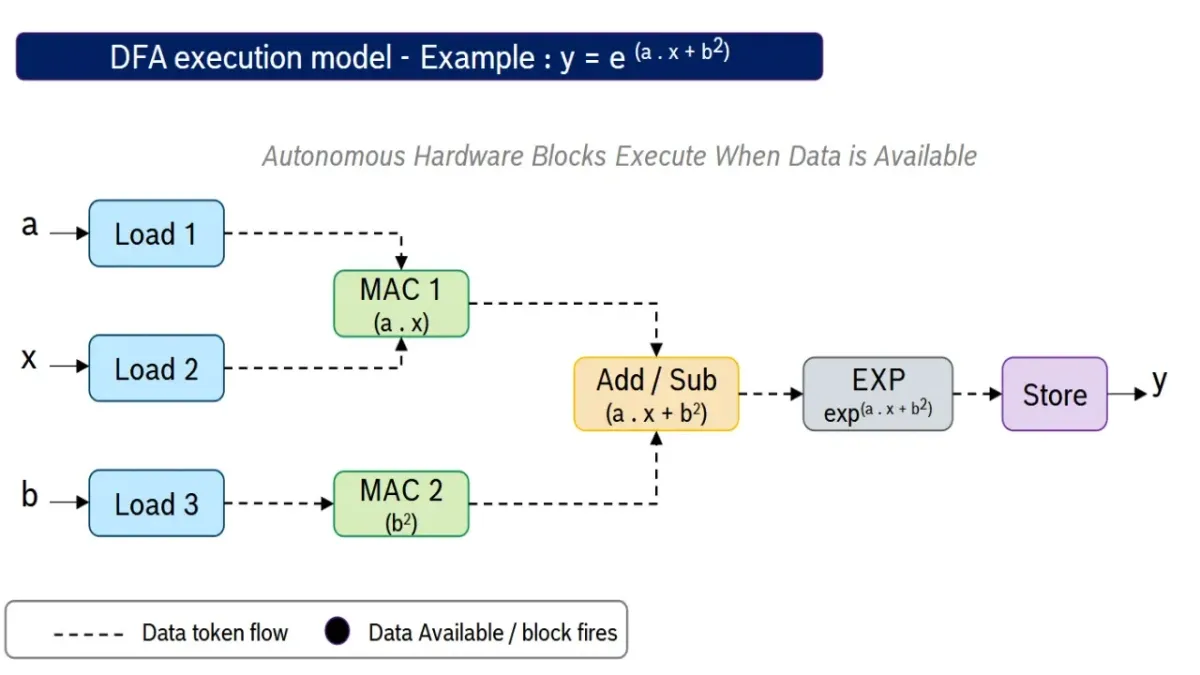
This data-driven execution model enables predictable accelerator execution, efficient parallelism, and low-latency processing. By efficiently accessing external memory, DFA can operate with a smaller internal memory footprint. Together with the configurable processing resources, this enables scalable performance and positions DFA as a compelling alternative to programmable SIMD accelerators for real-time control, signal processing, and floating-point AI workloads.
Algorithms and automotive applications
Representative algorithm families include FFT, FIR/IIR filters, matrix operations, and numerical solvers, as well as supported MLP, CNN, RNN, and classical machine-learning kernels. Actual suitability and performance depend on the workload and configuration.
- Powertrain and electrification
Field-oriented motor control, inverter control, estimation, and digital power algorithms - Vehicle dynamics and chassis
Actuator control, filtering, observers, and real-time coordination - Sensor processing and fusion
FFT, FIR/IIR filtering, feature processing, and numerical estimation - Embedded intelligence
Floating-point neural network inference and hybrid pipelines combining AI, signal processing, and control - Diagnostics and monitoring
Model-based monitoring, signal analysis, and estimation workloads
An ecosystem built for adoption
Bosch’s DFA is supported by tooling and integration of assets that help teams move from algorithm development to evaluation and MCU/SoC integration. These include code-generation workflows, driver support, simulation and virtual-platform resources, as well as engineering support for workload mapping and optimization. Availability and maturity vary by component and release.
DFA follows a scalable architecture approach designed to address different floating-point performance requirements. This allows semiconductor partners to align accelerator capacity with target workloads, latency requirements, power and area budgets, and the degree of function consolidation. The architecture is not tied to specific applications: The same algorithm may be supported at different performance levels depending on system requirements.
Explore Bosch IP:
- Data Flow Architecture IP
- Protocol controller IP for Classical CAN / CAN FD / CAN FD light commander and CAN XL
- Protocol controller IP for Classical CAN / CAN FD / CAN XL
- DMA Unit
From powertrain and chassis toward ADAS and radar
Today, DFA addresses deterministic signal-processing and control workloads in powertrain, electrification, and chassis systems. As the architecture scales to higher compute performance, it creates a path toward more demanding and consolidated workloads, including future ADAS and radar applications. Instead of assigning a fixed automotive domain to each DFA configuration, the expansion is driven by system-level compute needs.
Automotive MCU and SoC developers benefit from a common architectural foundation that can scale across different performance requirements, supported by a reusable software and development ecosystem. This enables a consistent integration approach and offers flexibility to address evolving automotive computing needs.
Related Semiconductor IP
- Data Flow Architecture IP
- Protocol controller IP for Classical CAN / CAN FD / CAN FD light commander and CAN XL
- Protocol controller IP for Classical CAN / CAN FD / CAN XL
- DMA Unit
- Protocol controller IP for a CAN FD light responder node
Related Blogs
- Architecture for Machine Learning Applications at the Edge
- Arm GPUs built on new 5th Generation GPU architecture to redefine visual computing
- Designing Energy-Efficient AI Accelerators for Data Centers and the Intelligent Edge
- Calligo Enables Next-Gen Computing at Scale with Synopsys Digital Design Flow