
What is Video Timing Generator?
Video Timing Generator is a Video Processing IP core from Zipcores Electronic Systems Engineering S.L. listed on Semi IP Hub.
The VID_TIMING_GEN IP Core is a fully configurable video timing generator with the ability to support any video resolution up to …
The VID_TIMING_GEN IP Core is a fully configurable video timing generator with the ability to support any video resolution up to 216 x 216 pixels in size. The module is compatible with a wide range of video DACs, encoders and transmitters and provides a flexible solution for displaying digital or analogue video on an external TV, monitor or flat panel display. The module is capable of clock speeds in excess of 400 MHz on some FPGA platforms, making it ideal for the latest generation HD and UHD video solutions.
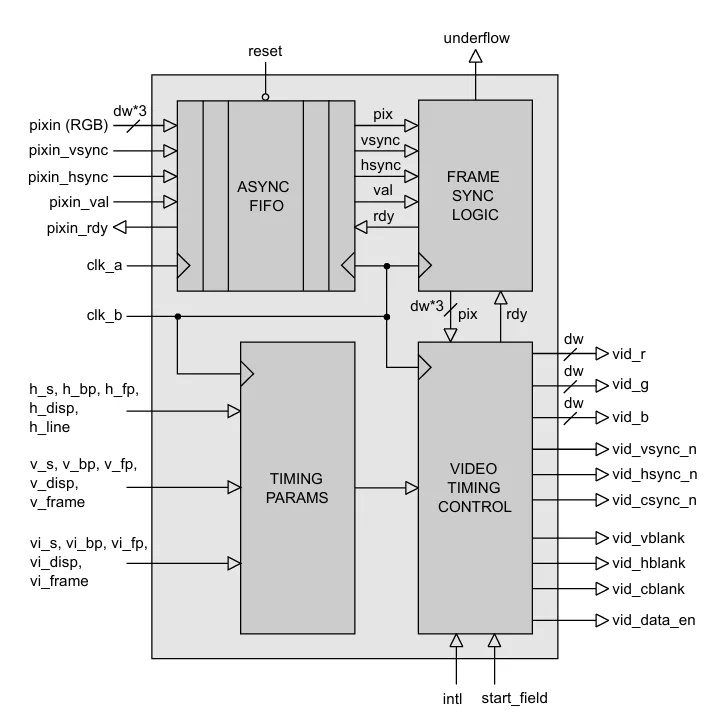
Input pixels and syncs are read on the rising edge of clk_a (the system clock) when pixin_val and pixin_rdy are both active high. The input signal pixin_vsync is coincident with the first active pixel in a frame and the signal pixin_hsync is coincident with the first active pixel in a line. (Note that these sync signals should not be confused with true video timing signals. Their purpose is to delineate the first pixel in a frame and the first pixel in a line only).
After resynchronizing the input pixels to the pixel-clock domain (clk_b), the controller locks to the first frame (or field) of video. Once frame-lock is achieved, pixels are supplied on demand to the video timing control unit. This module generates the correct RGB video, sync and blanking information depending on the chosen timing parameters.
Note: some files may require an NDA depending on provider policy.
Video Timing Generator is a Video Processing IP core from Zipcores Electronic Systems Engineering S.L. listed on Semi IP Hub.
Engineers should review the overview, key features, supported foundries and nodes, maturity, deliverables, and provider information before shortlisting this Video Processing IP.
Yes. Buyers can compare this product with similar semiconductor IP cores or IP families based on category, provider, process options, and structured technical specifications.