Vendor:
Truechip Solutions
Category:
USB
USB OTG 2.0 with xHCI Verification IP
Fully compliant with OTG Supplement to USB2.0 specification
Overview
Truechip's USB OTG 2.0 Verification IP provides an effective & efficient way to verify the components supporting USB2 Revision 2.0 Specification. Truechip's USB OTG 2.0 is a Dual-Role Device controller, which supports both device and host functions and is fully compliant with OTG Supplement to USB2.0 specification, and supports high-speed (480Mbps), full-speed (12Mbps), low-speed (1.5Mbps) transfer. This VIP is a lightweight with an easy plug-and-play interface, so that there is no hit on the design cycle time.
Key features
- Operates in High-Speed and Full-Speed mode
- Support 9 channels in host mode
- 9 Device mode endpoints in addition to control endpoint 0, 4 in, 3 out and 2 IN/OUT
- Built-in one 1024x35 bits FIFO
- Internal DMA with scatter/gather function
- Supports packet-based, dynamic FIFO memory allocation for endpoints for flexible, efficient use of RAM
- Support dynamic FIFO sizing
- Supports all USB2 transfer types; Control, Bulk, Interrupt, Isochronous.
- Supports High Bandwidth ISO and Interrupt transfers.
- Supports automatic ping capability
- Supports Session Request Protocol (SRP) and Host Negotiation Protocol (HNP)
- Supports suspend, resume, and remote wake
- Configurable Utmi+ Interface width 8 and 16 bits.
- Supports Randomization for packet fields and data payload with or without error injection.
- Comprehensive Compliance Test Suite for verification.
- Supports all types of error injection (control transfer error injection(Request error), PID, CRC, Interpacket Delay, Sync, EOP, Bitstuff etc.) and detection.
- Supports detailed activity log file for individual layers for ease of Debugging.
- Supports dynamically configurable modes.
- Strong Protocol Monitor with real time exhaustive programmable checks.
- Supports to configure Protocol Timers and intentional error masking.
- On the fly protocol checking using protocol check functions, assertion checks for UTMI and ULPI Interface.
- Built in Coverage analysis.
- Provides a comprehensive user API (callbacks) in Host & Device.
- Graphical analyser to show transactions for easy debugging.
Block Diagram
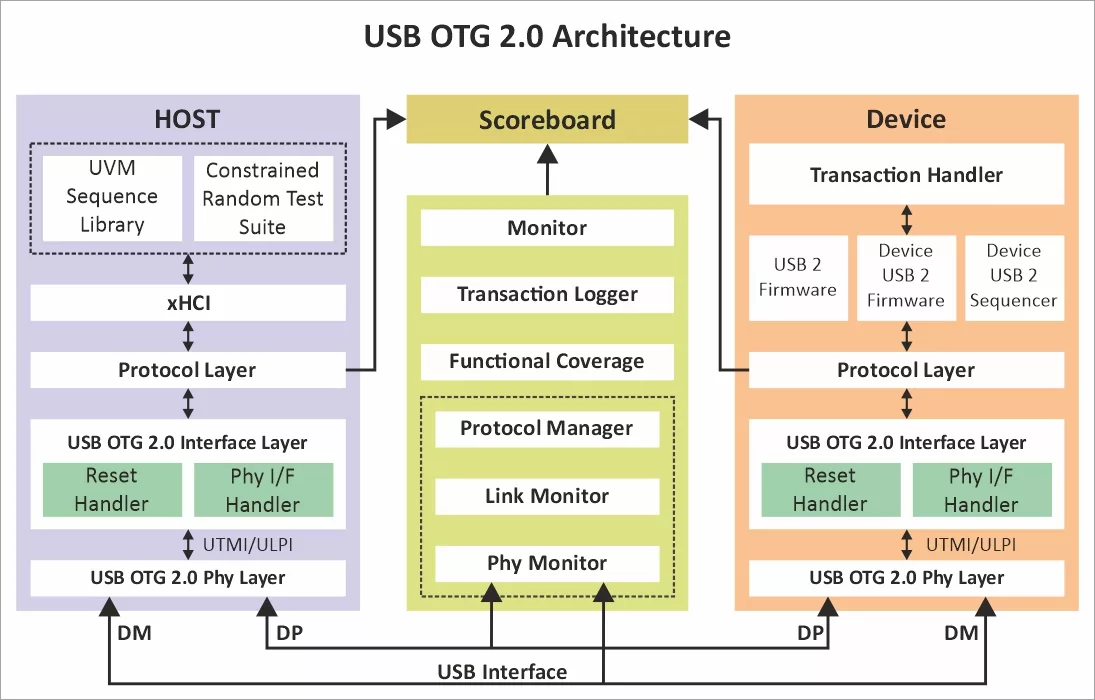
Click to open fullscreen
Benefits
- Available in native SystemVerilog (UVM/OVM/VMM) and Verilog
- Unique development methodology to ensure highest levels of quality
- 24X5 customer support & response under 90 Min.
- Unique and customizable licensing models.
- Exhaustive set of assertions and cover points with connectivity example for all the components.
- Consistency of interface, installation, operation and documentation across all our VIPs
- Provide complete solution and easy integration in IP and SoC environment.
What’s Included?
- USB2.0 HOST/DEVICE BFMs
- USB 2.0 Bus Monitor, Protocol Monitor and Scoreboard.
- BFM Agents for :
- Protocol Layer
- OTG Compliant PHY Layer
- Compliance Test Suite (CTS)
- Stress test for each standard layer
- xHCI VIP compatible with Revision 1.2
- Integration Guide, User Manual and Release Notes
- GUI analyser to view simulation packet flow
Specifications
Identity
Part Number
USB2 OTG
Vendor
Truechip Solutions
Type
Verification IP
Files
Note: some files may require an NDA depending on provider policy.
Provider

HQ:
USA
Learn more about USB IP core
Why eMMC is still a good low-budget storage option?
Revolutionizing Electronic Circuit Testing and Debugging Using JTAG
Is DisplayPort really the future standard?
Truechip Announces First Customer Shipment Of USB4v2 Verification IP
Truechip, today announced that it has shipped early adoption version of USB4v2 Verification IP.
Truechip: Exhibiting and Showcasing Latest Verification IPs and NOC IPs at Design Automation Conference (DAC) 2023
Truechip is exhibiting and showcasing its capabilities at the 60th Design Automation Conference (DAC) 2023, starting from July 9–13, 2023, at Moscone Center West in San Francisco, CA at booth # 2544, Level-II.
Frequently asked questions about USB IP cores
What is USB OTG 2.0 with xHCI Verification IP?
USB OTG 2.0 with xHCI Verification IP is a USB IP core from Truechip Solutions listed on Semi IP Hub.
How should engineers evaluate this USB?
Engineers should review the overview, key features, supported foundries and nodes, maturity, deliverables, and provider information before shortlisting this USB IP.
Can this semiconductor IP be compared with similar products?
Yes. Buyers can compare this product with similar semiconductor IP cores or IP families based on category, provider, process options, and structured technical specifications.