Vendor: SmartDV Category: USB

USB 1.0/1.1/2.0 Verification IP

USB 1.0/1.1/2.0 Verification IP provides an smart way to verify the USB 1.0/1.1/2.0 component of a SOC or a ASIC.

Verification IP View all specifications

Overview

USB 1.0/1.1/2.0 Verification IP provides an smart way to verify the USB 1.0/1.1/2.0 component of a SOC or a ASIC. It provides backward compatibility support for earliers versions 1.0, 1.1 and 2.0 of USB specifications. The SmartDV's USB 1.0/1.1/2.0 Verification IP is fully compliant with standard USB Specification 1.0, 1.1 and 2.0.

USB 1.0/1.1/2.0 VIP data transfer can be done at different speeds. Which intuitively involves high speed(480 Mbit/s), full speed(12 Mbit/s) or low speed(1.5Mbit/s). The USB 1.0/1.1/2.0 VIP includes an extensive test suite covering most of the possible scenarios. It performs all possible protocol tests in a directed or a highly randomized fashion which adds the possibility to create most wide range of scenarios to verify the DUT effectively. This way it detects the violation of protocol completely.

USB 1.0/1.1/2.0 Verification IP is supported natively in SystemVerilog, VMM, RVM, AVM, OVM, UVM, Verilog, SystemC, VERA, Specman E and non-standard verification env

USB 1.0/1.1/2.0 Verification IP comes with optional Smart Visual Protocol Debugger (Smart ViPDebug), which is GUI based debugger to speed up debugging.

Key features

  • USB 2.0
  • Compatible with USB 1.0, 1.1 and USB 2.0 specification
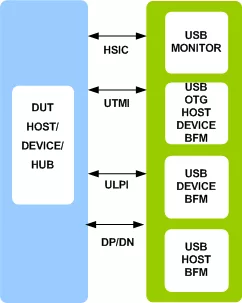
  • Supports Standard USB 2.0 interface, UTMI, UTMI+, ULPI and HSIC interfaces.
  • Standard DP/DM bus interface is supported.
  • Operates at high, full and low speed.
  • Support HOST and Device model.
  • Supports up to 127 devices.
  • Supports completely configurable bus enumeration.
  • Supports all descriptor types and device requests.
  • Supports Link Power Management (LPM).
  • Supports constrained randomization of protocol attributes.
  • All USB2.0 transfer types (Control, Isochronous, Interrupt, Bulk) are supported.
  • Supports both transaction level (Setup, In, Out, Ping) and packet level (Token, Data, Handshake, SOF) transmission/reception.
  • Constrained driven randomization of packets achieved by randomization of various fields of the packet.
  • Auto detection of device connection and disconnection.
  • Supports SRP and HNP compliance checking.
  • Provides SOF generation support.
  • Programmable inter packet and end-to-end delays.
  • Proficiency to generate random packets/transactions and respond to packets/transactions in directed or randomized fashion.
  • Supports all types of error injection and detection. Errors include:
    • Corrupt Sync byte
    • Corrupt PID Byte
    • Corrupt CRC-5 Byte
    • Corrupt CRC-16 Byte
    • Corrupt Endpoint Address Byte
    • Corrupt Setup Payload Size
    • Corrupt Setup Stage Data Payload
    • Corrupt EOP byte
    • Bit stuffing error.
  • Programmable timers for suspend, resume and reset signaling.
  • USB 2.0 OTG
  • Combination of OTG device communication
    • OTG device to Embedded Host
    • Targeted Host to peripheral only B-device
    • OTG device to OTG device
  • Supported devices
    • Dual A device
    • Dual B device
    • Embedded host
    • SRP only B device
  • Supported protocols
    • SRP
    • HNP
    • HNP polling
    • Suspend/Resume/Remote wakeup
    • ADP
  • Supported speeds
    • HS and FS
  • Supported feature selector
    • b_hnp_enable
    • a_hnp_support
    • a_alt_hnp_support
  • Support the all timeout condition
    • a_wait_vrise_tmout
    • a_wait_vfall_tmout
    • a_wait_bcon_tmout
    • a_aidl_bdis_tmout
    • a_bidl_adis_tmout
  • Support for bus drop and over current condition

Block Diagram

Benefits

  • Faster testbench development and more complete verification of USB 1.0/1.1/2.0 designs.
  • Easy to use command interface simplifies testbench control and configurationof device and host.
  • Simplifies results analysis.
  • Runs in every major simulation environment.

What’s Included?

  • Complete regression suite containing all the USB 1.0/1.1/2.0 testcases.
  • Examples showing how to connect various components, and usage of BFM and Monitor.
  • Detailed documentation of all class, task and function's used in verification env.
  • Documentation also contains User's Guide and Release notes.

Specifications

Identity

Part Number
USB 1.0/1.1/2.0 VIP
Vendor
SmartDV
Type
Verification IP

Files

Note: some files may require an NDA depending on provider policy.

Provider

HQ: India

Learn more about USB IP core

Keeping Pace with CXL Specification Revisions

As the Compute Express Link® (CXL®) specification rapidly evolves, so too must the tools and infrastructure used to verify designs built around it. Maintaining verification IP (VIP) that keeps pace with new specification revisions is no small task, particularly when dealing with major version shifts like the transition from CXL 2.0 to 3.0.

SmartDV Licenses SDIO IP Family to Ranix for V2X Products

To meet RANiX’s unique design goals, SmartDV will customize the IP to go beyond the standard SDIO functionality—thereby empowering RANiX to differentiate from their competitors. SmartDV will also provide RANiX with the requisite support and documentation to achieve ASIL certification for ISO 26262.

SmartDV Rolls Out Multi-Phase Expansion Plan

SmartDV™ Technologies, provider of flexible, customizable semiconductor design IP (intellectual property) and verification solutions, has expanded engineering operations beyond its headquarters in Bengaluru with the opening of a new office space in Coimbatore, Tamil Nadu, India.

Frequently asked questions about USB IP cores

What is USB 1.0/1.1/2.0 Verification IP?

USB 1.0/1.1/2.0 Verification IP is a USB IP core from SmartDV listed on Semi IP Hub.

How should engineers evaluate this USB?

Engineers should review the overview, key features, supported foundries and nodes, maturity, deliverables, and provider information before shortlisting this USB IP.

Can this semiconductor IP be compared with similar products?

Yes. Buyers can compare this product with similar semiconductor IP cores or IP families based on category, provider, process options, and structured technical specifications.

×
Semiconductor IP