
Vendor: NTLab Category: EEPROM

UHF RFID tag IP with 3.6kBit EEPROM and -18dBm sensitivity

130GF_RFID_EPCGen2_01 IP is intended for use in passive UHF transponder applications.

GlobalFoundries 130nm Silicon Proven View all specifications

Overview

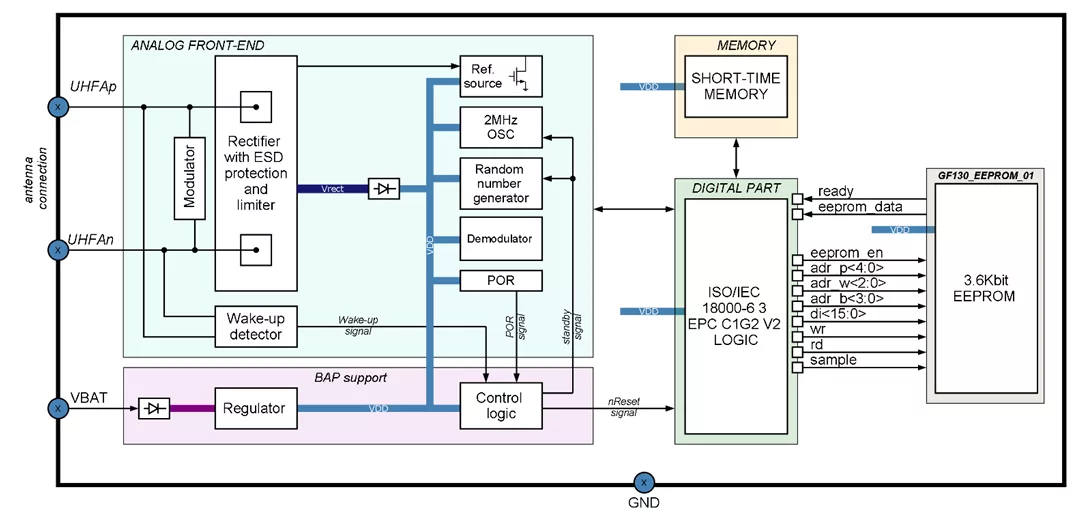
130GF_RFID_EPCGen2_01 IP is intended for use in passive UHF transponder applications. IP derives its operating power from an RF electromagnetic field generated by a reader, which is received and rectified by the IP. The tag IP sends the answer back to the reader using a backscatter modulation technique. RFID EPCGen2 IP provides a fast and flexible anti-collision protocol based on internal random number generator according to EPC standard. IP supports all EPC C1G2 mandatory commands. The IP contains an embedded 3.6Kbit EEPROM organized in 4 banks. IP has 2 operation modes: passive mode and Battery assisted passive (BAP) mode.

Block Diagram

Silicon Options

Foundry Node Process Maturity
GlobalFoundries 130nm 130 1300 nm Silicon Proven

Specifications

Identity

Part Number
130GF_RFID_EPCGen2_01
Vendor
NTLab
Type
Silicon IP

Files

Note: some files may require an NDA depending on provider policy.

Provider

HQ: Lithuania

Learn more about EEPROM IP core

Unleashing EEPROM Potential by Going Embedded: Introducing eMemory's NeoEE

EEPROM memory, which recently celebrated its 50th birthday, continues to defy obsolescence. Despite its age, EEPROM remains a mature, reliable, and affordable technology for many electronic systems. As IC designers embed EEPROM onto chips, it has become an integral part of chip design, offering essential benefits to applications such as MCU, PMIC, sensors, and RFID tags.

When Memory Shortages Change Architecture Decisions

For decades, the choice between embedded and external Non-Volatile Memory (NVM) in semiconductor designs has been straightforward. External memory, such as EEPROM, NOR Flash, or NAND Flash, offered lower cost per bit and greater flexibility, making a two-die architecture the default choice across a wide range of applications. That assumption is now being challenged.

Understanding Physical Unclonable Function (PUF)

A growing number of ASICs, microcontrollers and SoCs embed hardware cryptographic accelerators or software cryptographic libraries. The emergence of the Internet of Things (IoT) will call for an even faster adoption. We now can talk about cryptography pervasion.

Types of Storages for Computing System-On-Chips

We are living in an age where we generate the same amount of data each year that has been generated since antiquity. Ever wondered how and where these peta /exa/zetta bytes of data are stored?

CSoC Platform / Digital Subsystem IP for IoT

This paper describes a CSoC platform and configurable digital subsystem IP which can be deployed for development of IOT edge devices. The paper encompasses the different attributes of IOT edge device that can cater multiple industry segments, key features and benefits of CSoC platform, components of the digital subsystem IP that enables rapid prototyping of SoCs for IOT applications.

Frequently asked questions about EEPROM IP cores

What is UHF RFID tag IP with 3.6kBit EEPROM and -18dBm sensitivity?

UHF RFID tag IP with 3.6kBit EEPROM and -18dBm sensitivity is a EEPROM IP core from NTLab listed on Semi IP Hub. It is listed with support for globalfoundries Silicon Proven.

How should engineers evaluate this EEPROM?

Engineers should review the overview, key features, supported foundries and nodes, maturity, deliverables, and provider information before shortlisting this EEPROM IP.

Can this semiconductor IP be compared with similar products?

Yes. Buyers can compare this product with similar semiconductor IP cores or IP families based on category, provider, process options, and structured technical specifications.

×
Semiconductor IP