
What is Text Overlay Module (OSD)?
Text Overlay Module (OSD) is a Video Processing IP core from Zipcores Electronic Systems Engineering S.L. listed on Semi IP Hub.
The TXT_OVERLAY IP Core is a versatile On Screen Display (OSD) module that allows text and bitmap graphics to be inserted over RG…
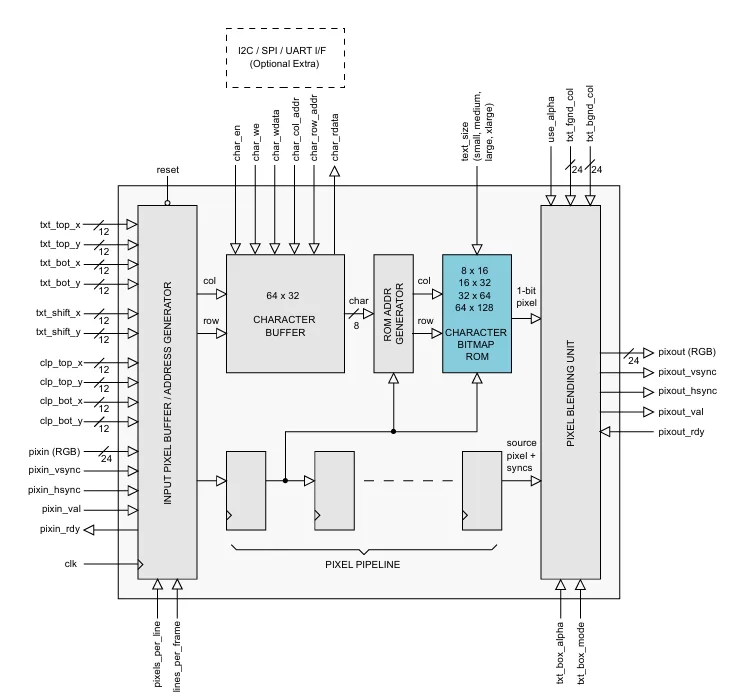
The TXT_OVERLAY IP Core is a highly versatile On Screen Display (OSD) module that allows text and bitmap graphics to be inserted over RGB video. The module supports a wide range of text effects and the programming interface is very simple. Text is written to a character buffer which is mapped (via a bitmap ROM) directly to the display.
The characters in the buffer are displayed in a 'text-box' which may be positioned anywhere in the video display area. Bitmaps for each character are stored in a ROM which may be modified to support different font styles or bitmap graphics.
Pixels and syncs flow in and out of the overlay module in accordance with the valid-ready pipeline protocol which is compatible with the popular AMBA AXI4-stream used widely in custom ASICs, FPGAs and SoCs2.
Pixels and syncs are sampled at the module inputs on a rising clock-edge when pixin_val and pixin_rdy are both high. Likewise, pixels and syncs are transferred out of the module on a rising clock-edge when pixout_val is high and pixout_rdy is high.
The pipeline protocol allows both input and output interfaces to be stalled independently if necessary. Any number of text overlay modules may be cascaded in series. By placing more than one overlay module together, the user is able to achieve more complex text and 2D effects.
Note: some files may require an NDA depending on provider policy.
Text Overlay Module (OSD) is a Video Processing IP core from Zipcores Electronic Systems Engineering S.L. listed on Semi IP Hub.
Engineers should review the overview, key features, supported foundries and nodes, maturity, deliverables, and provider information before shortlisting this Video Processing IP.
Yes. Buyers can compare this product with similar semiconductor IP cores or IP families based on category, provider, process options, and structured technical specifications.