Overview
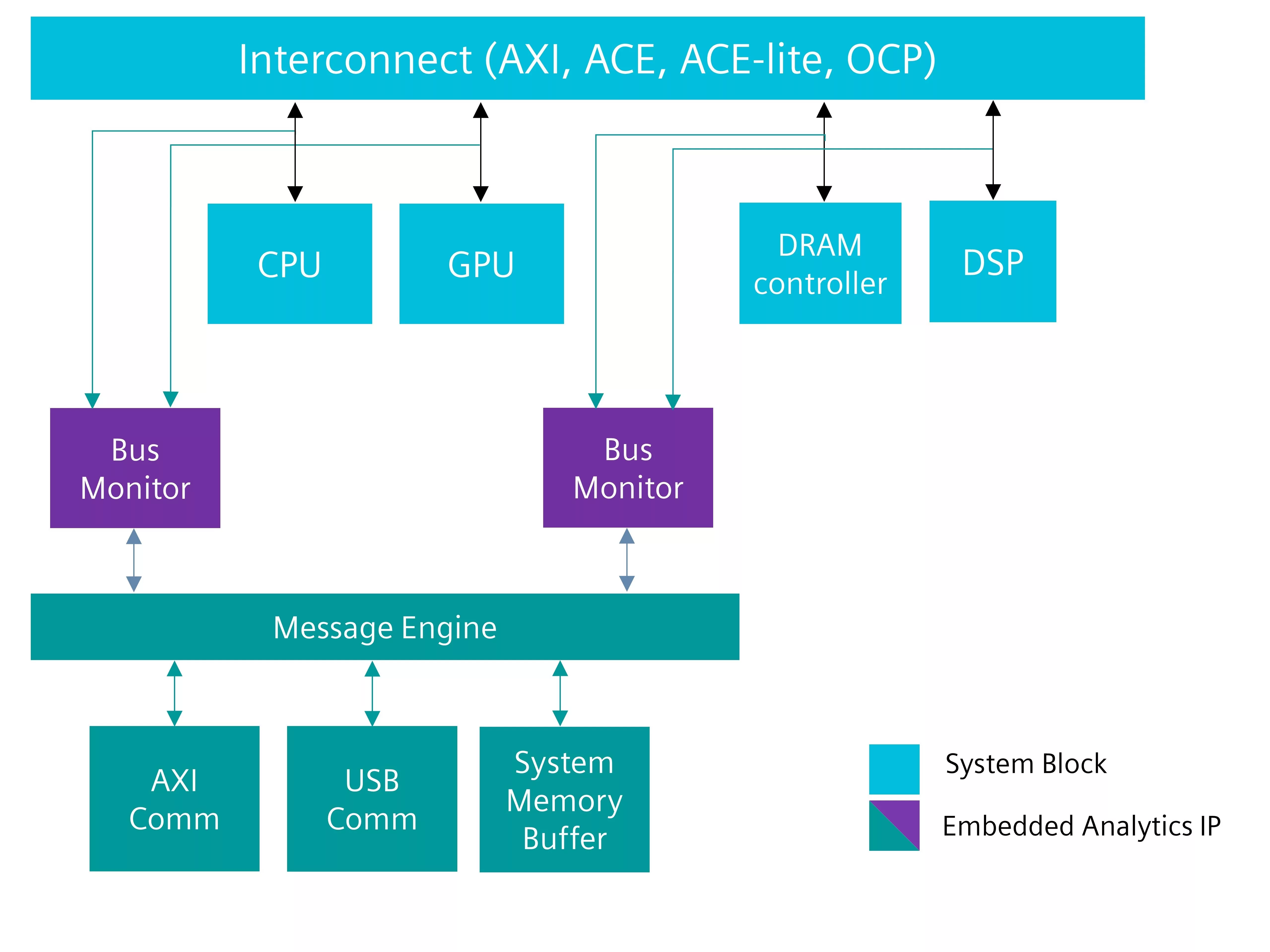
The Tessent Embedded Analytics Bus Monitor provides non-intrusive monitoring of interconnect activity across all major standards, including Arm® AMBA® AXI, ACE, and ACE-lite.
The Bus Monitor enables full transaction-level visibility of traffic buses with a wide range of measurements, analytics and statistics gathering. All of these are run-time configurable and include “logic analyzer” style controls and dependencies, local buffering and cross-triggering. The modules can track transactions (e.g. trace) and automatically gather statistics to identify issues such as contention, peak traffic, and deadlock.
All Tessent Embedded Analytics monitors (IPs), can be accessed via a dedicated, secure communication infrastructure. Non-intrusive debug and monitoring using an off-chip host or debugger is facilitated through USB 2, USB 3, JTAG, or Aurora interfaces. Embedded software can drive the system via an AXI interface to create a self-contained on-chip monitoring system.
Learn more about Monitoring IP core
Nuclei System Technology today announces a strategic collaboration with Siemens Digital Industries Software. The companies are working on full Tessent™ Enhanced Trace Encoder solution support for Nuclei's RISC-V processor cores.
Understanding program behaviour in complex systems is not easy. Understanding the behaviour of complete systems is even more challenging. Get non-intrusive, full-speed and system-level visibility with E-Trace.
To debug and profile a RISC-V processor that comprises tens or hundreds of cores and processes billions of instructions each second can be challenging. Is the software running as expected? Does the verification team see the same behavior as the firmware engineers or application developers?