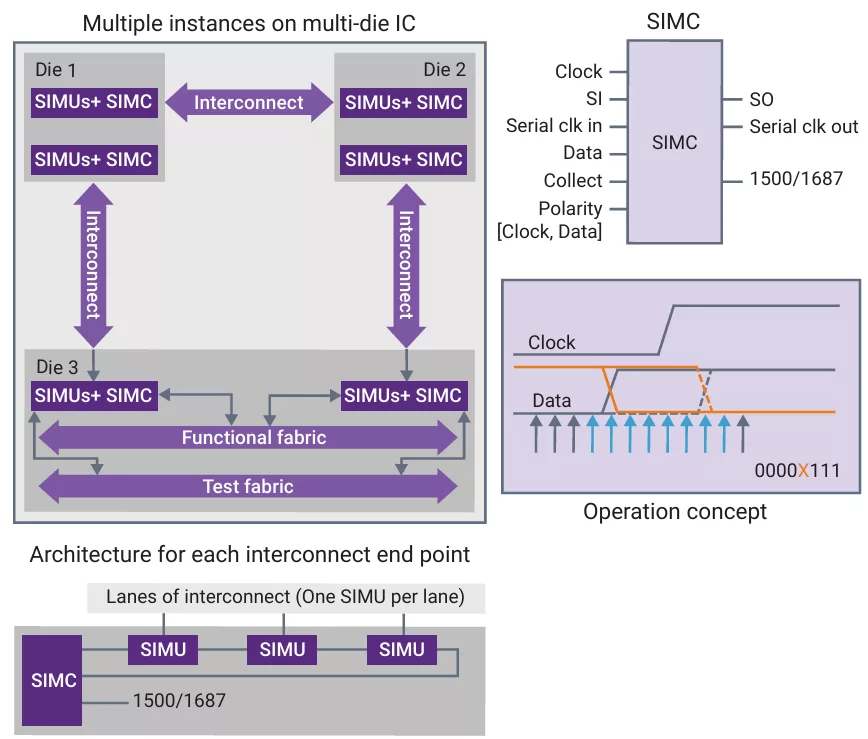
The SLM Signal Integrity Monitor (SIM) IP enables signal quality measurement for die-to-die interfaces. It can be implemented in silicon with minimal area overhead. It enables accurate measurement of silicon interconnects with real-time reporting for analytics. With the use of Monitor, Test and Repair (MTR), this real-time reporting enables structural lane monitoring, aging related degradation, and optional repair of failing lanes to maintain high-speed performance throughout the silicon lifecycle.
The SIM unit (SIMU) has a capture mode for reporting the positive and negative margin of signal edge relative to clock edge. It can support SDR and DDR formats with a clock forwarding scheme. Typically, one SIMU is connected at the end of each lane and all the SIMU’s form a chain connecting to the SIM controller (SIMC). The SIMC provides control /status and test access via 1500/1687.
Information collected from the SIM can be used to construct a 1D eye diagram and based on that, the PHY’s test and repair scheme can be implemented. SLM SIM IP supports SDR and DDR interfaces with UCIe, with HBM interfaces being primary applications. Signal integrity monitor units (SIMU) combined with a signal integrity monitor controller (SIMC) form a complete solution for a multi-die package. Scan chain, IEEE 1500/1687 is available via SIMC. SLM SIM IP is available as a hard macro integrated with UCIe, HBM PHYs from Synopsys or as configurable soft IP.
SLM Structural Monitors
Structural monitors are key to the success of Synopsys’ Silicon Lifecycle Management solution. These monitors are embedded in the silicon and report out the health of critical functions of the chip. Data from structural monitors can be collected at any stage of the silicon lifecycle and analyzed to gather insights. Based on these insights, actions can be taken to improve performance or mitigate an operational issue. Memory, CPU workload, interface, clock, delay, etc. are some critical functions on an SoC worth monitoring. Synopsys’ structural monitors are enabled with EDA and software automation for ease of use.
Key Features
- SIMU + SIMC based complete solution for multi-die packages
- Distributed architecture with low overhead
- Available as hard IP integrated with PHY or soft IP with flexibility to customize
- Capture state of silicon at any stage of its lifecycle