Vendor: Lattice Semiconductor Corp. Category: MIPI

SubLVDS to MIPI CSI-2 Image Sensor Bridge

Most off-the-shelf Application Processors use industry standard interfaces such as MIPI CSI-2.

Overview

Most off-the-shelf Application Processors use industry standard interfaces such as MIPI CSI-2. However, several high-end image sensors traditionally focused on industrial and A/V markets have proprietary interfaces such as SubLVDS. The mobile industry accelerated many advances in application processor technology while additionally driving down cost and power. Many new applications want to leverage mobile innovations. At the same time the camera remains an extremely important feature in smartphones and tablets today.

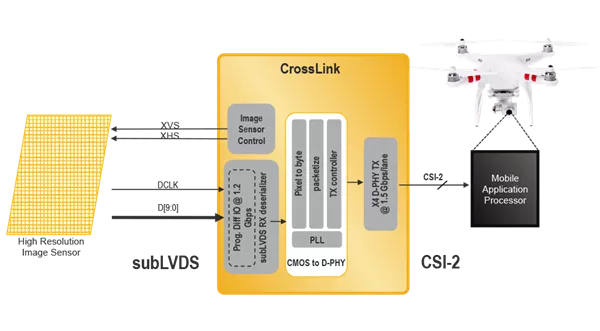
Lattice CrossLink is a programmable video interface bridging device capable of converting Sony image sensors from SubLVDS to MIPI CSI-2 at up to 6 Gbps allowing for full resolution and bandwidth conversion. This bridge is available as free IP is available in Lattice Diamond for allowing easy configuration and setup.

Key features

  • Supports 4, 8, or 10 data lanes from Sony image sensor in 10-bit or 12-bit pixel widths
  • Interfaces to MIPI CSI-2 Devices with 1 clock lane and 4 data lanes up to 6 Gbps total bandwidth
  • Generates XVS & XHS for image sensors in slave mode operation
  • Handles Sony IMX SubLVDS image sensors such as IMX236, IMX172, IMX178, IMX226, etc.
  • Easily configurable through Lattice Clarity Designer included in Lattice Diamond Software

Block Diagram

Specifications

Identity

Part Number
SuBLVDStoMIPICSI2ImageSensorBridge
Vendor
Lattice Semiconductor Corp.
Type
Silicon IP

Files

Note: some files may require an NDA depending on provider policy.

Provider

Learn more about MIPI IP core

M31 High-Speed and Long-Channel MIPI C/D-PHY Solution on TSMC N3P/N3C

With the rapid growth of AR/VR and high-resolution imaging systems such as drones and action cameras, MIPI CSI (Camera Serial Interface) and MIPI DSI (Display Serial Interface) require both high data throughput and low power consumption. M31 provides a MIPI C-PHY and D-PHY IP combo solution implemented on TSMC N3P and N3C processes.

MIPI CCI over I3C: Faster Camera Control for SoC Architects

Imagine a camera subsystem that responds in microseconds, consumes less power, and offers a more straightforward route to time-to-market. For SoC architects and IP integration teams, that vision is increasingly possible with MIPI Camera Control Interface (CCI) over I3C.

MIPI MPHY 6.0: Enabling Next-Generation UFS Performance

High-speed chip-to-chip data transfer is continuously evolving to meet increasing performance demands. MIPI MPHY is a high-speed physical layer interface developed by the MIPI Alliance. This protocol is used for high-speed chip-to-chip interfaces, mainly in mobile and automotive devices.

MIPI: Powering the Future of Connected Devices

From the first monochrome mobile displays to today’s ultra-high-definition automotive dashboards and immersive AR/VR headsets, MIPI technology has quietly become the backbone of modern data connectivity. Let’s explore how MIPI standards have evolved, the markets they serve, and why Rambus is at the forefront of this transformation.

Frequently asked questions about MIPI IP cores

What is SubLVDS to MIPI CSI-2 Image Sensor Bridge?

SubLVDS to MIPI CSI-2 Image Sensor Bridge is a MIPI IP core from Lattice Semiconductor Corp. listed on Semi IP Hub.

How should engineers evaluate this MIPI?

Engineers should review the overview, key features, supported foundries and nodes, maturity, deliverables, and provider information before shortlisting this MIPI IP.

Can this semiconductor IP be compared with similar products?

Yes. Buyers can compare this product with similar semiconductor IP cores or IP families based on category, provider, process options, and structured technical specifications.

×
Semiconductor IP