Vendor: T2M GmbH Category: Multi-Protocol PHY

PCIe 2.0 Serdes PHY IP, Silicon Proven in UMC 40LP

The full gamut of PCIe 2.0 Base operations is covered by PCIe 2.0 transceiver IP.

UMC 40nm LP In Production View all specifications

Overview

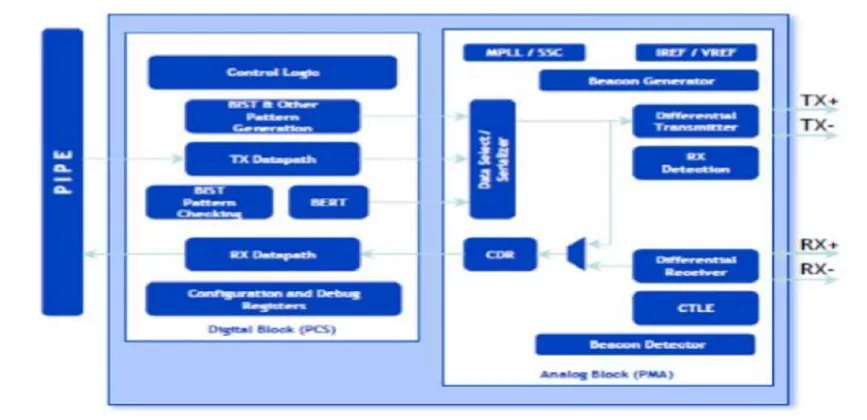
The full gamut of PCIe 2.0 Base operations is covered by PCIe 2.0 transceiver IP. It conforms to the PIPE 3.0 standard. This IP combines high-speed mixed signal circuits to handle PCIe 2.0 traffic at 5Gbps and is backward compatible with PCIe 1.0 data rate at 2.5Gbps. It is intended to consume less power and have a small die area. The requirements for various channel conditions can be fulfilled by the PCIe 2.0 IP owing to its support for both TX and RX equalisation techniques.

Key features

  • Compatible with PCIe base Specification
  • Full compatible with PIPE3.0 interface specification
  • Independent channel power down control
  • Implemented Receiver equalization Adaptive-CTLE to compensate insertion loss
  • Support 16-bit/32bit parallel interface
  • Support for PCIe gen1(2.5Gbps) and PCIe gen2(5.0Gbps)
  • Support flexible reference clock frequency
  • Support 100MHz differential reference clock input or output (with SSC optionally) in PCIe Mode
  • Support Spread-Spectrum clock (SSC) generation and receiving from -5000ppm to 0ppm
  • Support programmable transmit amplitude and Deemphasis
  • Support TX detect RX function in PCIe Mode
  • Support Beacon signal generation and detection in
  • Production test support is optimized through high coverage at-speed BIST and loopback
  • Integrated on-die termination resistors and IO Pads/Bumps
  • Embedded Primary & Secondary ESD Protection
  • ESD: HBM/MM/CDM/Latch Up 2000V/200V/500V/100mA
  • Silicon Proven in UMC 40nm LP

Block Diagram

What’s Included?

  • GDSII & layer map
  • Place-Route views (.LEF)
  • Liberty library (.lib)
  • Verilog behaviour model
  • Netlist & SDF timing
  • Layout guidelines, application notes
  • LVS/DRC verification reports

Silicon Options

Foundry Node Process Maturity
UMC 40nm LP In Production

Specifications

Identity

Part Number
PCIe 2.0 Serdes PHY IP in 40LP
Vendor
T2M GmbH
Type
Silicon IP

Files

Note: some files may require an NDA depending on provider policy.

Provider

HQ: Germany

Learn more about Multi-Protocol PHY IP core

How a 16Gbps Multi-link, Multi-protocol SerDes PHY Can Transform Datacenter Connectivity

Increasingly, more of the focus on mobile has centered around cloud datacenters and the networking to get the data back and forth between these datacenters and the mobile device. Functions like voice recognition and mapping depend on the ability to split the functionality between the smartphone, for local processing like encryption and compression, and the back end, where a large number of servers can do the heavier lifting before returning the results.

One PHY, Zero Tradeoffs: Multi-Protocol PHY for Edge AI Interface Consolidation

The Cadence 10G multi-protocol PHY was architected to address this exact challenge. Designed to scale across multiple process nodes, it consolidates PCI Express (PCIe), USB, DisplayPort, Ethernet, and other interfaces into a single, compact, silicon-efficient block. What sets it apart is simultaneous multi-protocol support, which enables multiple data paths without duplicating hardware, requiring extra board connectors, or paying the area and power penalty of separate IP blocks.

Frequently asked questions about Multi-Protocol PHY IP cores

What is PCIe 2.0 Serdes PHY IP, Silicon Proven in UMC 40LP?

PCIe 2.0 Serdes PHY IP, Silicon Proven in UMC 40LP is a Multi-Protocol PHY IP core from T2M GmbH listed on Semi IP Hub. It is listed with support for umc In Production.

How should engineers evaluate this Multi-Protocol PHY?

Engineers should review the overview, key features, supported foundries and nodes, maturity, deliverables, and provider information before shortlisting this Multi-Protocol PHY IP.

Can this semiconductor IP be compared with similar products?

Yes. Buyers can compare this product with similar semiconductor IP cores or IP families based on category, provider, process options, and structured technical specifications.

×
Semiconductor IP