Overview
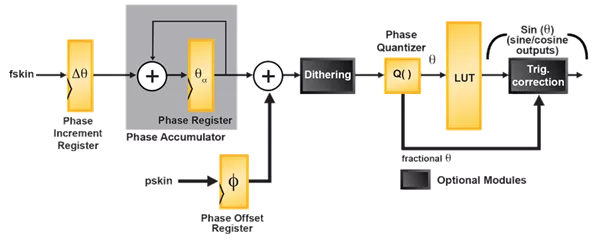
Numerically Controlled Oscillators (NCO), also called Direct Digital Synthesizers (DDS), offer several advantages over other types of oscillators in terms of accuracy, stability and reliability. NCOs provide a flexible architecture that enables easy programmability such as on-the-fly frequency/phase. NCOs are used in many communications systems including digital up/down converters used in 3G wireless and software radio systems, digital PLLs, radar systems, drivers for optical or acoustic transmissions, and multilevel FSK/PSK modulators/demodulators.
Lattice provides a parameterizable NCO IP core that supports multiple channels and a Quadrature Amplitude Modulation (QAM) mode, in addition to other usual configurations. The resource utilization and performance trade-off can be tuned by configuring different parameters of the IP core to obtain the optimal Spurious Free Dynamic Range (SFDR) result. The Lattice NCO core offers a variety of memory reduction schemes and mechanisms for SFDR improvement.
Learn more about Oscillator IP core
Extending Lattice's post-quantum cryptography leadership from silicon to a complete platform security stack, Lattice Sentry now delivers CNSA 2.0-aligned, NIST-compliant protection across AI data centers, and critical infrastructure, giving system designers a validated, production-ready path to quantum-resistant security.
Combining Arm® AGI CPU server platforms with Lattice FPGAs and AMI firmware creates a solution that provides advanced security, manageability, connectivity, and flexibility for next-generation AI data center infrastructure.
Lattice Prompt pairs with AI agentic tools developers already use, combining them with Lattice design tools, knowledge base, and documentation to turn natural language inputs into validated responses, dramatically accelerating FPGA development while optimizing design performance and capability.
First announced on May 4, 2026, the acquisition creates the industry's most complete secure management and control platform.
The acquisition brings together Lattice’s industry-leading low power FPGAs with AMI’s industry‑leading platform firmware and infrastructure manageability solutions for cloud and AI to create a complete portfolio of secure management and control solutions.
The collaboration demonstrates a real-time AI sensor fusion architecture that integrates TI mmWave radar and camera sensors using NVIDIA Holoscan Sensor Bridge running on Lattice’s low power FPGA. The FPGA acts as a companion chip delivering synchronized sensor data directly into GPU-accessible memory to enable low-latency and robust perception for robotics and industrial edge AI applications.