Vendor:
Mikroprojekt
Category:
Display Controller
Multilayer Configurable Display Controller
The IQ-DispML is a multi-layer, fully software configurable display controller IP core.
Overview
The IQ-DispML is a multi-layer, fully software configurable display controller IP core. It performs continuous refresh of graphical flat panel displays (TFT LCD, AMOLED) from the designated frame buffers located in a memory device mapped to the system bus.
Multiple layers are blended into a single image, which is outputted to the display. SDRAM and SRAM devices are supported as frame buffers, depending on the bandwidth requirements.
IQ-DispML is designed to provide an optimum tradeoff of performance and resource utilization in FPGA devices while retaining a high degree of configurability. The IP core can be additionally scaled down at compile time by reducing the number of layers, bus widths and fixing timing parameters, allowing the user to fully optimize the IQ-DispML for a specific configuration.
Multiple layers are blended into a single image, which is outputted to the display. SDRAM and SRAM devices are supported as frame buffers, depending on the bandwidth requirements.
IQ-DispML is designed to provide an optimum tradeoff of performance and resource utilization in FPGA devices while retaining a high degree of configurability. The IP core can be additionally scaled down at compile time by reducing the number of layers, bus widths and fixing timing parameters, allowing the user to fully optimize the IQ-DispML for a specific configuration.
Key features
- Fully programmable clock and timing control for flat panel displays with progressive scanning
- Support for resolutions up to 4096x4096
- Completely variable timing parameters, for standard or specific display resolutions
- Support for 8,16, 18 or 24 bit RGB output color depth
- Standard or multiplexed display data bus
- Display power control lines
- Interrupt generation on vertical sync for software synchronization
- Frame buffer management Double buffering to reduce image flicker
- Variable frame buffer organization with software-configurable memory stripe
- Image scroll via unconstrained frame buffer addressing
- Frame buffer color depth support
- Alpha blending of all layers, with per-layer additional transparency (“layer fading”)
- Independent positioning and dimensioning of all layers
- Compile-time configuration for reducing resource cost by fixing parameters
- Support for multiple clock domains to ease timing closure
- Integrated DMA memory master supporting low-overhead burst transfers
- Configuration bus slave interface with address-mapped registers
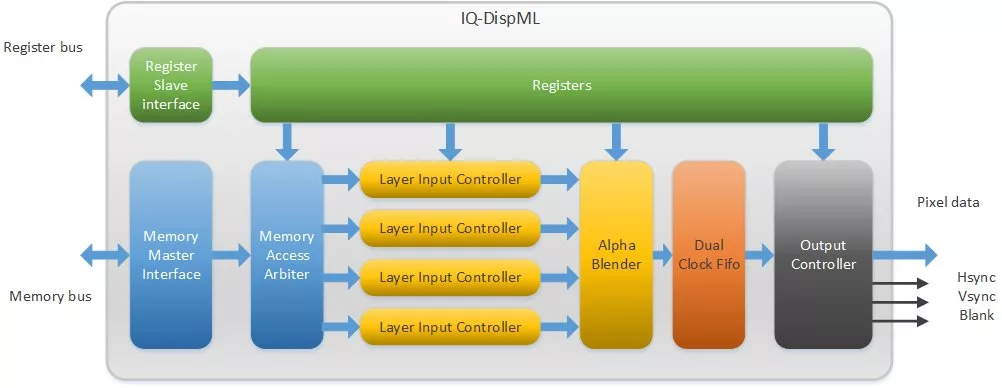
Block Diagram
IQ-DispML block diagram
Applications
- Vending machines
- Video monitors
- Automotive infotainment
- Medical instrumentation
- Human machine interface (HMI) systems
- Mobile devices
Specifications
Identity
Part Number
IQ-DispML
Vendor
Mikroprojekt
Type
Silicon IP
Files
Note: some files may require an NDA depending on provider policy.
Provider
Learn more about Display Controller IP core
Empowering AI-Enabled Systems with MIPI C/D-PHY Combo IP: The Complete Audio-Visual Subsystem and AI
High Speed, Low Power and Flexibility Drive DisplayPort's Increasing Popularity
In this article we provide an introduction to DP, talk about the various factors that IC designers will want to consider when integrating the DP functionality into their SOC, and present at a high-level the solutions Silicon Creations provides in this area.
The whys and hows of secure boot
With the proliferation of Internet of Things (IoT) devices, which now span just about every walk of life, from smart cities to wireless jewellery, the need to prioritize security in IoT-style embedded systems has never been greater. The secure boot process is a vital first step in securing any embedded system, a necessary part of your application’s anti-malware fortress. Let’s take a look at the pros and cons, with a focus on one of the most popular processors in electronics – the i.MX6.
Motion Picture: a Reality on Emulation Platform
In present day’s situation, whenever we are in the phase of designing a cluster SoC, we have no reliable way of verifying our design in real case scenarios, or showcase the possibilities of our design through any demos. This, sometimes, paves way for critical design bugs which requires re-spins/cuts.
Sequential clock gating maximizes power savings at IP level
In this paper we talk about design exploration using the PowerPro tool. For analysis of power optimization based on this tool, we have included Advanced Driver Assistance System (ADAS) and cluster IPs with high speed processing requirements. These IPs have multiple complex operation requirements within a clock period, making them ideal candidates for power saving. The IPs under consideration are image processors, high-speed bus fabrics for a memory controller, display controllers, and video codecs.
Frequently asked questions about Display Controller IP
What is Multilayer Configurable Display Controller?
Multilayer Configurable Display Controller is a Display Controller IP core from Mikroprojekt listed on Semi IP Hub.
How should engineers evaluate this Display Controller?
Engineers should review the overview, key features, supported foundries and nodes, maturity, deliverables, and provider information before shortlisting this Display Controller IP.
Can this semiconductor IP be compared with similar products?
Yes. Buyers can compare this product with similar semiconductor IP cores or IP families based on category, provider, process options, and structured technical specifications.