Overview
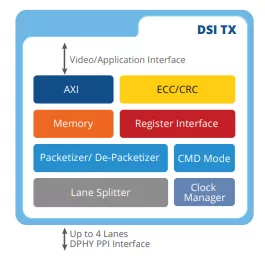
MIPI is the Mobile Industry Processor Interface that provides specification for software and hardware interfaces in mobile terminals and thereby encouraging the adoption of these standards throughout the industry chain for achieving interoperability has come up with many specifications like CSI, DSI, DPHY, CPHY, MPHY, SoundWire, UniPro and more. The MIPI Display Serial Interface (DSI) is an interface between a display or any other data interface, and a host processor baseband application engine. This interface is defined by the MIPI Alliance, which lays down a series of modules required in a MIPI compliant product. MIPI DSI Receiver is leveraged by mobile and high–speed serial applications as a controller for receiving video, command or user data, transmitted via MIPI DSI Transmitter over MIPI lines. It is sent to the next, higher level for subsequent processing. The MIPI DSI Receiver, along with MIPI DSI Transmitter and MIPI DPHY, provides a complete solution for MIPI DSI communication.
Learn more about MIPI IP core
T2M-IP, the global leader in semiconductor IP cores and technology expertise, is proud to announce the immediate availability of its partner's VESA-compliant DisplayPort v1.4 Rx PHY and Controller IP Cores.
T2M announces the availability of its partner’s Bluetooth V6.0 RF Transceiver IP Core in 22nm ULL and 40nm ULP.
Incorporating BroadR-Reach™ technology for Automotive Excellence, this PHY delivers exceptional performance for automotive and industrial applications, providing a superior alternative to traditional BaseT1 solutions.
Designed to meet the evolving needs of next-generation automotive and industrial applications, the CAN XL Controller IP offers superior performance and flexibility while maintaining backward compatibility with previous CAN standards.
T2MIP, a leading provider of semiconductor IP cores, proudly announces the immediate availability of their partner's H.264 and H.265 HEVC Codec IP cores.
T2M-IP is excited to announce that its state-of-the-art USB 3.0 IP, developed in the 22nm ULP (Ultra Low Power) and ULL (Ultra Low Leakage) process technologies, has been successfully licensed to over 10 customers worldwide in the past two years.