Overview
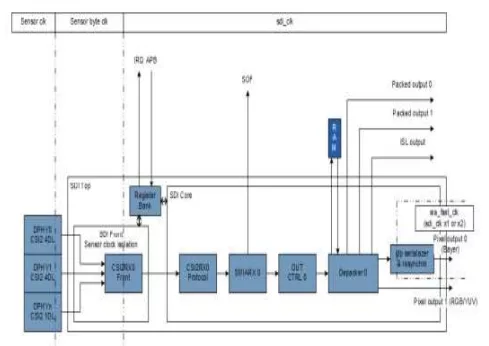
The CSI-2 Receiver IP is in charge of handling CSI2 & SMIA protocols, as well as depacking input data to pixels. It also selects the correct destination for each data packet (Bayer input of ISP, RGB/YUV input of ISP, Memory). The IP reorders up to 4 x 1Gbps data lanes, separates sensor clock of CSI-2 Core from DPHY byte clock and merges active ones into 32 bits words. The
IP Core is able to store in memory all CSI2 datatype and to process rawbayer, compressed rawbayer, yuv pixel reconstruction for on-the-fly ISP processing. It also performs ECC/CRC check & correction and provides data to SMIA.CSI-2 Receiver IP supports Virtual Channel and Datatype selection. It supports continuous and gated clock configurations
Learn more about MIPI IP core
T2M-IP, the global leader in semiconductor IP cores and technology expertise, is proud to announce the immediate availability of its partner's VESA-compliant DisplayPort v1.4 Rx PHY and Controller IP Cores.
T2M announces the availability of its partner’s Bluetooth V6.0 RF Transceiver IP Core in 22nm ULL and 40nm ULP.
Incorporating BroadR-Reach™ technology for Automotive Excellence, this PHY delivers exceptional performance for automotive and industrial applications, providing a superior alternative to traditional BaseT1 solutions.
Designed to meet the evolving needs of next-generation automotive and industrial applications, the CAN XL Controller IP offers superior performance and flexibility while maintaining backward compatibility with previous CAN standards.
T2MIP, a leading provider of semiconductor IP cores, proudly announces the immediate availability of their partner's H.264 and H.265 HEVC Codec IP cores.
T2M-IP is excited to announce that its state-of-the-art USB 3.0 IP, developed in the 22nm ULP (Ultra Low Power) and ULL (Ultra Low Leakage) process technologies, has been successfully licensed to over 10 customers worldwide in the past two years.