Vendor: Chip Interfaces ApS Category: MIPI

MIPI CSI-2 IP

scalable and silicon-agnostic implementation of the MIPI Camera Serial Interface 2 version 4.1 The MIPI CSI-2 IP core is a scalab…

Overview

Highly scalable and silicon-agnostic implementation of the MIPI Camera Serial Interface 2 version 4.1

The MIPI CSI-2 IP core is a highly scalable and silicon-agnostic implementation of the  MIPI Camera Serial Interface 2 version 4.1 targeting ASIC and FPGA technologies. The MIPI CSI-2 implementation enables high-speed, low-power transmission of image data from camera modules to host processors.

Optimized for performance, flexibility, and minimal resource utilization, this IP supports various applications, including mobile, automotive, industrial vision, and embedded systems. It supports advanced features like Smart Region of Interest (SROI), Always-On Sentinel Conduit (AOSC), and RGB, YUV and RAW data types and JPGEG format and Raw Data Compression, enhancing versatility in real-time imaging and machine vision systems.

With scalable lane support and seamless integration into FPGA and ASIC environment. The IP comes with the widest parameter set available and has gone through extensive testing in our UVM regression test environment.
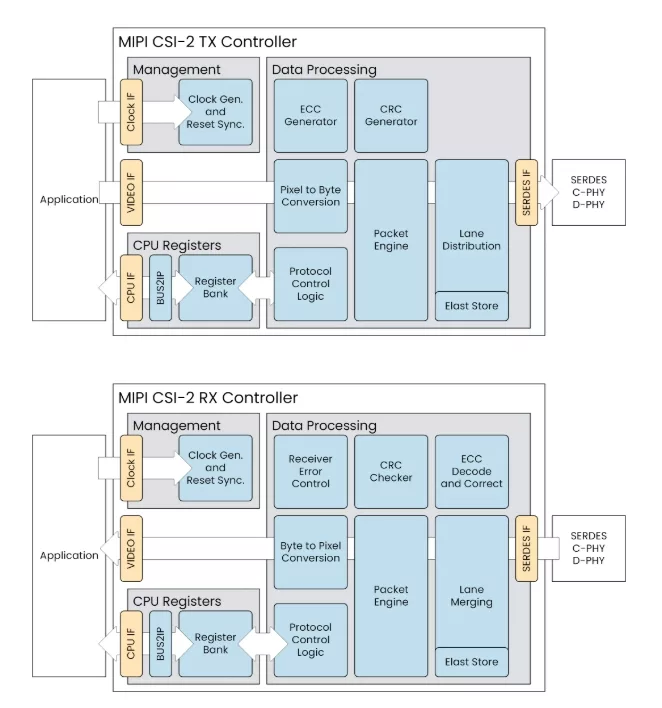

Key features

  • Supports:
    • (SROI) Smart Region of Interest,
    • (USL) Universal Serial Link,
    • (AOSC) Always-On Sentinel Conduit,
    • (MPC) Multi-Pixel Compression
  • Integrates Easily with C-PHY and D-PHY through the MIPI PPI Interface
  • Support for all Data Types and Compression Modes
  • Silicon Agnostic

Block Diagram

Benefits

  • Test Environment: CSI-2 IP is Tested in UVM regression for full functional coverage
  • Silicon Agnostic: Designed in Verilog and targeting ASICs and FPGAs
  • System Integration: Integration support with C-PHY / D-PHY components for quick and efficient  deployment
  • Active Support: All support is actively provided by engineers directly

What’s Included?

  • The IP Core can be delivered in Source code or Encrypted format.
  • The following deliverables will be provided with the IP Core license:
    • Solid documentation, including User Manual, Release Note and Quick Start Guide.
    • Simulation Environment, including Simple Testbed, Test case, Test Script.
    • Timing Constraints in Synopsys SDC format.
    • Access to support system and direct support from Chip Interfaces Engineers.
    • Test Report , Synopsys SGDC Files and Synopsys Lint, CDC and Waivers available on request

Specifications

Identity

Part Number
MIPI CSI-2 IP
Vendor
Chip Interfaces ApS
Type
Silicon IP

Files

Note: some files may require an NDA depending on provider policy.

Provider

Learn more about MIPI IP core

JESD204 Frame Mapping explained from converter samples to lanes

The JESD204 Transport Layer oversees converter data mapping onto a set of JESD204 Lanes. The nature of these lanes is dependent on the version of the JESD204 standard and a function of the PCS and over the years despite the Serdes technology changing with ever increasing line rates, the function and features of the Transport Layer remained the same

Why What Where DIFI and the new version 1.3

This article will introduce the main concepts of the Digital Intermediate Frequency Interoperability (DIFI) standard including the new features introduced in version 1.3.  With no assumptions of prior knowledge from the reader this should serve as an introduction to the standard but also for those familiar with DIFI raise awareness of the added features of link establishment in new standard version.

Multiple ways JESD204 performs bitstream alignment

Bitstream alignment is a function of the Receiver (RX), as seen in the figure below it is the first functional block of the receiver right after the clock domain crossing (CDC) and gear boxing which are quite generic Serdes adaptation layer that can be found in almost every design working with a Serdes.

Frequently asked questions about MIPI IP cores

What is MIPI CSI-2 IP?

MIPI CSI-2 IP is a MIPI IP core from Chip Interfaces ApS listed on Semi IP Hub.

How should engineers evaluate this MIPI?

Engineers should review the overview, key features, supported foundries and nodes, maturity, deliverables, and provider information before shortlisting this MIPI IP.

Can this semiconductor IP be compared with similar products?

Yes. Buyers can compare this product with similar semiconductor IP cores or IP families based on category, provider, process options, and structured technical specifications.

×
Semiconductor IP