Vendor: section5.ch Category: Image Conversion

JPEG encoder

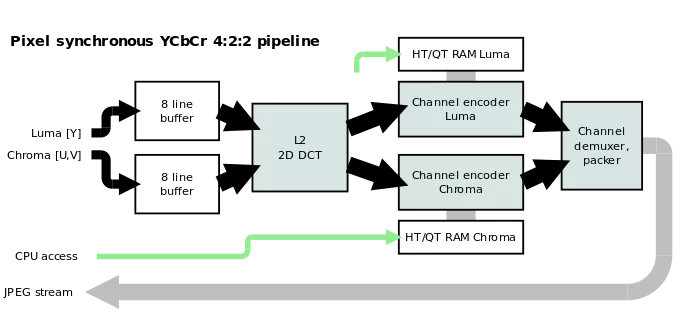
The JPEG IP is basically split into the following variants: L2 dual pipe simultaneous encoding for high quality YUV422, for examp…

Overview

The JPEG IP is basically split into the following variants:

  • L2 dual pipe simultaneous encoding for high quality YUV422, for example 1280×720@60fps (100 MHz pixel clock for default setup, custom platform optimizations possible for higher clocks)
  • L2x using off-standard optimizations for specific image properties (spectral imaging)

Example configurations / reference designs

The current default JPEG SoC encoder setup, making use of the JPEG L2 encoder, is a fully functional MJPEG (RFC2435 standard) camera network streaming solution, including a stress test option (deterministic pseudo random pattern). Precompiled bit files are currently available for download (free, but registration required) for the following platforms:

  • Lattice HDR60/ECP3 [ MT9M024 Network camera | MT9P031 (J7) on request ]
  • Lattice VIP stereo kit: [ IMX214 camera head ]

Board supply packages are no longer maintained per se, a core license however grants you access to the unmutilated source code.

To test this setup on Windows or Linux platforms, a gstreamer installation and a 100M capable Ethernet interface is required. The necessary scripts to run the MJPEG low latency demo are listed in the dombert Product Brief in the documentation section below.

A few example configurations for MJPEG streaming are found in the table below.

Resolution Quality fps Bandwidth [MByte/s]
768×512 90% 33 3.2
768×512 70% 63.33 4.7
1440×960 88% 23.5 7.6
1920×1024 82% 18 7.6

The streaming pipeline is optimized for minimum frame drops using the above gstreamer setup. For a gstreamer receiver and the network not subject to excessive load, thousands of hours of video have been verified without a lost frame.

Simulation models and verification

The JPEG encoder IP L1 and L2 modules are extensively verified against standard compliance using the following techniques:

  • Fully bit accurate co-simulation and coverage to verify loopback software compliance (Encoding->Decoding->Validation). A simplified virtualized encoder hardware model for co-simulation is supplied. It allows you to simulate the encoder hardware design against your own test data and timing using Python without the requirement to install any software. See details in [ Co-Simulation models ‘2.0’ ]
  • Compression bandwidth and FIFO stress tests: Generation of worst-case-compressible image patterns and statistics on FPGA SoC setup

Streaming ‘System on chip’

The embedded system processor ‘dombert’ is programmable in C (GNU toolchain) and allows to freely configure the encoder’s packet queue to support other UDP/IP based transmission standards such as SRTP (with use of a hardware AES encryption IP core).

The setup for the HDR60 development kit is featured by a hardware debug port and GDB test scripts for convenient video hardware debugging.
Key features

  • Baseline JPEG compliant (ITU T.81), Motion JPEG
  • Up to 12 bits depth possible (default: 8 bit)
  • Super low latency (less than 1/10 of frame duration for rolling shutter cameras)
  • Lossy compression by default
  • Fully bit and cycle accurate co-simulation model available in Docker container
  • Two-Chip reference design: No external RAM, only FPGA and Ethernet Phy required.
  • Low power consumption due to clock synchronous, distributed operation

Block Diagram

Specifications

Identity

Part Number
JPEG_L2
Vendor
section5.ch
Type
Silicon IP

Files

Note: some files may require an NDA depending on provider policy.

Provider

HQ: Switzerland

Learn more about Image Conversion IP core

Enabling AI Vision at the Edge

Computer vision has made tremendous advances in the last several years due to the proliferation of AI technology. The intersection of big data and massive parallel computing changed the way in which machines are programmed to understand unstructured 2D and 3D data, such as video feeds from cameras.

Nextreme Structured ASICs: An alternative for designing cost-optimized ARM926EJ processor-based embedded systems

Traditional IC design options that embedded system designers have had to choose from include fixed hardware devices such as standalone microprocessors, microcontrollers and ASSPs or configurable hardware devices such as FPGAs and cell-based ASICs. In this paper we present a new design option called Nextreme Structured ASICs which provide embedded system designers with a compelling alternative to custom embedded system design.

Generating High Speed CSI2 Video by an FPGA

In this article, we show how fast video streams conforming to MIPI CSI2 rev2.0 over MIPI DPHY rev1.2 can be generated, using VLSI Plus’ SVTPlus-CSI2-F IP core, with simple off-FPGA analog front-end. The high bit rates can be achieved with a relatively slow FPGA clock frequency, trading off FPGA resources for simple timing closure.

Viewpoint: Opportunity to win on different design fronts

Beyond pure process scaling which is necessary to meet today's price, power, and performance goals, chip designers have to grapple with tighter integration and product performance specialities in areas such as integrated power management, image sensing, application-specific data conversion, and enhanced display drivers.

Frequently asked questions about image conversion IP cores

What is JPEG encoder?

JPEG encoder is a Image Conversion IP core from section5.ch listed on Semi IP Hub.

How should engineers evaluate this Image Conversion?

Engineers should review the overview, key features, supported foundries and nodes, maturity, deliverables, and provider information before shortlisting this Image Conversion IP.

Can this semiconductor IP be compared with similar products?

Yes. Buyers can compare this product with similar semiconductor IP cores or IP families based on category, provider, process options, and structured technical specifications.

×
Semiconductor IP