Vendor: InPsy Category: Single-Protocol PHY

HDMI 1.4/2.0 Transmitter PHY

The HDMI 2.0 TX (Transmitter) is a multimedia interface designed to deliver high-definition video and audio from source devices t…

Overview

The HDMI 2.0 TX (Transmitter) is a multimedia interface designed to deliver high-definition video and audio from source devices to display devices. Our silicon proven HDMI Transmitter PHY is an essential component for applications requiring high-resolution and high-fidelity content transmission, such as home theater systems.

Key features

  • Fully compliant with HDMI 1.4 and 2.0 specifications
  • Supports High Bandwidth: Supports up to 18 Gbps (R, G, B), allowing for higher resolutions, faster refresh rates, and more color depth
  • Supports High Dynamic Range (HDR): Compatible with HDR formats, enhancing the contrast and color accuracy of the displayed content
  • Supports four (4) operation modes
    • Normal mode
    • Active power down mode
    • Idle mode
    • Power saving mode

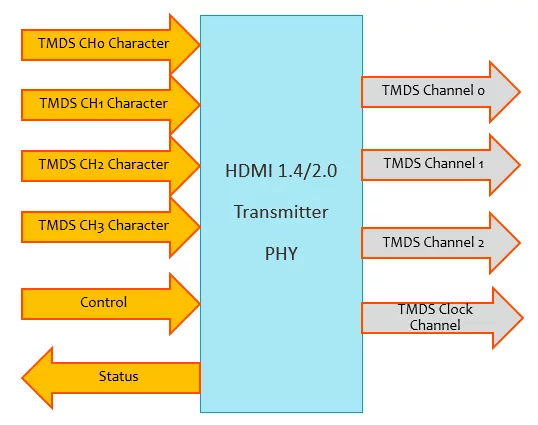
Block Diagram

Files

Note: some files may require an NDA depending on provider policy.

Specifications

Identity

Part Number
HDMI 1.4/2.0 Transmitter PHY
Vendor
InPsy
Type
Silicon IP

Provider

InPsy
HQ: Taiwan (R.O.C.)
InPsy was founded in September 2019 with a vision to empower customer innovation with cutting-edge semiconductor interconnect IP solutions. Through seamless collaboration with major global wafer foundries, chip design houses and strategic partners, InPsy has demonstrated its mass production proven track record of IP technology firsts on the most advanced technology nodes. Ultimately, our mission is to be the leading provider of innovative silicon IP solutions, recognized globally for our unmatched customer satisfaction, exceptional quality, and technical excellence. Think of us as your outsourced, in-house IP design team

Learn more about Single-Protocol PHY IP core

UFS Goes Mainstream

UniversalFlash Storage (UFS) was created for mobile applications and computer systems requiring high performance and low power consumption. These systems typically use embedded Flash based on the JEDEC standard eMMC. UFS was defined by JEDEC as the evolutionary replacement for eMMC offering significantly higher memory bandwidth. The standard builds on existing standards such as the SCSI command set, the MIPI Alliance M-PHY and UniPro as well as eMMC form factors to simplify adoption and development.

Design IP Faster: Introducing the C~ High-Level Language

In this paper, we introduce a new high-level, dataflow programming language called C~ (“C flow”) that further increases productivity by raising the level of abstraction from behavioral descriptions, while overcoming the limitations of C for hardware design. We present the syntax and semantics of this language, and the framework that provides hardware and software code generation. This paper illustrates the benefits of using C~ for hardware design of a IEEE 802.3 MAC, synthesized for FPGA and for 90nm CMOS technology.

Universal Flash Storage: Mobilize Your Data

Universal Flash Storage (UFS) was created for mobile applications and computer systems requiring high performance and low power consumption. These systems typically use embedded Flash based on the JEDEC standard eMMC. UFS was defined by JEDEC as the evolutionary replacement for eMMC offering significantly higher memory bandwidth. The standard builds on existing standards such as the SCSI command set, the MIPI Alliance M-PHY and UniProSM as well as eMMC form factors to simplify adoption and development.

Can MIPI and MDDI Co-Exist?

Since MIPI and MDDI standards both target interfaces to cameras and displays on mobile devices, are two separate standards really needed?

Frequently asked questions about Single-Protocol PHY IP

What is HDMI 1.4/2.0 Transmitter PHY?

HDMI 1.4/2.0 Transmitter PHY is a Single-Protocol PHY IP core from InPsy listed on Semi IP Hub.

How should engineers evaluate this Single-Protocol PHY?

Engineers should review the overview, key features, supported foundries and nodes, maturity, deliverables, and provider information before shortlisting this Single-Protocol PHY IP.

Can this semiconductor IP be compared with similar products?

Yes. Buyers can compare this product with similar semiconductor IP cores or IP families based on category, provider, process options, and structured technical specifications.

×
Semiconductor IP