Overview
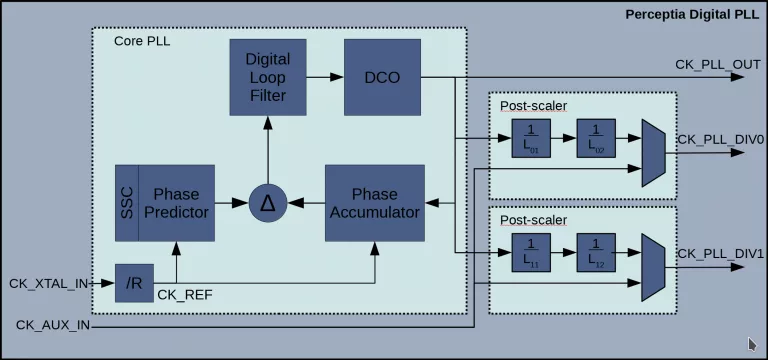
The DeepSub™ pPLL02F is a general purpose all digital PLL featuring low-jitter and compact area suitable for many clocking applications at frequencies up to 2GHz. It is suitable as a clock source for moderate speed microprocessor blocks and other logic.
To give SoC designers the maximum flexibility in building complex multi-domain clock systems, pPLL02F is very small (< 0.01 sq mm) and low power (< 3.5mW). It is well suited to applications with many clock domains where each is driven by their own PLL. To simplify system design, PLL02F has an integrated power supply regulator which allows multiple instances of PLL02F to share common power supplies. Alternatively instances of pPLL02F can share supplies with the blocks that use its output clock.
pPLL02F integrates easily into any SoC design and includes all the views and models required by back end flows.
The pPLL02F is built using Perceptia’s second generation all digital PLL technology. This robust technology delivers identical performance across many processes, regardless of PVT conditions. It consumes a small fraction of the area of an analog PLL whilst maintaining comparable performance.
pPLL02F can be used as an integer-N PLL or as a fractional-N PLL. The fractional-N mode provides a high flexibility to choose the best combination of input and output clock frequencies at the system level.
Learn more about PLL IP core
Perceptia Devices, a leader in high-performance clocking IP, today announced the availability of the design kit for its pPLL03 phase-locked loop IP on Samsung Foundry’s 14LPU technology node.
How do you ensure that every part of a system receives the clock it needs—without wasting power or sacrificing performance? The answer lies in creating a well-structured frequency plan built around a PLL.
Developed to operate at cryogenic temperatures, Perceptia’s 10-bit ADC and DAC IP blocks are specifically designed for use in emerging applications such as quantum computing, superconducting electronics, and lownoise sensor interfaces.
Perceptia Devices, a leader in low-jitter clocking IP, today announced the commencement of a port of its proven pPLL03 phase-locked loop (PLL) to Samsung Foundry’s 14LPU process node. This marks another milestone in Perceptia’s ongoing strategy to make its silicon-proven PLL solutions available across a wide range of advanced semiconductor platforms.
The pPLL03 is Perceptia’s low jitter, high-performance PLL IP core targeted at demanding SoC applications including AI accelerators, microprocessors, ADC/DAC sampling clocks, and high-speed digital subsystems.
Perceptia Devices today announced the availability of the preliminary characterisation report for its pPLL08W wide-range phase-locked loop (PLL) IP implemented in GlobalFoundries’ 22FDX® process technology.