Vendor: Rambus, Inc. Category: Post Quantum

Fast Quantum Safe Engine for ML-KEM (CRYSTALS-Kyber) and ML-DSA (CRYSTALS-Dilithium)

The Quantum Safe Engine (QSE) IP provides Quantum Safe Cryptography acceleration for ASIC, SoC and FPGA devices.

CRYSTALS-Dilithium (ML-DSA) View all specifications

Overview

The Quantum Safe Engine (QSE) IP provides Quantum Safe Cryptography acceleration for ASIC, SoC and FPGA devices. The QSE-IP-86 core is typically integrated in a hardware Root of Trust or embedded secure element in chip designs together with a PKE-IP-85 core that accelerates classic public key cryptography and a TRNG-IP-76 core that generates true random numbers. For highly secure applications requiring additional protection against differential power analysis (DPA) attacks, a DPA version of the QSE is available.

The QSE supports the FIPS 203 ML-KEM and FIPS 204 ML-DSA standards. The embedded QSE core firmware allows the core functionality to be updated to adapt to potential future updates in the NIST specifications.

How the QSE-IP-86 Quantum Safe Engine works

The QSE employs FIPS 203 ML-KEM, based on the CRYSTALS-Kyber algorithm, for key exchange and key de/encapsulation. This is combined with FIPS 204 ML-DSA, based on the CRYSTALS-Dilithium algorithm for digital signature, signature verification and key generation. Both operations are offered at up to NIST Category 5. The embedded SHA-3, SHAKE-128, SHAKE-256 accelerators are used to accelerate hash and extendable-output (XOF) functions.

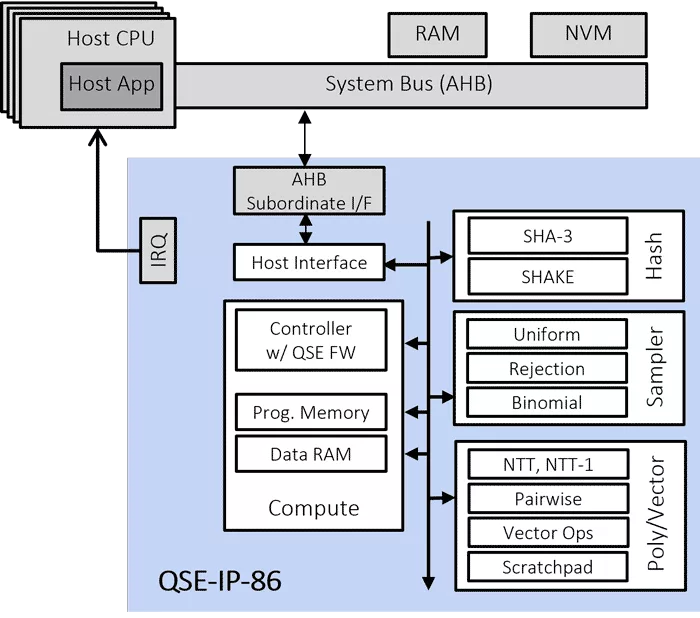
The QSE is comprised of a controller, a lattice accelerator, a SHA-3 hash and SHAKE XOF accelerator, a host interface and firmware and software driver components.

A system host controller writes input data for a high-level cryptographic operation (such as ML-KEM, ML-DSA or SHA-3) into a dedicated SRAM and issues high-level commands to the QSE’s internal CPU. The internal CPU controls the lower-level operations and leverages the internal hardware modules (PQ core for NTT/inverse NTT operations, SHA-3 core for SHAKE) to accelerate the calculations. The internal CPU accesses keys and data stored in a dedicated SRAM while performing its operations.

The SHA-3/SHAKE core integrated in the QSE is also available for SHA-3 acceleration operations for (future) support of hash-based signature verify operations (like XMSS/LMS) implemented on the host processor.

At 1GHz, the Rambus QSE performs 7,100/13,500 ML-KEM-1024 (CRYSTALS-Kyber Cat-5) decapsulation/encapsulation operations per second and typically up to 1,400 ML-DSA-87 (CRYSTALS-Dilithium Cat-5) sign operations per second.

Key features

  • Compliant with FIPS 203 ML-KEM and FIPS 204 ML-DSA standards
  • Uses CRYSTALS-Kyber, CRYSTALS-Dilithium quantum-resistant algorithms
  • Includes SHA-3, SHAKE-128 and SHAKE-256 acceleration
  • The embedded QSE CPU combined with Rambus-supplied firmware implements the full FIPS 203/204 protocols
  • Can be used stand alone or integrated into higher function security cores
  • Offered as standard QSE-IP-86 or as DPA-protected QSE-IP-86-DPA
  • Supports ASIC, SoC and FPGA implementations
  • Firmware programmable to allow updates with evolving quantum-resistant standards

Block Diagram

What’s Included?

  • Complete Documentation
    • Integration guides
    • Reference manual
    • Application developer guide
  • RTL and FW Package
    • Verilog RTL for synthesis and simulation
    • Standard EDA tool flow scripts and support files
    • Verification test bench and test vectors
  • SW Package
    • Driver Development Kit, including examples

Specifications

Identity

Part Number
QSE-IP-86
Vendor
Rambus, Inc.
Type
Silicon IP

Security

Crypto Algorithm
CRYSTALS-Dilithium (ML-DSA)

Files

Note: some files may require an NDA depending on provider policy.

Provider

HQ: USA

Learn more about Post Quantum IP core

Why Anti-tamper Sensors Matter: Agile Analog and Rambus Deliver Comprehensive Security Solution

If your device processes valuable data, controls a critical function, or connects to a wider network, it’s a target. Attackers don’t just try to break software; they increasingly physically tamper with hardware; probing, fault injecting, or opening enclosures to bypass protections and extract secrets. The consequences range from IP theft and fraud to orchestrated downtime across fleets of connected devices.

How to design secure SoCs Part IV: Runtime Integrity Protection

In previous articles, we gave an overview about secure SoC architectures (Part I), about the importance of key management (Part II) and secure boot (Part III) - the first line of defense. Part IV of the series focuses on runtime integrity protection, a paramount, ensuring the application remains secure even during active operation.

How to design secure SoCs Part IV: Runtime Integrity Protection

SoC designers are increasingly challenged to integrate robust security measures into their designs. Modern connected devices, such as automotive Electronic Control Units (ECUs), Internet of Things (IoT) nodes, and industrial control systems, face increasing susceptibility to cyberattacks. This escalating threat landscape underscores the critical importance of mandatory security requirements.

Nine Compelling Reasons Why Menta eFPGA Is Essential for Achieving True Crypto Agility in Your ASIC or SoC

Today’s world is already overly complicated to provide robust product security, with extremely motivated hackers creating novel threats exposing new vulnerabilities every day. But considering tomorrow’s world with the looming threat of quantum computing, expanding AI possibilities and rapidly evolving regional regulations and export control risk with severe financial penalties, this is a daunting challenge.

Providing protection against EMFI attacks

This Agile Analog blog post is focused on describing the dangers of Electromagnetic Fault Injection (EMFI) attacks and outlining the importance of EMFI sensors that are designed to provide protection.

Frequently asked questions about Post-Quantum Cryptography IP cores

What is Fast Quantum Safe Engine for ML-KEM (CRYSTALS-Kyber) and ML-DSA (CRYSTALS-Dilithium)?

Fast Quantum Safe Engine for ML-KEM (CRYSTALS-Kyber) and ML-DSA (CRYSTALS-Dilithium) is a Post Quantum IP core from Rambus, Inc. listed on Semi IP Hub.

How should engineers evaluate this Post Quantum?

Engineers should review the overview, key features, supported foundries and nodes, maturity, deliverables, and provider information before shortlisting this Post Quantum IP.

Can this semiconductor IP be compared with similar products?

Yes. Buyers can compare this product with similar semiconductor IP cores or IP families based on category, provider, process options, and structured technical specifications.

×
Semiconductor IP