Vendor: Silicon Library Inc. Category: Displayport

DisplayPort 1.4a / eDP 1.4b TX PHY and Controller IP

Comprehensive transmitter solution compliant with VESA DisplayPort 1.4a and Embedded DisplayPort (eDP) 1.4b standards

Controller + 1 View all specifications

Overview

Silicon Library (SLI) DisplayPort (DP) 1.4a / Embedded DisplayPort (eDP) 1.4b TX IP cores provide a comprehensive transmitter solution compliant with VESA DisplayPort 1.4a and Embedded DisplayPort (eDP) 1.4b standards, enabling seamless integration into SoCs for modern multimedia applications. The solution consists of two modules: a physical layer (PHY) and a controller (Link Layer / PCS). The PHY is a hard macro supporting high-speed data rates up to 8.1Gbps (HBR3), while the controller is provided as a synthesizable soft macro. In addition to required DisplayPort functionalities, the solution supports optional features including Multi-Stream Transport (MST), Display Stream Compression (DSC), Forward Error Correction (FEC) and HDCP 1.4/2.3 Content Protections by its configurable controller. SLI’s PHY IPs and Controller IPs work together to deliver the best results with simplified integration although SLI’s PHY and Controller IPs can be offered as independent products .

This PHY IP is available as Silicon proven ‘off-the-shelf’ IP in various major fabs and technology nodes from 12nm to 55nm.

Key features

PHY Features

  • DP version 1.4a / eDP version 1.4b compliant transmitter
  • Supports both SST and MST (up to 4 streams) modes
  • Configurable (4/2/1) link channels and one AUX channel
  • 1.62Gbps (RBR), 2.7Gbps (HBR), 5.4Gbps (HBR2), and 8.1Gbps (HBR3) per lane
    •  Also supports all recommended data rates (i.e. 2.16Gbps) defined in eDP v1.4b
  • Programable pre-emphasis
  • Programable analog characteristics
  • Test modes including Loopback test, PLL test and DC test

Controller Features

  • DP version 1.4a / eDP version 1.4b compliant transmitter
  • Supports SST and optionally MST (up to 4 streams) modes
  • Supports both video packet and audio packet
    • Supports all digital video output formats (RGB/YCbCr/RAW/Y-only)
    • Supports LPCM audio (up to 8ch) via I2S slave I/F
  • Supports both Default and Enhanced Framing Modes
  • Hardware link training management
  • Hardware EDID reading via AUX CH
  • Configuration registers programmable via AMBA APB interface
  • Supports HDCP 1.4 / 2.3 (optional)
  • Supports DSC and FEC (Rambus Inc) as options

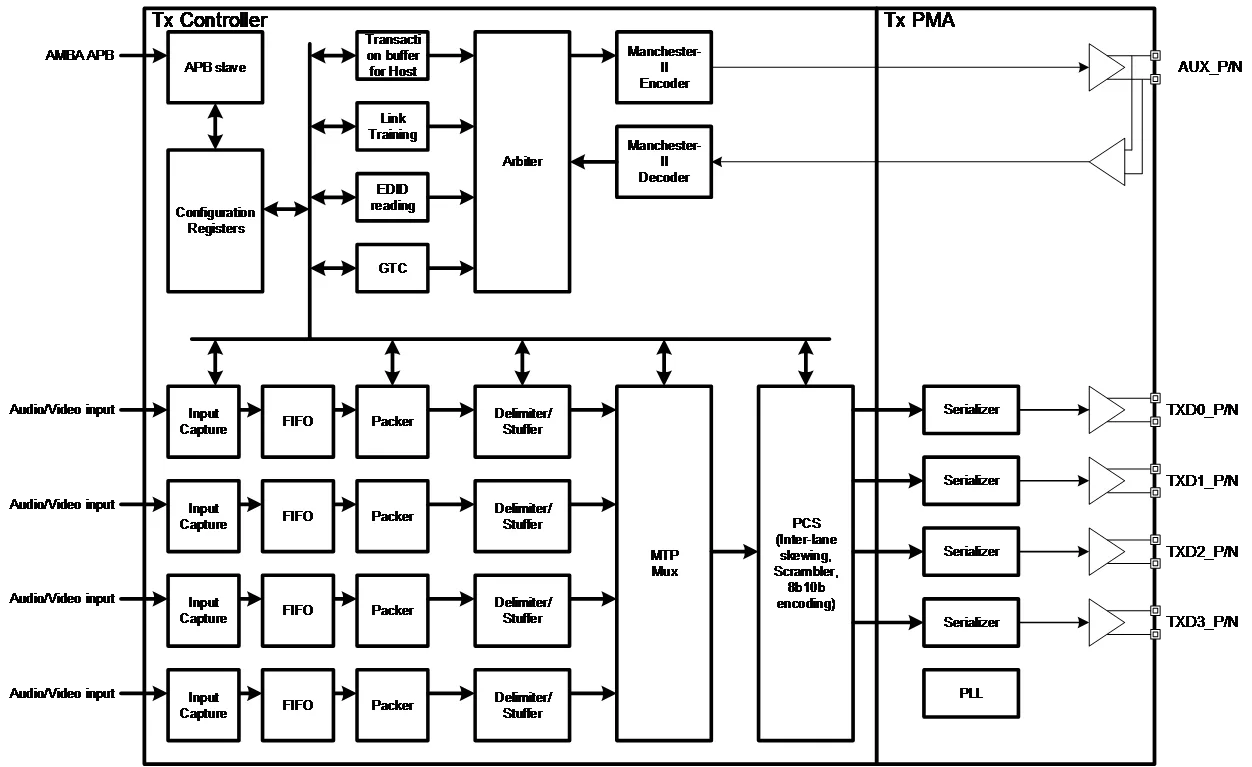
Block Diagram

Specifications

Identity

Part Number
DisplayPort 1.4a / eDP 1.4b TX PHY and Controller IP
Vendor
Silicon Library Inc.
Type
Silicon IP
Controller / PHY
Controller , PHY

Files

Note: some files may require an NDA depending on provider policy.

Provider

Learn more about Displayport IP core

VESA Adaptive-Sync V2 Operation in DisplayPort VIP

In a computer system, both the GPU as well as the monitor have a certain rate at which they render or update an image, respectively. The rate is nothing but the frequency at which the image is refreshed (updated in the image it shows/displays), usually expressed in hertz, and can vary based on the content displayed on the screen.

DisplayPort 2025: Navigating the Next Wave of Display Innovation

This article breaks down the latest DisplayPort trends, the key technological shifts driving the protocol forward, and the strategic challenges implementers need to navigate — especially as DisplayPort IP finds its way into increasingly safety-critical domains.

Audio Transport in DisplayPort VIP

DisplayPort uses Secondary Data Packets (SDPs), which are transported over the Main-Link that are not main video stream data. This allows it to carry audio and video simultaneously. The VIP supports audio transmission both in the original mode as defined in the specification as well as just as any other SDP being transmitted.

Frequently asked questions about DisplayPort IP cores

What is DisplayPort 1.4a / eDP 1.4b TX PHY and Controller IP?

DisplayPort 1.4a / eDP 1.4b TX PHY and Controller IP is a Displayport IP core from Silicon Library Inc. listed on Semi IP Hub.

How should engineers evaluate this Displayport?

Engineers should review the overview, key features, supported foundries and nodes, maturity, deliverables, and provider information before shortlisting this Displayport IP.

Can this semiconductor IP be compared with similar products?

Yes. Buyers can compare this product with similar semiconductor IP cores or IP families based on category, provider, process options, and structured technical specifications.

×
Semiconductor IP