Overview
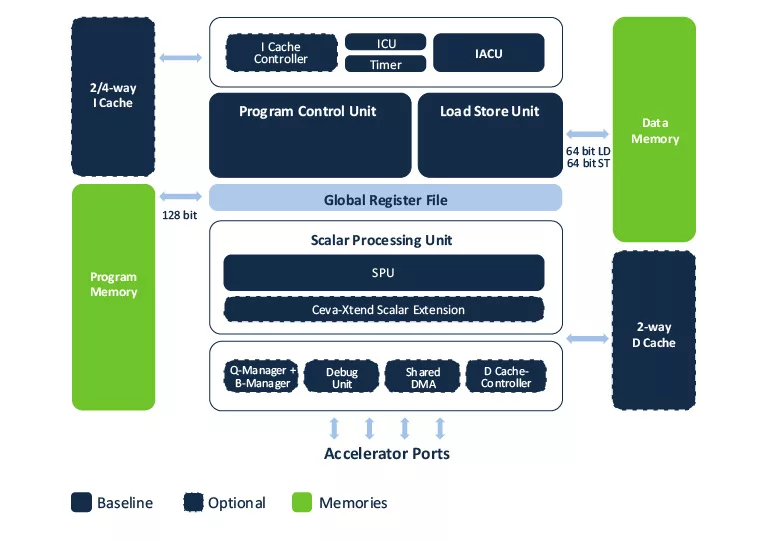
The Ceva-BX1 audio digital signal controller IP handles both modest signal-processing and control workloads with up to 8 GMACs per second performance and high-level-language programming. Yet it is power-efficient enough for always-on applications and use in wearables and TWS earbuds. The Ceva-BX1 supports a range of integer and floating-point data types for a wide range of applications, from audio signal processing to light AI workloads, with remarkably compact code size. Optimized high-speed interfaces expedite Ceva-BX1 connection to coprocessors or accelerators, and a rich software partners ecosystem provide ready-to-use application-level solutions.
The Solution
The Ceva-BX1 combines the capabilities of signal processing and control-code execution into a single compact, low-power DSP core. Computational speed comes from dual-32×32 and quad-16×16 MACs with added support for 16×8 and 8×8 MAC operations, implemented in an 11-stage pipeline. A floating-point unit supporting half, single, and double-precision IEEE floating-point is optional. These resources are directed by a four-way VLIW instruction set architecture with optimizations for single-instruction-multiple-data (SIMD) operation. A hardware loop buffer speeds kernel code execution, while efficient execution of control code is aided by dynamic branch prediction and a branch target buffer. Trusted execution modes enable secure operation. On signal-processing tasks the Ceva-BX1 can reach up to 8 GMACs per second, and on control workloads it can achieve up to 4.41 CoreMark/MHz. The hardware design is optimized for speed, achieving 2 GHz operation when implemented in a TSMC 7nm process node using only common standard cells and memory compilers.
Learn more about DSP Core IP core
Former Intel, Infineon and GlobalFoundries executive brings more than two decades of experience developing and commercializing advanced semiconductor technologies, strengthening Ceva's technology execution and customer relationships from Silicon Valley
Ceva’s next-generation Ceva-Waves UWB architecture supports the new standard, delivering advanced ranging performance in challenging Non-Line-of-Sight (NLoS) environments and at extended range, while maintaining low-power operation and resilience to interference. It also supports UWB radar sensing and new channels introduced with the latest generation of the standard.
The collaboration pairs Ceva-Waves™ market leading UWB baseband IP and software with UWB radio frequency (RF) technology developed by LG’s SoC Center, giving customers a silicon-ready platform for integrating UWB into their SoCs.
A field guide to the applications, constraints, and design choices behind on-device audio intelligence – and a sneak peek at a whitepaper we’ve been writing.
ATS296X-series combines Actions’ latest wireless audio technology with Ceva's Bluetooth® High Data Throughput platform, extending a collaboration that has delivered more than 100 million wireless audio SoCs