Overview
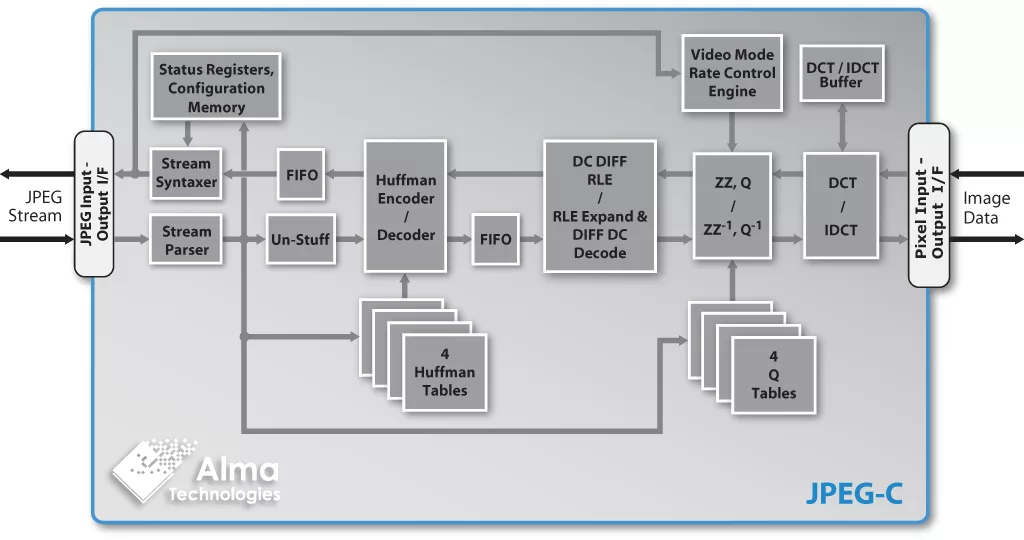
The JPEG-C core is a standalone and high-performance, half-duplex 8-bit Baseline JPEG Codec for still image and video compression applications. Full compliance with the Baseline Sequential DCT mode of the ITU-T T.81 JPEG standard makes this IP core ideal for interoperable systems and devices. The JPEG-C is available for ASIC or AMD-Xilinx, Efinix, Intel, Lattice and Microchip FPGA and SoC based designs.
In addition to the standard defined Baseline JPEG streams, the core is also capable of supporting the video payload of many (de facto) standard motion JPEG container formats. The JPEG-C can also be enhanced with an optional add-on bit-rate control block, which will benefit the bandwidth constrained applications.
The core is designed with easy-to-use, fully controllable and FIFO-like, streaming input and output interfaces. Being carefully designed and rigorously verified, the JPEG-C is a reliable and easy to integrate core. Its deliverables include a complete verification environment and a bit-accurate software model.
Learn more about Video Processing IP core
Alma Technologies S.A. today announced its new UHT-SCALER IP core, a standalone and high-performance image scaler, designed for enabling ultra-high frame rate SD, HD or Ultra HD (4K/8K and beyond) image resizing, even in low-end ASIC or FPGA silicon.
Alma Technologies S.A. today announced its new UHT-JPEGLS-E scalable encoder IP core that enables numerically lossless encoding of ultra-high frame rate SD/HD, and Ultra HD video (4K/8K and beyond), even in highly cost-effective FPGA and ASIC technologies.
Alma Technologies S.A. today announced its new UHT-DSC-E and UHT-DSC-D DSC 1.2b encoder and decoder IP cores that enable the transport of high-definition content with up to 10K resolution, 120Hz refresh rate, high dynamic range and high color depth through existing interfaces, such as VESA DisplayPort, MIPI DSI and HDMI 2.1.
This new scalable UHT JPEG 2000 encoder IP core provides the extreme performance needed by modern video compression applications that have to cope with massive pixel rates and resolutions.
An online tool for back-to-back comparison of the image compression standards implemented by our IP cores is now available on our website. The Bit Accurate Models of the respective image compression cores are used to encode / decode a user supplied test image, in order to evaluate and compare their actual performance.
Alma Technologies S.A., a company that designs, markets, sells and supports innovative semiconductor IP since 2001, today introduced at the Toulouse Space Show 2016 a new encoder IP core which implements the CCSDS 122.0-B-1 lossless and lossy image data compression standard.