Overview
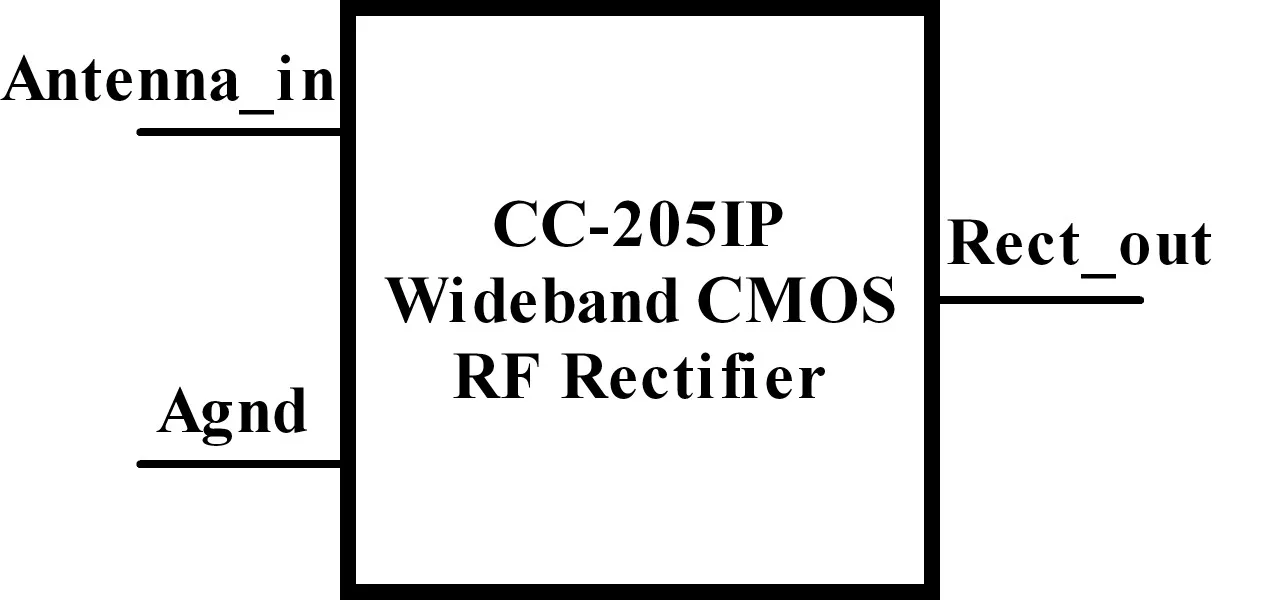
The CC-205IP Wideband CMOS RF Rectifier is a CMOS full wave rectifier with a 6Mhz to 5.8Ghz rectification frequency range capability, can rectify input power signals ranging from -18dBm to over +33dBm, while maintaining a 40% to 90% conversion efficiency. The CC-205IP, at maximum efficiency at 5.8Ghz, outputs a 3.3V DC voltage with a current capacity of 125mA, making it ideal for on chip RF Power Transfer and Broadcasting, and RFID transceivers. The CC-205IP can be interfaced to on and off chip supercapacitors, making the IP block ideal for RF Power Transfer Systems in burst mode operation. The CC-205IP has an aspect ratio of 140um X 140um making it an ideal choice for RFID chips and systems. The CC-205IP features wideband, adjustable Antenna matching capability, with the ability of directly interfacing to a given antenna impedance, avoiding the conversion losses incurred with an antenna to rectifier interface matching network. The rectifier block features a -40 dB S11 return loss, adding to it’s overall conversion efficiency. The CC-205IP Wideband CMOS RF Rectifier is available on XFABs XT013 manufacturing process, and can be ported to any given RFCMOS process.
Learn more about DC/DC Converter IP core
This white paper introduces a procedure for choosing the proper DCDC switching converter for a given application. It explains basic, performance, and optional metrics in detail. It also demonstrates other practical aspects that are sometimes overlooked by system designers. Multiple application examples are provided.
This article focuses on the design issues that are simplified by including an integrated inductor optimized for a range of electrical and layout applications as part of the power management solution
In this article, we review the effect of radiation on passive and active electronic components and the technologies, processes and device techniques that make them radiation-tolerant or radiation-hard.
In this second part of Paving the way for the next generation audio codec for True Wireless Stereo (TWS) applications whitepaper, energy efficiency will be discussed and several means to achieve extra-long playtime will be exposed.
The free lunch offered for decades by Moore’s law is now over and scaling down to the next technology node no longer offers the required energy efficiency gains. Design teams must now pursue their gains by deploying increasingly complex power management techniques to meet the demands of the new IoT markets.
To know which LDO you need, you must first define the application of your LDO and then examine which parameters are most important when dealing with that application. With the multiple parameters that characterize a particular LDO, it is not easy to determine which LDO is best suited. To help you figure this out, we have put together this reference. This guide presents a list of all the key LDO parameters along with their definitions, the most common applications of LDOs, and which parameters are critical for each.