CDM Dependence on Device Capacitance
This blog will focus on what happens during the CDM pulse itself, and will show how the pulse properties change as a function of DUT to Field Plate capacitance.
A 600MBps Low Power Die-to-Die Interface in TSMC 16nm FFC/FFC+.
A 600MBps Low Power Die-to-Die Interface in TSMC 16nm FFC/FFC+.
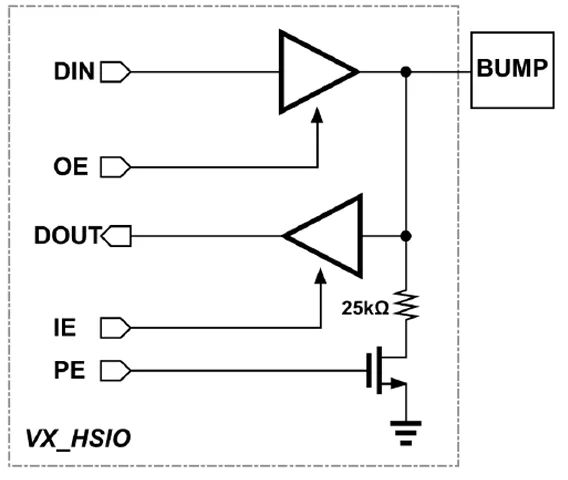
This library is a production-quality, silicon-proven custom Die-to-Die high speed interface available in TSMC’s 16nm process. The I/O cell is bidirectional, has two modes of operation: standard full rail to rail swing, or a custom low noise pseudo-differential interface. The RX cells have a weak pull-down feature.
Operating Conditions
| Parameter | Value |
| Core Device | FFC (0.8V) |
| I/O Device | 1.8V |
| Core | Uses SVT only |
| BEOL | 2Xa1Xd_h (M5 below) |
| PAD | Flipchip |
| Cell Size | 50um x 50um |
| VDDCore | 0.8V |
| Tj | -40C to 125C |
Library Cell Summary
| Cell Name | Description |
| VX_HSIO | Bidirectional I/O Cell |
Pin List
| Pin | Type |
| VDD | Power |
| VSS | Ground |
| DIN | Input 0.8V |
| OE | Input 0.8V |
| DOUT | Output0.8V |
| IE | Input 0.8V |
| PE | Input 0.8V |
| BUMP | OUT0.8V |
| Foundry | Node | Process | Maturity |
|---|---|---|---|
| TSMC | 16nm | 16nm 160 nm | — |
Note: some files may require an NDA depending on provider policy.

Low Power D2D Interface in TSMC 16nm FFC/FFC+ is a Custom IP core from Certus Semiconductor listed on Semi IP Hub. It is listed with support for tsmc.
Engineers should review the overview, key features, supported foundries and nodes, maturity, deliverables, and provider information before shortlisting this Custom IP.
Yes. Buyers can compare this product with similar semiconductor IP cores or IP families based on category, provider, process options, and structured technical specifications.