Vendor: Obsidian Technology Category: DC/DC Converter

5-60V Input Buck Regulator - Globalfoundries 180nm BCD

The OT1152 is an 80mA CMOS buck regulator designed for use with high input voltages and logic level output voltages..

GlobalFoundries 180nm BCD View all specifications

Overview

The OT1152 is an 80mA CMOS buck regulator designed for use with high input voltages and logic level output voltages..

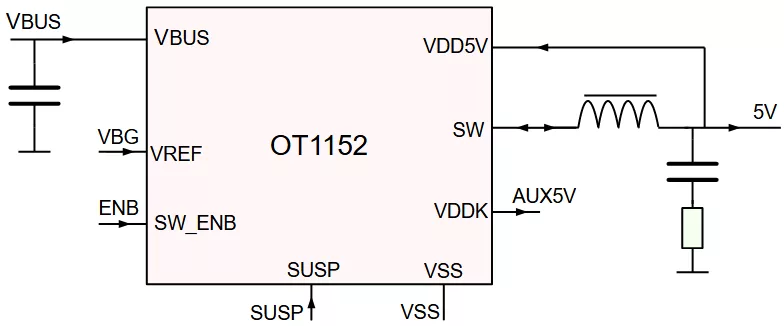
This implementation takes a 4.5-60V input and produces a 5V voltage output at a current up to 80mA. An external bandgap bias circuit is an option. Requires GF 180nm BCD process.

Requires Globalfoundries 180nm BCD or similar process.
Key features

  • Wide operating voltage range 4.5V – 60V.
  • Output voltage optionally 5V, or 3.3V.
  • Soft start.
  • Auxiliary 3-5V LDO output for optional external reference startup etc.
  • Output short circuit protection.
  • Works with straight-through IO pads.
  • External 4.7µF capacitor.
  • External 330µH/inductor.
  • Power down/enable input.
  • Suspend mode input lowers regulator power for light loads, by using a non-synchronous rectifier.
  • <2% line and load regulation.
  • 300KHz operation.
  • -40°C to 125°C temperature operation.
  • Base cell area 0.4mm2 in 0.18µ 65V BCD CMOS.
  • Global Foundries 180nm BCD process compatibility.
  • Available LDO, bandgap, and POR support cells.

Block Diagram

Applications

  • Power from USB-C VBUS witch may vary widely during operation.
  • Power from multiple different voltage power sources.
  • Primary PMIC voltage regulator.

What’s Included?

  • GDS layout.
  • LEF outline.
  • Spice/CDL netlist for LVS.
  • Timing files.
  • Integration notes.

Silicon Options

Foundry Node Process Maturity
GlobalFoundries 180nm BCD

Specifications

Identity

Part Number
OT1152_g180_80mA
Vendor
Obsidian Technology
Type
Silicon IP

Files

Note: some files may require an NDA depending on provider policy.

Provider

Learn more about DC/DC Converter IP core

Guide to Choosing the Best DCDC Converter for Your Application

This white paper introduces a procedure for choosing the proper DCDC switching converter for a given application. It explains basic, performance, and optional metrics in detail. It also demonstrates other practical aspects that are sometimes overlooked by system designers. Multiple application examples are provided.

How to simplify switch-mode DC-DC converter design

This article focuses on the design issues that are simplified by including an integrated inductor optimized for a range of electrical and layout applications as part of the power management solution

Breaking new energy efficiency records with advanced power management platform

The free lunch offered for decades by Moore’s law is now over and scaling down to the next technology node no longer offers the required energy efficiency gains. Design teams must now pursue their gains by deploying increasingly complex power management techniques to meet the demands of the new IoT markets.

Guide to Choosing the Best LDO for Your Application

To know which LDO you need, you must first define the application of your LDO and then examine which parameters are most important when dealing with that application. With the multiple parameters that characterize a particular LDO, it is not easy to determine which LDO is best suited. To help you figure this out, we have put together this reference. This guide presents a list of all the key LDO parameters along with their definitions, the most common applications of LDOs, and which parameters are critical for each.

Frequently asked questions about DC-DC Converter IP cores

What is 5-60V Input Buck Regulator - Globalfoundries 180nm BCD?

5-60V Input Buck Regulator - Globalfoundries 180nm BCD is a DC/DC Converter IP core from Obsidian Technology listed on Semi IP Hub. It is listed with support for globalfoundries.

How should engineers evaluate this DC/DC Converter?

Engineers should review the overview, key features, supported foundries and nodes, maturity, deliverables, and provider information before shortlisting this DC/DC Converter IP.

Can this semiconductor IP be compared with similar products?

Yes. Buyers can compare this product with similar semiconductor IP cores or IP families based on category, provider, process options, and structured technical specifications.

×
Semiconductor IP