
120..950 MHz Frequency multiplier
A frequency multiplier is a circuit that generates an output signal whose output frequency is a harmonic of its input frequency.
Overview
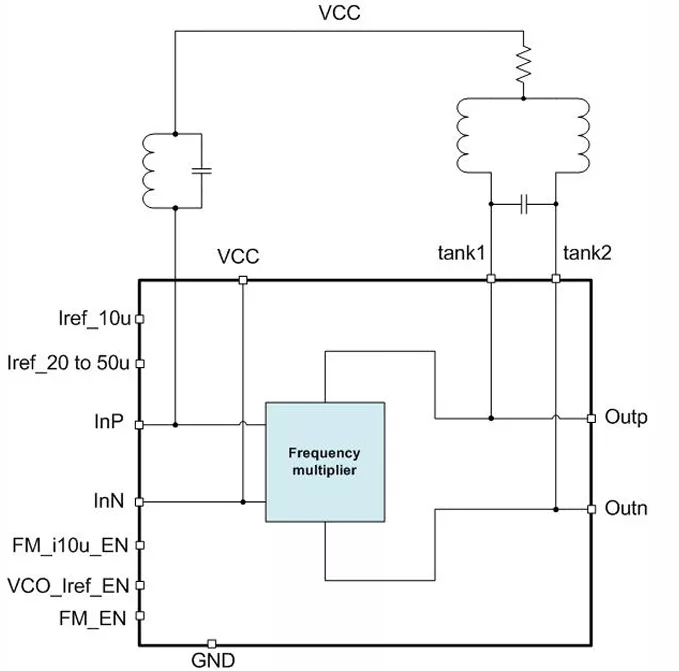
A frequency multiplier is a circuit that generates an output signal whose output frequency is a harmonic of its input frequency. Frequency multipliers consist of a nonlinear circuit that distorts the input signal and consequently generates harmonics of the input signal. An input filter and output resonance circuit select the desired harmonic frequencies and remove the unwanted fundamental and other harmonics from the output.
The block is fabricated on iHP SiGe BiCMOS 0.25 um (SGB25V) technology.
Key features
- iHP SGB25V
- Wide frequency range (120..950 MHz)
- Low current consumption
- Operating frequency selection using external components
- Small area
- Portable to other technologies (upon request)
Block Diagram
Applications
- Frequency synthesizer
- Functional signal generator
What’s Included?
- Schematic or NetList
- Abstract model (.lef and .lib files)
- Layout view (optional)
- Behavioral model (Verilog)
- Extracted view (optional)
- GDSII
- DRC, LVS, antenna report
- Test bench with saved configurations (optional)
- Documentation
Specifications
Identity
Files
Note: some files may require an NDA depending on provider policy.
Provider
Learn more about PLL IP core
CoreHW Develops 80GHz mmWave PLL with Synopsys RFIC Design Flow on GlobalFoundries 22FDX Technology
Specifying a PLL Part 3: Jitter Budgeting for Synthesis
Specifying a PLL Part 2: Jitter Basics
Specifying a PLL Part 1: Calculating PLL Clock Spur Requirements from ADC or DAC SFDR
Achieving Groundbreaking Performance with a Digital PLL
Frequently asked questions about PLL IP cores
What is 120..950 MHz Frequency multiplier?
120..950 MHz Frequency multiplier is a PLL IP core from NTLab listed on Semi IP Hub.
How should engineers evaluate this PLL?
Engineers should review the overview, key features, supported foundries and nodes, maturity, deliverables, and provider information before shortlisting this PLL IP.
Can this semiconductor IP be compared with similar products?
Yes. Buyers can compare this product with similar semiconductor IP cores or IP families based on category, provider, process options, and structured technical specifications.